QUESTION IMAGE
Question
what is your answer?
- use your formula from activity 1 to verify your results in activity 3.
- in your own words how can you find the surface area of a prism?
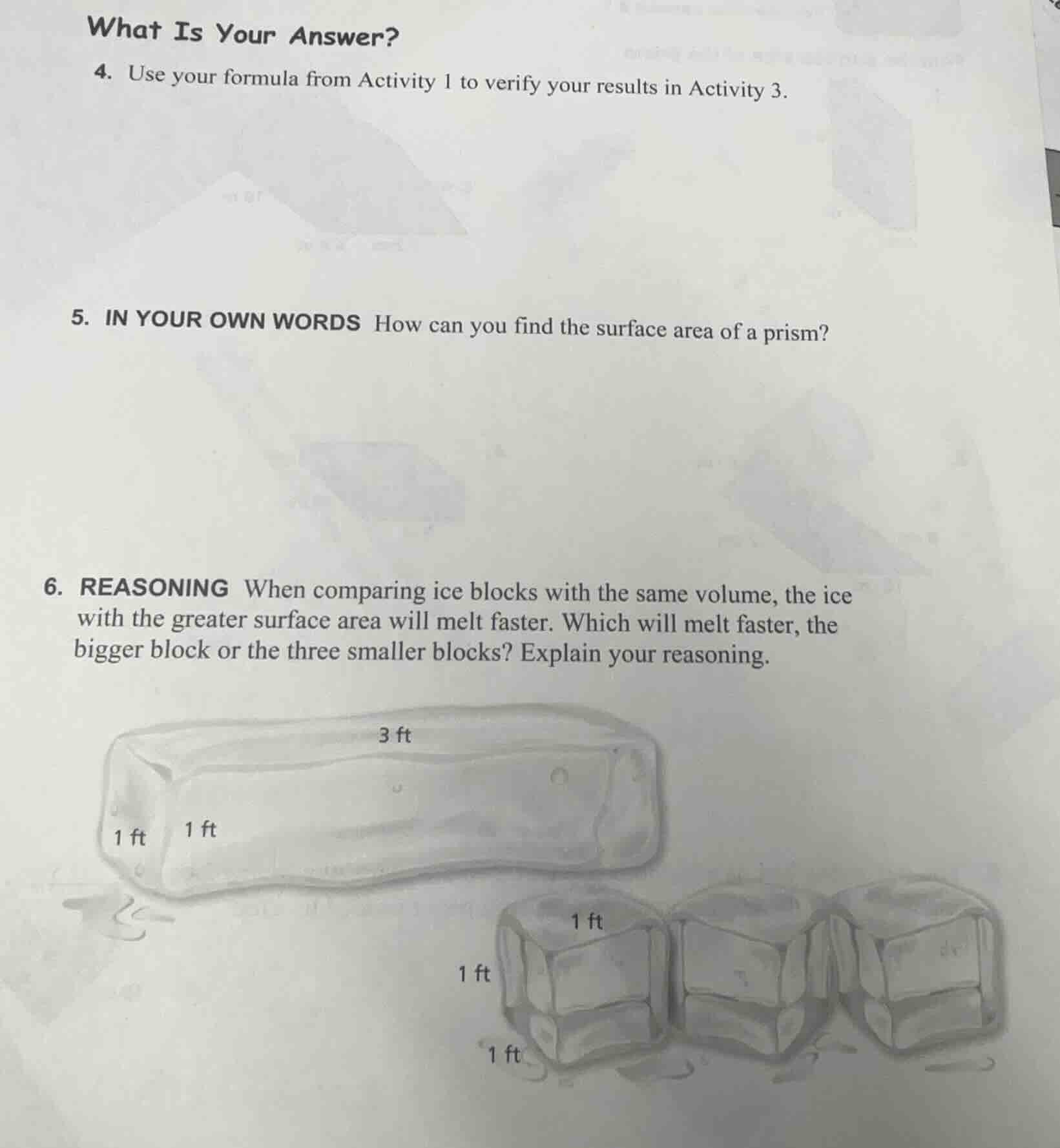
- reasoning when comparing ice blocks with the same volume, the ice with the greater surface area will melt faster. which will melt faster, the bigger block or the three smaller blocks? explain your reasoning.
3 ft
1 ft 1 ft
1 ft
1 ft 1 ft
Step1: Calculate volume of big prism
Volume formula: $V = l \times w \times h$
$V_{big} = 3 \times 1 \times 1 = 3$ ft³
Step2: Calculate surface area of big prism
Surface area formula for rectangular prism: $SA = 2(lw + lh + wh)$
$SA_{big} = 2(3 \times 1 + 3 \times 1 + 1 \times 1) = 2(3 + 3 + 1) = 2 \times 7 = 14$ ft²
Step3: Calculate volume of one small cube
$V_{small} = 1 \times 1 \times 1 = 1$ ft³
Total volume of 3 small cubes: $3 \times 1 = 3$ ft³ (matches big prism)
Step4: Calculate surface area of one small cube
Surface area formula for cube: $SA = 6s^2$
$SA_{one small} = 6 \times 1^2 = 6$ ft²
Total SA of 3 small cubes: $3 \times 6 = 18$ ft²
Step5: Compare surface areas
$18 > 14$, so 3 small blocks have larger SA.

Snap & solve any problem in the app
Get step-by-step solutions on Sovi AI
Photo-based solutions with guided steps
Explore more problems and detailed explanations
(for question 5):
To find the surface area of a prism, first calculate the area of the two identical polygonal bases. Then find the area of each of the rectangular (or parallelogram) lateral faces that connect the corresponding sides of the two bases. Add the total area of the two bases to the total area of all the lateral faces to get the total surface area.