QUESTION IMAGE
Question
9
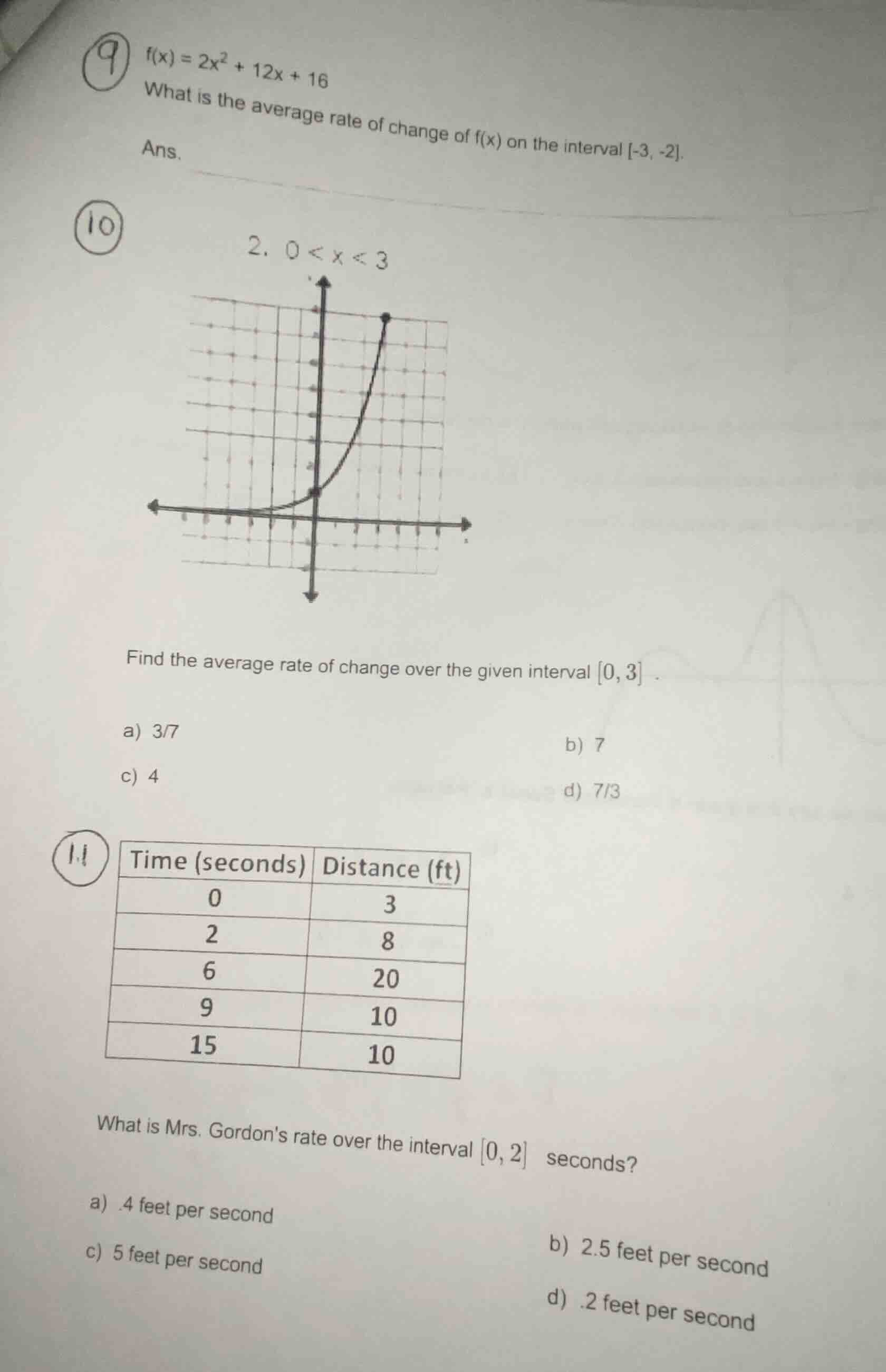
$f(x) = 2x^2 + 12x + 16$
what is the average rate of change of $f(x)$ on the interval $-3, -2$.
ans.
10
- $0 < x < 3$
graph of a curve
find the average rate of change over the given interval $0, 3$.
a) $3/7$ b) $7$
c) $4$ d) $7/3$
11
| time (seconds) | distance (ft) |
|---|---|
| 2 | 8 |
| 6 | 20 |
| 9 | 10 |
| 15 | 10 |
what is mrs. gordons rate over the interval $0, 2$ seconds?
a).4 feet per second b) 2.5 feet per second
c) 5 feet per second d).2 feet per second
Problem 9:
Step1: Recall the formula for average rate of change
The average rate of change of a function \( f(x) \) on the interval \([a, b]\) is given by \(\frac{f(b) - f(a)}{b - a}\). For the function \( f(x) = 2x^2 + 12x + 16 \) and the interval \([-3, -2]\), we first find \( f(-3) \) and \( f(-2) \).
Step2: Calculate \( f(-3) \)
Substitute \( x = -3 \) into \( f(x) \):
\[
\]
Step3: Calculate \( f(-2) \)
Substitute \( x = -2 \) into \( f(x) \):
\[
\]
Step4: Calculate the average rate of change
Using the formula \(\frac{f(-2) - f(-3)}{-2 - (-3)}\):
\[
\]
Step1: Recall the average rate of change formula
The average rate of change of a function \( y = f(x) \) on the interval \([a, b]\) is \(\frac{f(b) - f(a)}{b - a}\). From the graph, we need to find \( f(0) \) and \( f(3) \).
Step2: Determine \( f(0) \) and \( f(3) \) from the graph
From the graph, when \( x = 0 \), the \( y \)-value ( \( f(0) \)) is \( 1 \) (assuming the grid and the point at \( x = 0 \) is \( (0, 1) \)) and when \( x = 3 \), the \( y \)-value ( \( f(3) \)) is \( 8 \) (assuming the top point is \( (3, 8) \)). Wait, maybe the graph is \( y = x^2 + 1 \) or similar? Wait, the interval is \( 0 < x < 3 \) but the interval for average rate of change is \([0, 3]\). Let's re - evaluate. Wait, looking at the options, the formula is \(\frac{f(3)-f(0)}{3 - 0}\). Let's assume from the graph: when \( x = 0 \), \( f(0)=1 \); when \( x = 3 \), \( f(3)=8 \).
Step3: Calculate the average rate of change
\[
\frac{f(3)-f(0)}{3 - 0}=\frac{8 - 1}{3}=\frac{7}{3}
\]
Wait, no, maybe the graph has \( f(0) = 1 \) and \( f(3)=8 \)? Wait, the options are \( \frac{3}{7},\ 7,\ 4,\ \frac{7}{3} \). Let's do it properly. The average rate of change formula is \( \text{ARC}=\frac{f(b)-f(a)}{b - a} \). Let's assume from the graph: at \( x = 0 \), the point is \( (0, 1) \) and at \( x = 3 \), the point is \( (3, 8) \). Then \( \text{ARC}=\frac{8 - 1}{3-0}=\frac{7}{3}\approx2.33 \), which is option d. Wait, maybe I misread the graph. Alternatively, if the function is \( y = x^2+1 \), at \( x = 0 \), \( y = 1 \); at \( x = 3 \), \( y=9 + 1=10 \), no. Wait, the problem says "Find the average rate of change over the given interval \([0, 3]\)". Let's use the formula correctly. Let's suppose that from the graph, when \( x = 0 \), \( f(0)=1 \) and when \( x = 3 \), \( f(3)=8 \). Then \( \text{ARC}=\frac{8 - 1}{3}=\frac{7}{3}\), which is option d.
Step1: Recall the formula for rate of change (average rate of change)
The rate of change (average rate of change) of distance with respect to time over the interval \([t_1, t_2]\) is given by \(\frac{d(t_2)-d(t_1)}{t_2 - t_1}\), where \( d(t) \) is the distance function.
Step2: Identify \( d(0) \) and \( d(2) \) from the table
From the table, when \( t = 0 \) seconds, \( d(0)=3 \) feet and when \( t = 2 \) seconds, \( d(2)=8 \) feet.
Step3: Calculate the rate of change
Using the formula \(\frac{d(2)-d(0)}{2 - 0}\):
\[
\frac{8 - 3}{2-0}=\frac{5}{2}=2.5
\]

Snap & solve any problem in the app
Get step-by-step solutions on Sovi AI
Photo-based solutions with guided steps
Explore more problems and detailed explanations
The average rate of change of \( f(x) \) on the interval \([-3, -2]\) is \( 2 \).