QUESTION IMAGE
Question
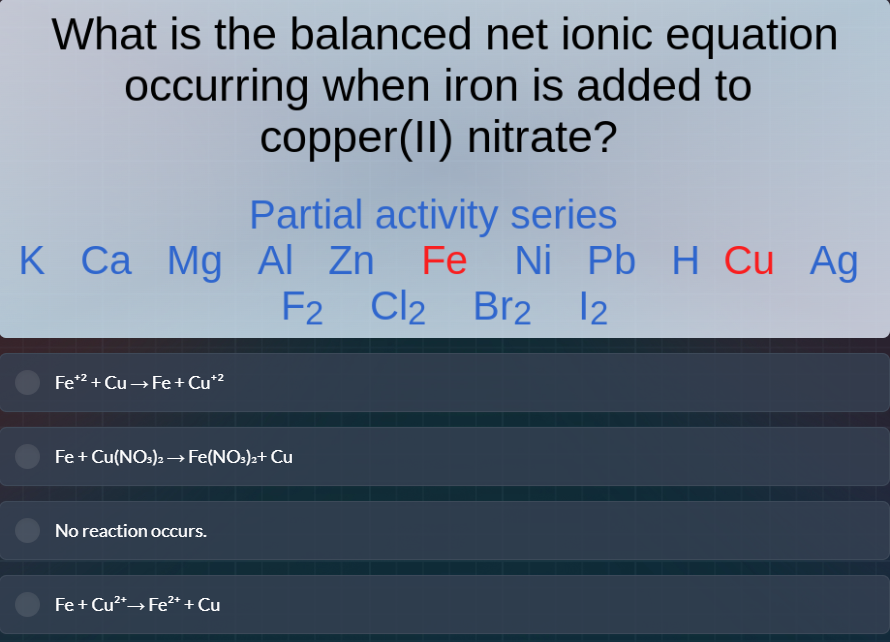
what is the balanced net ionic equation occurring when iron is added to copper(ii) nitrate? partial activity series k ca mg al zn fe ni pb h cu ag f₂ cl₂ br₂ i₂ fe²⁺+cu→fe+cu⁺² fe + cu(no₃)₂ → fe(no₃)₂+ cu no reaction occurs. fe+cu²⁺→fe²⁺+ cu
- First, analyze the activity series: Fe is more reactive than Cu (since Fe is to the left of Cu in the activity series), so a single - replacement reaction will occur.
- The reactants are iron (Fe) and copper(II) nitrate. Copper(II) nitrate dissociates into $Cu^{2 + }$ and $NO_3^ - $ ions. Iron is a solid metal, and in the reaction, Fe will react with the $Cu^{2+}$ ions.
- Now, let's analyze each option:
- Option 1: $Fe^{2+}+Cu
ightarrow Fe + Cu^{+2}$: This is the reverse of what should happen. Fe is more reactive than Cu, so Fe should react to form $Fe^{2+}$, not the other way around.
- Option 2: $Fe + Cu(NO_3)_2
ightarrow Fe(NO_3)_2+Cu$: This is a molecular equation, not a net ionic equation. The question asks for the net ionic equation.
- Option 3: No reaction occurs: This is incorrect because Fe is more reactive than Cu, so a reaction will occur.
- Option 4: $Fe + Cu^{2+}
ightarrow Fe^{2+}+Cu$: In this equation, Fe (solid) reacts with aqueous $Cu^{2+}$ ions. Fe is oxidized to $Fe^{2+}$ (losing electrons) and $Cu^{2+}$ is reduced to Cu (gaining electrons). This is the correct net ionic equation as it shows the species that are actually involved in the reaction (excluding the spectator ions, which are $NO_3^-$ in this case).

Snap & solve any problem in the app
Get step-by-step solutions on Sovi AI
Photo-based solutions with guided steps
Explore more problems and detailed explanations
D. $\boldsymbol{Fe + Cu^{2+}
ightarrow Fe^{2+}+Cu}$