QUESTION IMAGE
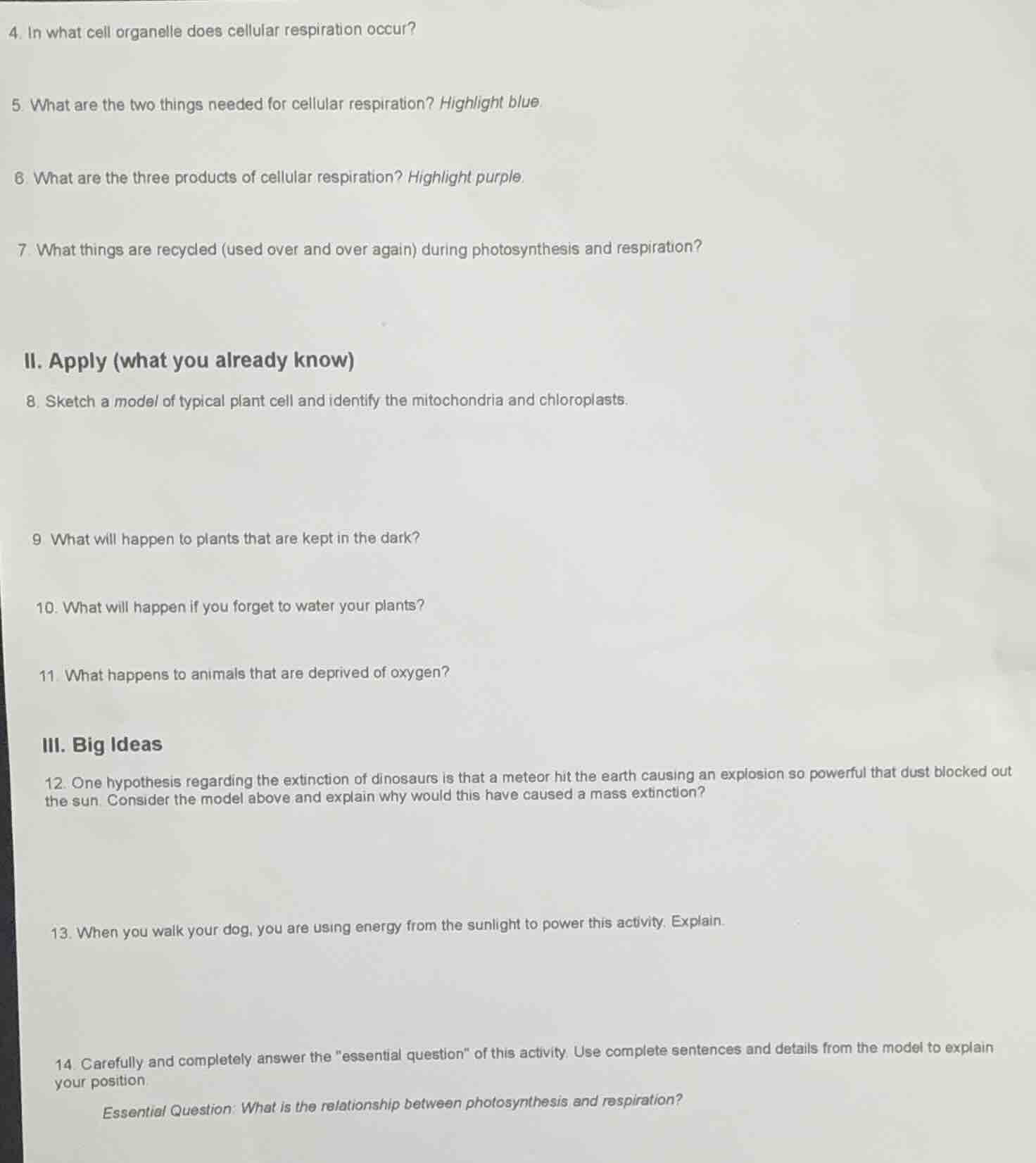
Question
- in what cell organelle does cellular respiration occur?
- what are the two things needed for cellular respiration? highlight blue
- what are the three products of cellular respiration? highlight purple
- what things are recycled (used over and over again) during photosynthesis and respiration?
ii. apply (what you already know)
- sketch a model of typical plant cell and identify the mitochondria and chloroplasts.
9 what will happen to plants that are kept in the dark?
- what will happen if you forget to water your plants?
- what happens to animals that are deprived of oxygen?
iii. big ideas
- one hypothesis regarding the extinction of dinosaurs is that a meteor hit the earth causing an explosion so powerful that dust blocked out the sun. consider the model above and explain why would this have caused a mass extinction?
- when you walk your dog, you are using energy from the sunlight to power this activity. explain.
- carefully and completely answer the \essential question\ of this activity. use complete sentences and details from the model to explain your position.
essential question: what is the relationship between photosynthesis and respiration?
Question 4:
Cellular respiration is the process that breaks down glucose to release energy, and this process primarily occurs in the mitochondria, the powerhouse of the cell.
Question 5:
Cellular respiration requires a fuel source (glucose, from broken-down food) and oxygen to drive the energy-releasing reactions.
Question 6:
The full process of cellular respiration produces energy in the form of ATP, plus carbon dioxide and water as waste products.
Question 7:
Photosynthesis uses carbon dioxide and water to make glucose and oxygen; cellular respiration uses glucose and oxygen to make carbon dioxide and water, so these four molecules are recycled between the two processes.
Question 9:
Plants need sunlight for photosynthesis to make glucose (their food source). Without light, photosynthesis stops, so plants cannot produce new food. They will use stored energy, wilt, lose leaves, and eventually die.
Question 10:
Water is critical for photosynthesis (it is a key reactant) and for maintaining cell structure (turgor pressure). Without water, photosynthesis stops, cells lose turgor, plants wilt, and eventually die from lack of energy and structural failure.
Question 11:
Animals rely on oxygen for aerobic cellular respiration, which produces nearly all their needed energy. Without oxygen, cells switch to inefficient anaerobic respiration, build up lactic acid, and eventually cannot produce enough energy to sustain vital functions, leading to organ failure and death.
Question 12:
If sunlight was blocked, plants could not perform photosynthesis to make food. Without plants, herbivores would lose their food source and die, and then carnivores (including dinosaurs) that rely on herbivores would also die, causing a mass extinction across the food web.
Question 13:
Sunlight is used by plants for photosynthesis to make glucose. When you eat plants (or animals that ate plants), you break down that glucose via cellular respiration to produce ATP, which is the energy currency your body uses to power activities like walking your dog.
Question 14:
Photosynthesis and cellular respiration are complementary, cyclical processes. Photosynthesis (occurring in chloroplasts of plants/algae) uses carbon dioxide, water, and sunlight to produce glucose and oxygen. Cellular respiration (occurring in mitochondria of all eukaryotic cells) uses glucose and oxygen to produce carbon dioxide, water, and ATP (usable energy). The products of one process are the reactants of the other, creating a continuous cycle that recycles carbon dioxide, water, glucose, and oxygen, and sustains energy flow in ecosystems.

Snap & solve any problem in the app
Get step-by-step solutions on Sovi AI
Photo-based solutions with guided steps
Explore more problems and detailed explanations
- Mitochondria
- Glucose (sugar/food) and oxygen
- ATP (energy), carbon dioxide, and water
- Carbon dioxide, water, glucose, and oxygen
- The plants will be unable to perform photosynthesis, so they will use stored energy, wilt, and eventually die.
- The plants will lose turgor pressure, wilt, be unable to perform photosynthesis, and eventually die.
- The animals will be unable to perform aerobic cellular respiration, leading to insufficient energy production, organ failure, and eventually death.
- Blocked sunlight would stop plant photosynthesis, eliminating the base of the food web. Herbivores would die without plant food, followed by carnivores like dinosaurs, causing mass extinction.
- Sunlight powers plant photosynthesis to make glucose. You consume this glucose (directly from plants or indirectly from animals that ate plants), break it down via cellular respiration to produce ATP, which fuels your muscle activity to walk the dog.
- Photosynthesis and cellular respiration are interdependent, cyclical processes. Photosynthesis produces glucose and oxygen (the reactants for cellular respiration), while cellular respiration produces carbon dioxide and water (the reactants for photosynthesis). This cycle recycles key molecules and transfers energy: sunlight energy is stored in glucose via photosynthesis, then released as ATP via cellular respiration to power all living organisms.