QUESTION IMAGE
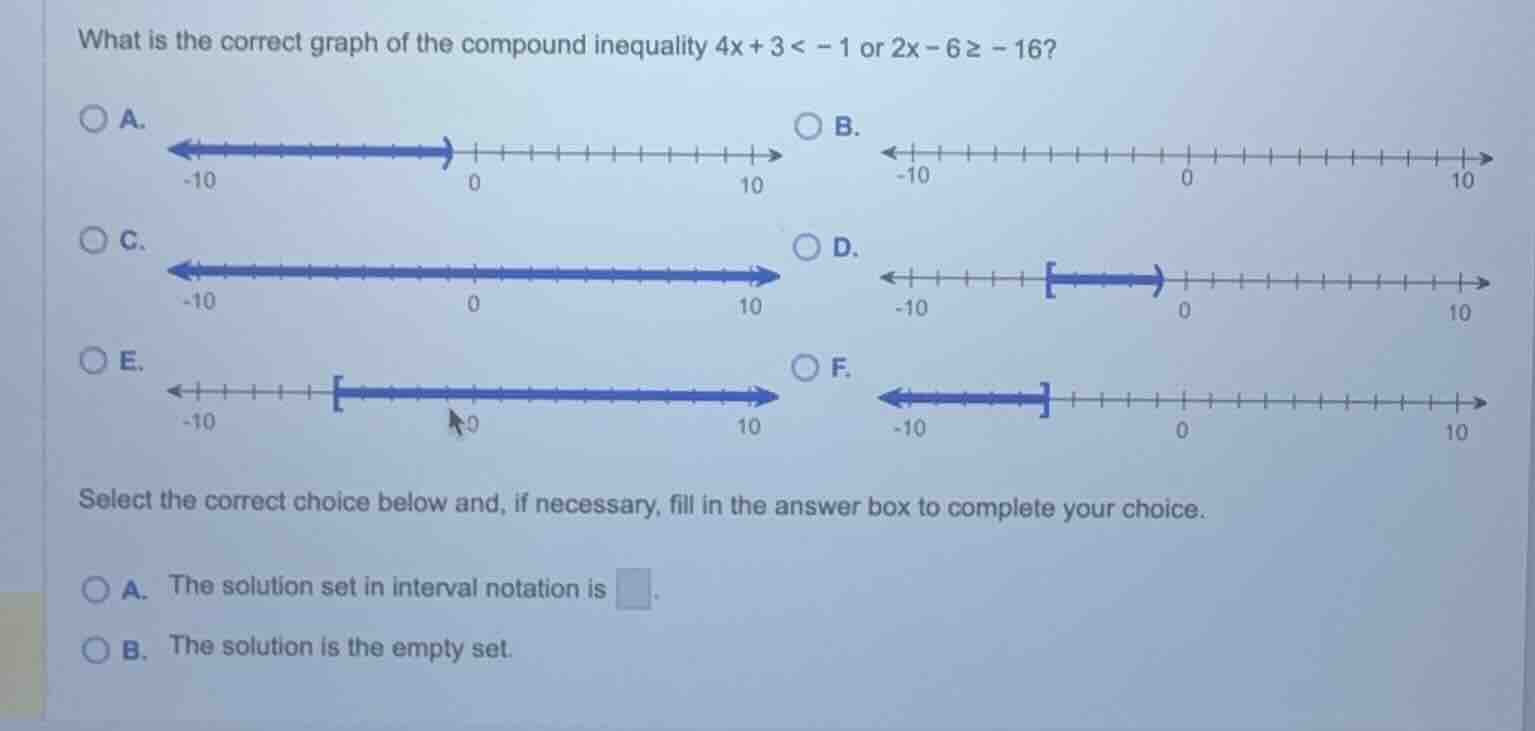
Question
what is the correct graph of the compound inequality $4x + 3 < -1$ or $2x - 6 \geq -16$?\
\
\\u25cb a. \\u25cb b. \
\
\\u25cb c. \\u25cb d. \
\
\\u25cb e. \\u25cb f. \
\
select the correct choice below and, if necessary, fill in the answer box to complete your choice.\
\
\\u25cb a. the solution set in interval notation is \\u25a1.\
\\u25cb b. the solution is the empty set.
Step1: Solve \(4x + 3 < -1\)
Subtract 3 from both sides: \(4x < -1 - 3\)
Simplify: \(4x < -4\)
Divide by 4: \(x < -1\)
Step2: Solve \(2x - 6 \geq -16\)
Add 6 to both sides: \(2x \geq -16 + 6\)
Simplify: \(2x \geq -10\)
Divide by 2: \(x \geq -5\)
Step3: Combine the solutions (since it's "or")
The solution is \(x < -1\) or \(x \geq -5\), which covers all real numbers (because every number is either less than -1 or greater than or equal to -5, or both).

Snap & solve any problem in the app
Get step-by-step solutions on Sovi AI
Photo-based solutions with guided steps
Explore more problems and detailed explanations
A. The solution set in interval notation is \((-\infty, \infty)\) (or we can also note that the graph should be option C as it covers the entire number line). But following the first part of the answer options, the interval notation is \((-\infty, \infty)\) and the graph is option C. However, based on the interval notation part, the solution set is all real numbers, so the interval is \((-\infty, \infty)\) and the correct graph is option C. But for the first answer option (A) in the problem's sub - options, the solution set in interval notation is \((-\infty, \infty)\).