QUESTION IMAGE
Question
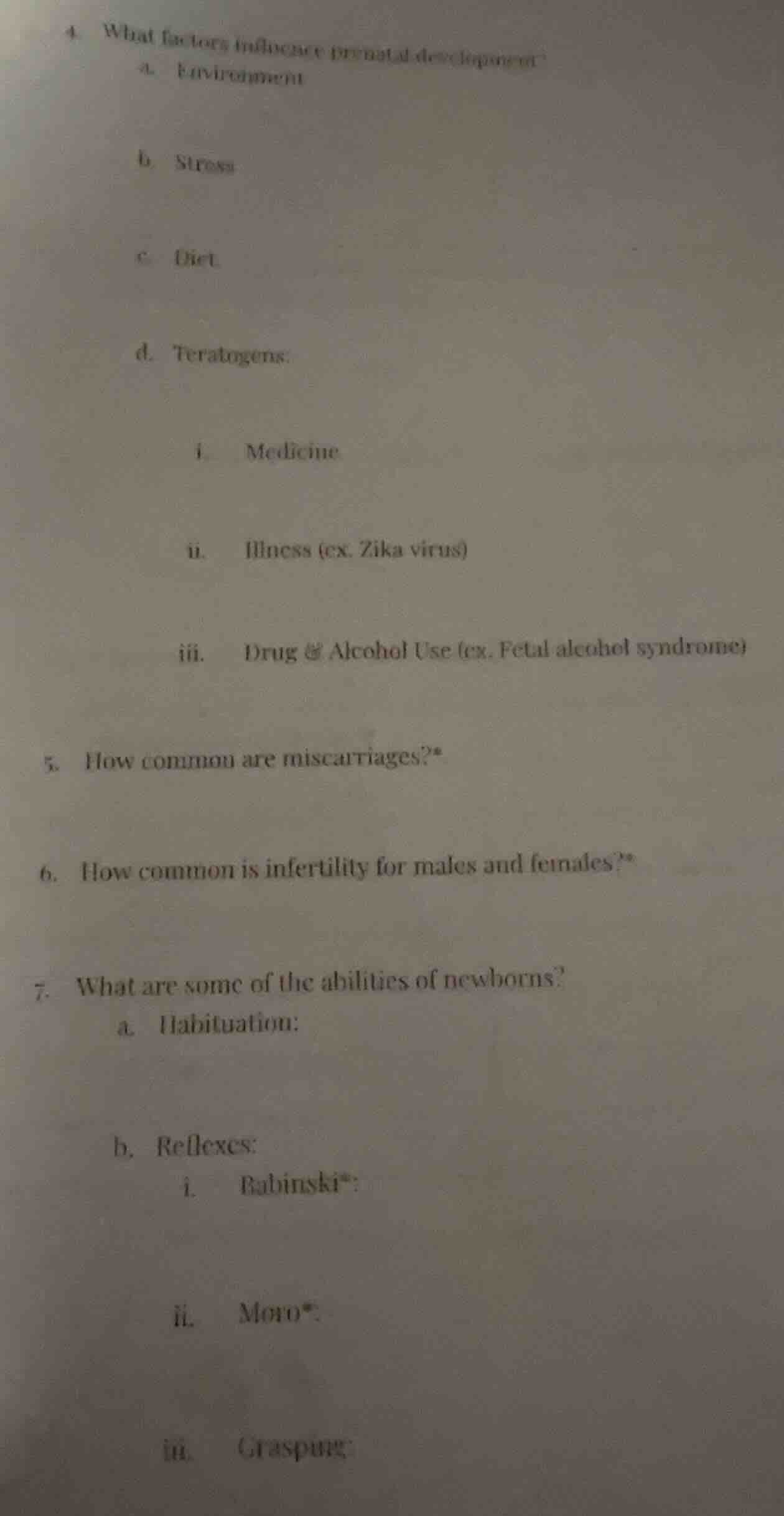
- what factors influence prenatal development?
a. environment
b. stress
c. diet
d. teratogens:
\ti. medicine
\tii. illness (ex. zika virus)
\tiii. drug & alcohol use (ex. fetal alcohol syndrome)
- how common are miscarriages?*
- how common is infertility for males and females?*
- what are some of the abilities of newborns?
a. habituation:
b. reflexes:
\ti. babinski*:
\tii. moro*:
\tiii. grasping:
- For question 4: All listed items are established factors that impact prenatal development. Environmental conditions can expose the fetus to harmful substances, maternal stress affects hormonal balance, diet provides critical nutrients for fetal growth, and teratogens are direct agents that cause birth defects.
- For question 5: Research shows miscarriages are very common, with many occurring before a person knows they are pregnant.
- For question 6: Infertility rates are relatively similar between males and females, with each gender accounting for roughly half of all infertility cases, and overall affecting a notable portion of couples trying to conceive.
- For question 7: These are well-documented newborn abilities. Habituation is a learning process where newborns stop responding to repeated stimuli, and the listed reflexes are involuntary, innate responses that are standard in healthy newborns.

Snap & solve any problem in the app
Get step-by-step solutions on Sovi AI
Photo-based solutions with guided steps
Explore more problems and detailed explanations
- All the listed factors influence prenatal development:
a. Environment
b. Stress
c. Diet
d. Teratogens:
i. Medicine
ii. Illness (ex. Zika virus)
iii. Drug & Alcohol Use (ex. Fetal alcohol syndrome)
- Miscarriages are very common; it is estimated that 10-20% of known pregnancies end in miscarriage, and up to 50% of all pregnancies (including those that end before a person realizes they are pregnant) result in miscarriage.
- Infertility affects approximately 1 in 8 couples trying to conceive. Males account for about 40-50% of infertility cases, and females account for another 40-50% (the remaining cases are either combined male and female factors or unexplained).
- The listed items are key abilities of newborns:
a. Habituation: A form of learning where newborns decrease their response to a repeated, non-threatening stimulus
b. Reflexes:
i. Babinski: When the sole of the foot is stroked, the big toe moves upward and the other toes fan out
ii. Moro: A startle reflex where newborns throw their arms out, spread their fingers, and then bring their arms back in when they feel a loss of support
iii. Grasping: Newborns automatically curl their fingers around an object that touches their palm