QUESTION IMAGE
Question
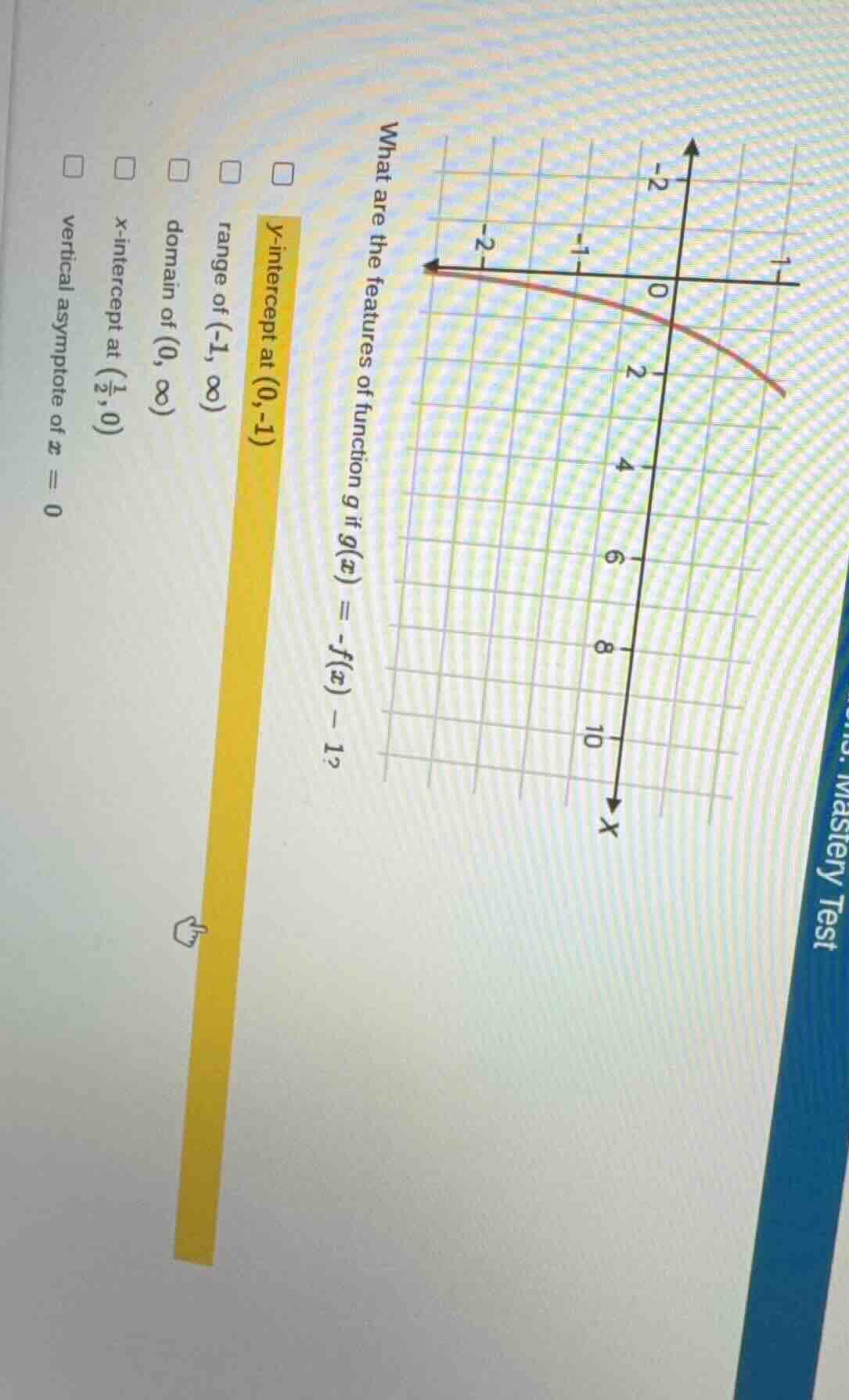
what are the features of function g if ( g(x) = -f(x) - 1 )?
( y )-intercept at ( (0, -1) )
range of ( (-1, infty) )
domain of ( (0, infty) )
( x )-intercept at ( left( \frac{1}{2}, 0
ight) )
vertical asymptote of ( x = 0 )
To solve this, we analyze the transformation \( g(x)=-f(x)-1 \) and the original graph of \( f(x) \):
Step 1: Analyze the original function \( f(x) \)
From the graph, \( f(x) \) appears to be an exponential or logarithmic - like curve. Let's assume the original \( f(x) \) has a \( y \) - intercept at \( (0,0) \) (since it crosses the \( y \) - axis at \( x = 0,y = 0 \)) and domain \( (0,\infty) \), range \( (- \infty,0) \), \( x \) - intercept (if any) and vertical asymptote \( x = 0 \).
Step 2: Analyze the transformation for \( g(x)=-f(x)-1 \)
- Y - intercept:
For the \( y \) - intercept, we set \( x = 0 \). Then \( g(0)=-f(0)-1 \). If the original \( f(0) = 0 \) (from the graph, the curve passes through \( (0,0) \)), then \( g(0)=-0 - 1=-1 \). So the \( y \) - intercept of \( g(x) \) is at \( (0,-1) \).
- Range:
The range of \( f(x) \) (from the graph) seems to be \( (- \infty,0) \). When we apply the transformation \( y=-f(x)-1 \), first, the transformation \( y = - f(x) \) reflects \( f(x) \) over the \( x \) - axis. So the range of \( -f(x) \) is \( (0,\infty) \). Then, the transformation \( y=-f(x)-1 \) shifts the graph down by 1 unit. So the range of \( g(x)=-f(x)-1 \) is \( (-1,\infty) \).
- Domain:
The domain of a function is affected by vertical transformations (reflections and vertical shifts) in the same way as the original function. If the domain of \( f(x) \) is \( (0,\infty) \), the domain of \( g(x)=-f(x)-1 \) is also \( (0,\infty) \) (since vertical transformations do not affect the domain).
- X - intercept:
To find the \( x \) - intercept, we set \( g(x) = 0 \), so \( 0=-f(x)-1\Rightarrow f(x)=- 1 \). There is no information from the original graph to suggest that \( f(x)=-1 \) at \( x=\frac{1}{2} \), so this option is incorrect.
- Vertical Asymptote:
Vertical asymptotes are affected by horizontal transformations. Since \( g(x) \) is a vertical transformation of \( f(x) \), if the original \( f(x) \) has a vertical asymptote \( x = 0 \), the vertical asymptote of \( g(x) \) is also \( x = 0 \). But we are checking the options one by one.
Now let's check each option:
- Option 1: \( y \) - intercept at \( (0,-1) \): As we calculated above, when \( x = 0 \), \( g(0)=-f(0)-1 \). If \( f(0) = 0 \) (from the graph of \( f(x) \) passing through \( (0,0) \)), then \( g(0)=-1 \). So this is correct.
- Option 2: Range of \( (-1,\infty) \): The range of \( f(x) \) is \( (-\infty,0) \). For \( y=-f(x)-1 \), when we reflect \( f(x) \) over the \( x \) - axis, the range of \( -f(x) \) is \( (0,\infty) \). Then shifting down by 1 unit, the range of \( -f(x)-1 \) is \( (-1,\infty) \). This is correct.
- Option 3: Domain of \( (0,\infty) \): Vertical transformations (reflection over \( x \) - axis and vertical shift) do not change the domain. If the domain of \( f(x) \) is \( (0,\infty) \), the domain of \( g(x) \) is also \( (0,\infty) \). This is correct.
- Option 4: \( x \) - intercept at \( (\frac{1}{2},0) \): To find the \( x \) - intercept, we set \( g(x) = 0\Rightarrow -f(x)-1=0\Rightarrow f(x)=-1 \). There is no evidence from the graph of \( f(x) \) that \( f(\frac{1}{2})=-1 \), so this is incorrect.
- Option 5: Vertical asymptote of \( x = 0 \): Vertical asymptotes are determined by the values of \( x \) where the function is undefined. Vertical transformations (reflection and vertical shift) do not change the vertical asymptote. If \( f(x) \) has a vertical asymptote at \( x = 0 \), \( g(x) \) also has a vertical asymptote at \( x = 0 \). This is correct. But we are to choose the features of…
Step 1: Find \( g(0) \)
Set \( x = 0 \) in \( g(x)=-f(x)-1 \). If \( f(0) = 0 \) (from the graph of \( f(x) \)), then \( g(0)=-f(0)-1=-0 - 1=-1 \).
Step 2: Determine the \( y \) - intercept
The \( y \) - intercept occurs at \( x = 0 \). So the \( y \) - intercept of \( g(x) \) is \( (0,-1) \).

Snap & solve any problem in the app
Get step-by-step solutions on Sovi AI
Photo-based solutions with guided steps
Explore more problems and detailed explanations
\( y \) - intercept at \( (0,-1) \) (along with range \( (-1,\infty) \), domain \( (0,\infty) \) and vertical asymptote \( x = 0 \) as correct features)