QUESTION IMAGE
Question
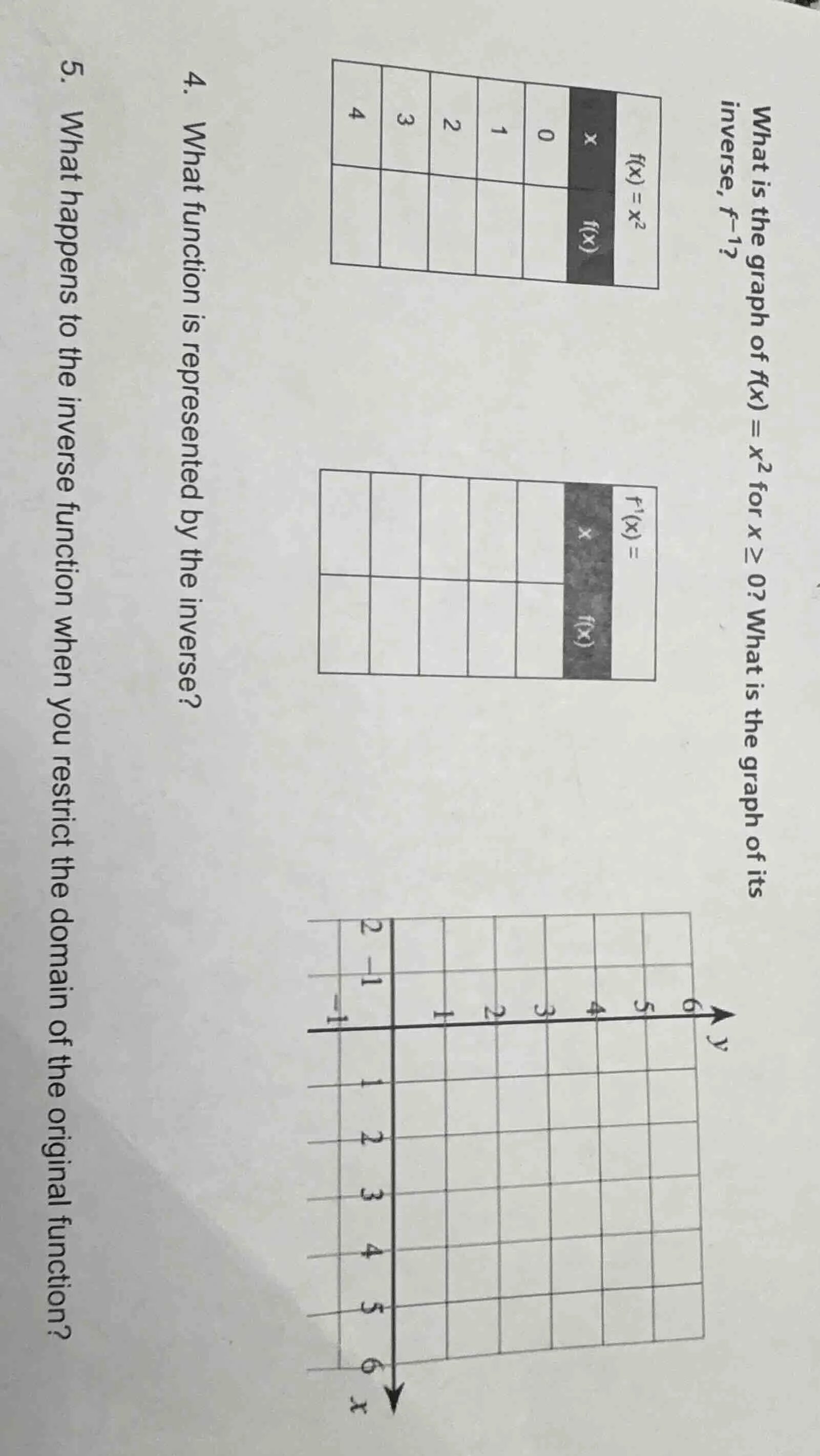
what is the graph of $f(x) = x^2$ for $x \geq 0$? what is the graph of its inverse, $f^{-1}$?
- what function is represented by the inverse?
- what happens to the inverse function when you restrict the domain of the original function?
For the function \( f(x) = x^2 \) with \( x \geq 0 \) and its inverse:
Step 1: Find the inverse function
To find the inverse of \( f(x) = x^2 \) (for \( x \geq 0 \)):
- Start with \( y = x^2 \).
- Swap \( x \) and \( y \): \( x = y^2 \).
- Solve for \( y \): \( y = \sqrt{x} \) (since \( x \geq 0 \) in the original function, the inverse takes the non - negative root).
So, \( f^{-1}(x)=\sqrt{x} \).
Step 2: Graph of \( f(x)=x^2 \) for \( x \geq 0 \)
The function \( y = x^2 \) is a parabola. When \( x \geq 0 \), we are looking at the right - hand half of the parabola \( y = x^2 \). The vertex of the parabola \( y = x^2 \) is at the origin \((0,0)\). For \( x = 0\), \( y = 0\); for \( x = 1\), \( y = 1\); for \( x = 2\), \( y = 4\), and so on. As \( x\) increases, \( y\) increases quadratically.
Step 3: Graph of \( f^{-1}(x)=\sqrt{x} \)
The function \( y=\sqrt{x} \) has a domain \( x\geq0 \) (since we can't take the square root of a negative number in the real - number system) and a range \( y\geq0 \). For \( x = 0\), \( y = 0\); for \( x = 1\), \( y = 1\); for \( x = 4\), \( y = 2\), and so on. The graph of \( y=\sqrt{x} \) is a curve that starts at the origin and increases slowly as \( x\) increases. Also, the graph of a function and its inverse (when the function is one - to - one) are symmetric about the line \( y = x \).
Step 4: Function represented by the inverse
The inverse function \( f^{-1}(x)=\sqrt{x} \) is a square - root function. It undoes the operation of squaring a non - negative number. For example, if \( f(2)=2^2 = 4\), then \( f^{-1}(4)=\sqrt{4}=2 \).
Step 5: Effect of restricting the domain of the original function on the inverse
The original function \( f(x)=x^2 \) without a domain restriction (\( x\in\mathbb{R} \)) is not one - to - one (for example, \( f(2)=4 \) and \( f(- 2)=4 \)), so it does not have an inverse function in the set of real functions. But when we restrict the domain of \( f(x)=x^2 \) to \( x\geq0 \), the function becomes one - to - one (each \( y\) - value corresponds to exactly one \( x\) - value). This allows the inverse function \( f^{-1}(x)=\sqrt{x} \) to exist. If we had not restricted the domain, we could not define a unique inverse function over the real numbers.

Snap & solve any problem in the app
Get step-by-step solutions on Sovi AI
Photo-based solutions with guided steps
Explore more problems and detailed explanations
s:
- The graph of \( f(x)=x^2 \) for \( x\geq0 \) is the right - hand half of the parabola \( y = x^2 \) with vertex at \((0,0)\) and increasing for \( x\geq0 \).
- The inverse function \( f^{-1}(x)=\sqrt{x} \), and its graph is the curve \( y = \sqrt{x} \) (symmetric to \( y = x^2 \) (for \( x\geq0 \)) about \( y = x \)).
- The function represented by the inverse is the square - root function \( f^{-1}(x)=\sqrt{x} \).
- Restricting the domain of \( f(x)=x^2 \) to \( x\geq0 \) makes \( f(x) \) one - to - one, so that the inverse function \( f^{-1}(x) \) can exist (without the restriction, \( f(x) \) is not one - to - one and has no real - valued inverse function).