QUESTION IMAGE
Question
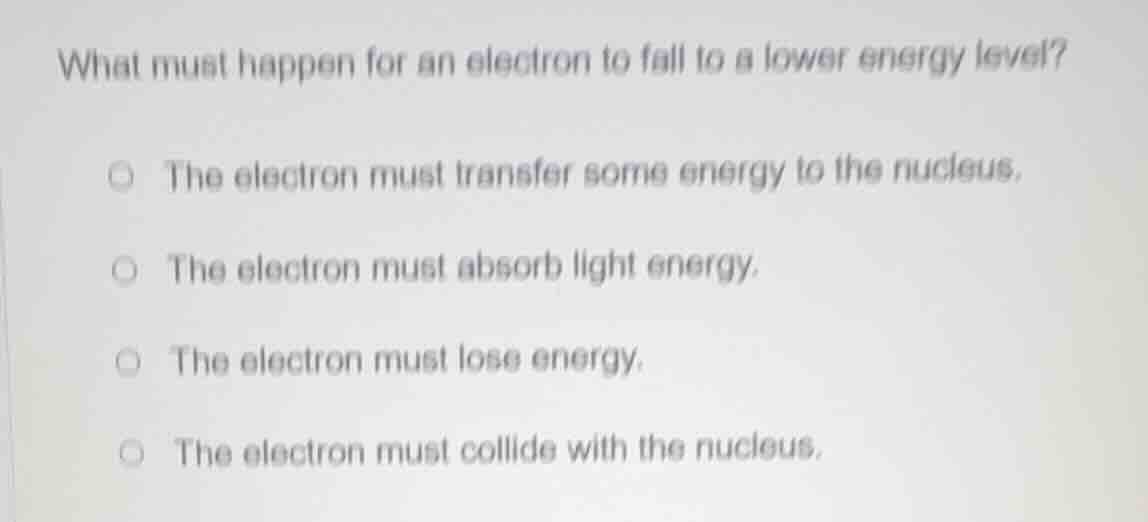
what must happen for an electron to fall to a lower energy level?
the electron must transfer some energy to the nucleus.
the electron must absorb light energy.
the electron must lose energy.
the electron must collide with the nucleus.
To determine the correct answer, we analyze each option based on the concept of electron energy levels:
- "The electron must transfer some energy to the nucleus."
Electrons do not transfer energy to the nucleus to change energy levels. Energy level changes involve interactions with photons (light) or other particles, not direct energy transfer to the nucleus. Eliminate this option.
- "The electron must absorb light energy."
Absorbing light energy causes an electron to move to a higher energy level (excitation). To fall to a lower level, the electron must release energy, not absorb it. Eliminate this option.
- "The electron must lose energy."
When an electron falls from a higher energy level to a lower one, it releases (loses) energy, typically in the form of a photon (light). This matches the fundamental principle of electron energy transitions.
- "The electron must collide with the nucleus."
Electrons do not collide with the nucleus under normal circumstances (quantum mechanics prevents this). Energy level changes are governed by photon absorption/emission, not nuclear collisions. Eliminate this option.

Snap & solve any problem in the app
Get step-by-step solutions on Sovi AI
Photo-based solutions with guided steps
Explore more problems and detailed explanations
The electron must lose energy.