QUESTION IMAGE
Question
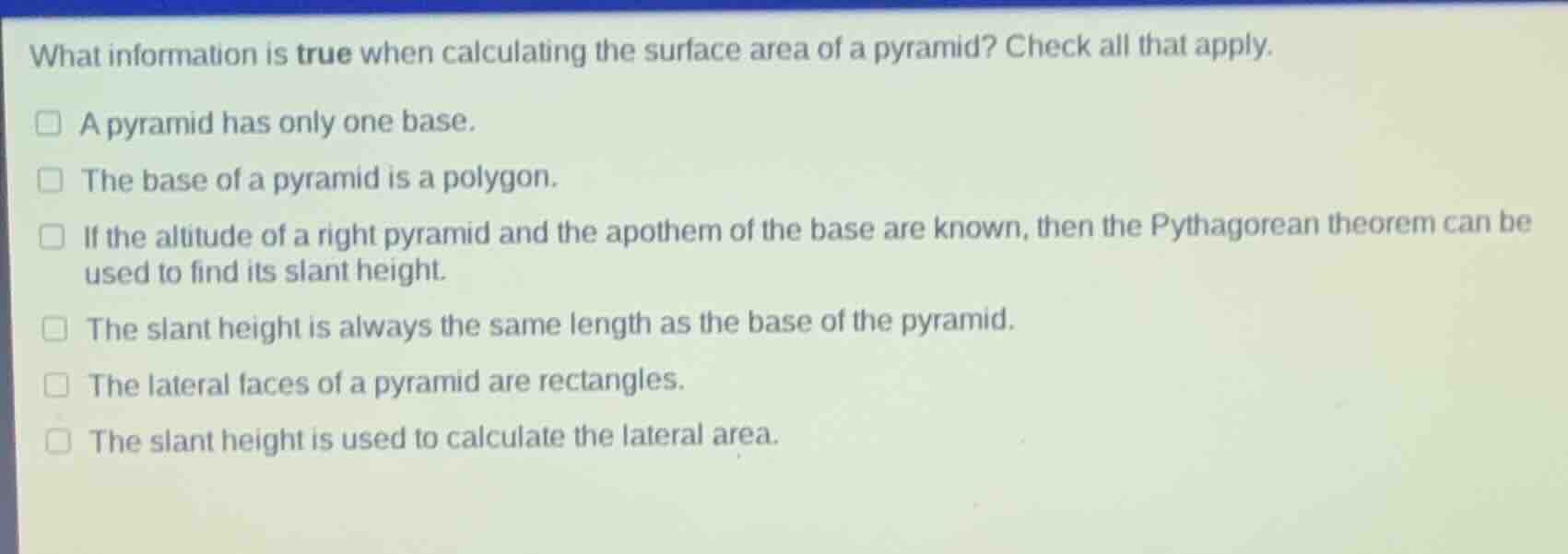
what information is true when calculating the surface area of a pyramid? check all that apply. a pyramid has only one base. the base of a pyramid is a polygon. if the altitude of a right pyramid and the apothem of the base are known, then the pythagorean theorem can be used to find its slant height. the slant height is always the same length as the base of the pyramid. the lateral faces of a pyramid are rectangles. the slant height is used to calculate the lateral area.
- A pyramid is defined as a polyhedron with one polygonal base and triangular lateral faces meeting at an apex, so it has only one base.
- By definition, the base of a pyramid is a polygon (a closed, straight-sided figure).
- For a right pyramid, the altitude, apothem of the base, and slant height form a right triangle, so the Pythagorean theorem ($a^2 + b^2 = c^2$) can find the slant height.
- Slant height depends on pyramid dimensions and is not equal to the base length.
- Lateral faces of a pyramid are triangles, not rectangles.
- Lateral area of a pyramid uses the slant height in the formula $\frac{1}{2} \times \text{perimeter of base} \times \text{slant height}$.

Snap & solve any problem in the app
Get step-by-step solutions on Sovi AI
Photo-based solutions with guided steps
Explore more problems and detailed explanations
A. A pyramid has only one base.
B. The base of a pyramid is a polygon.
C. If the altitude of a right pyramid and the apothem of the base are known, then the Pythagorean theorem can be used to find its slant height.
F. The slant height is used to calculate the lateral area.