QUESTION IMAGE
Question
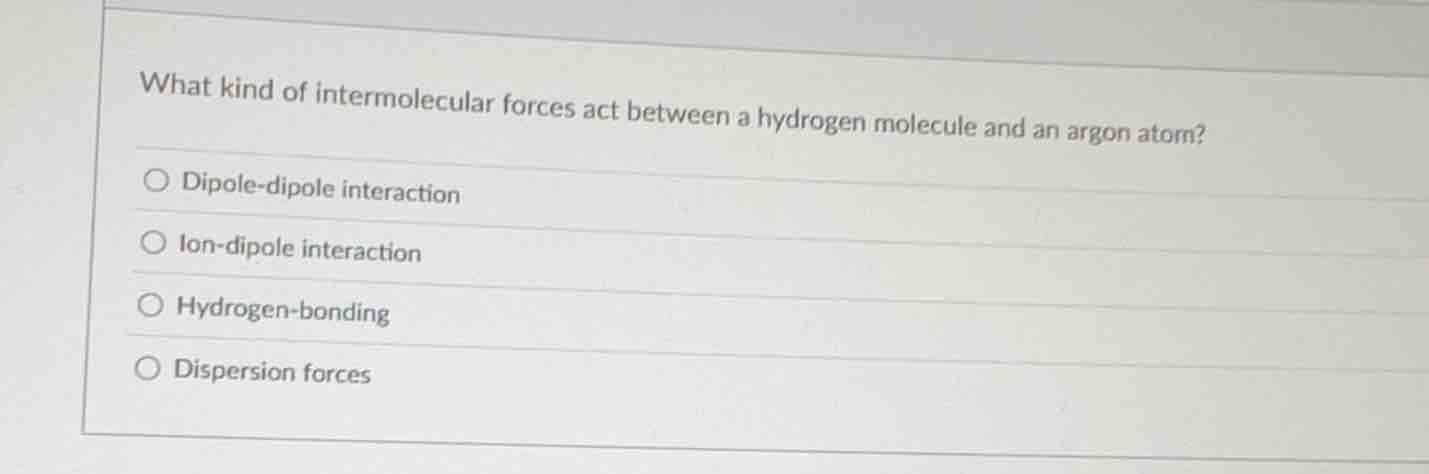
what kind of intermolecular forces act between a hydrogen molecule and an argon atom?
- dipole-dipole interaction
- ion-dipole interaction
- hydrogen-bonding
- dispersion forces
Brief Explanations
- Analyze the nature of the particles: A hydrogen molecule ($H_2$) is non - polar, and an argon atom (Ar) is a noble gas atom (also non - polar).
- Recall the types of intermolecular forces:
- Dipole - dipole interactions occur between polar molecules. Since both $H_2$ and Ar are non - polar, this is not the case.
- Ion - dipole interactions occur between an ion and a polar molecule. There are no ions here, so this is not applicable.
- Hydrogen - bonding is a special type of dipole - dipole interaction that occurs when a hydrogen atom is bonded to a highly electronegative atom (F, O, N) and is attracted to another highly electronegative atom. This is not relevant here as neither $H_2$ nor Ar has the necessary structure for hydrogen - bonding.
- Dispersion forces (also called London dispersion forces) are the intermolecular forces that act between all molecules (including non - polar molecules and atoms) due to the temporary dipoles that arise from the movement of electrons. Since both $H_2$ (non - polar molecule) and Ar (non - polar atom) will experience temporary dipoles, dispersion forces act between them.

Snap & solve any problem in the app
Get step-by-step solutions on Sovi AI
Photo-based solutions with guided steps
Explore more problems and detailed explanations
D. Dispersion forces