QUESTION IMAGE
Question
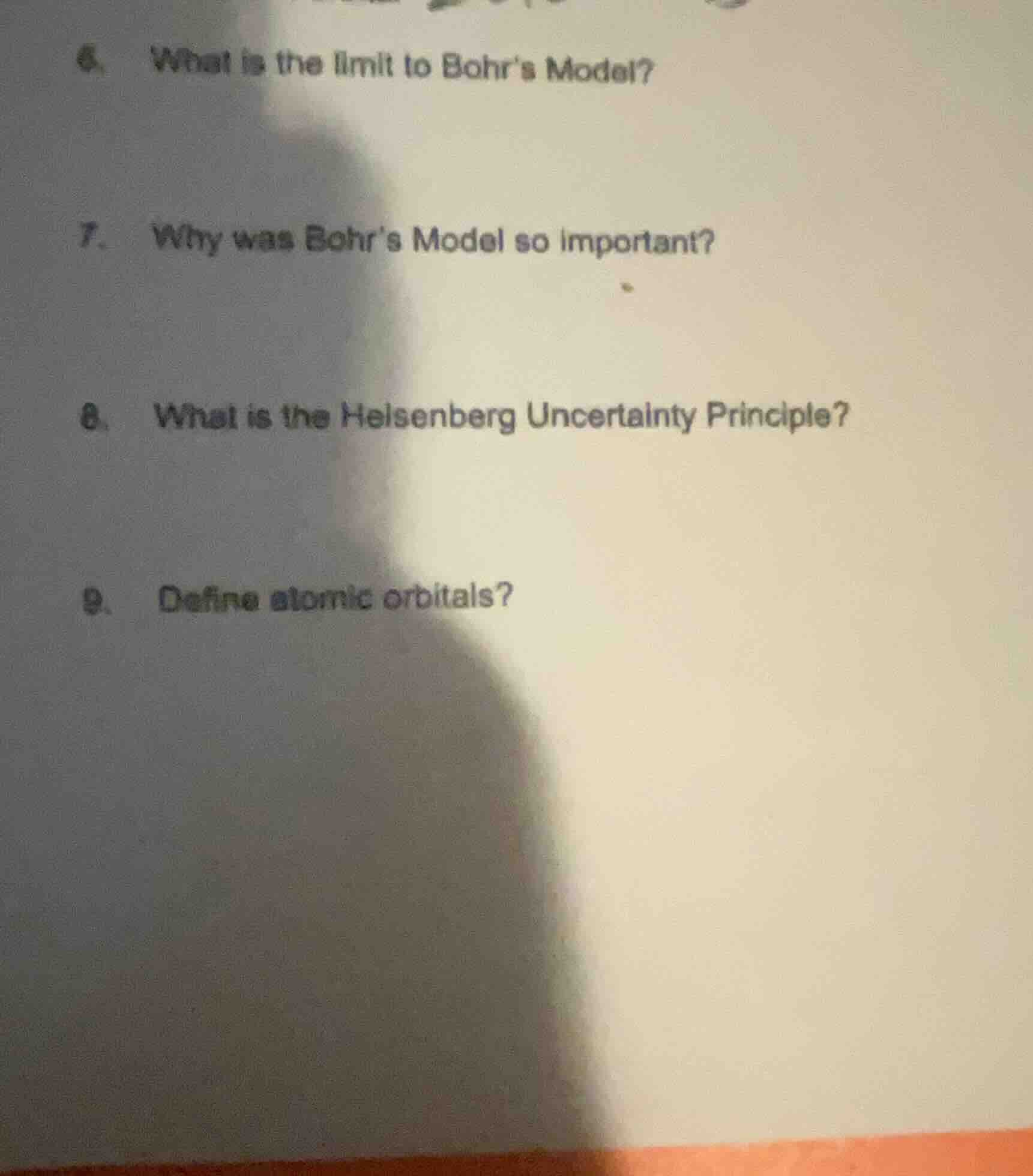
- what is the limit to bohrs model?
- why was bohrs model so important?
- what is the heisenberg uncertainty principle?
- define atomic orbitals?
Question 6: What is the limit to Bohr’s Model?
Bohr's model, though revolutionary, has limitations. It works well for hydrogen - like (single - electron) atoms but fails for multi - electron atoms. It assumes electrons move in fixed circular orbits (a classical physics idea), while quantum mechanics shows electrons have wave - like properties and their positions are described by probability distributions (orbitals), not definite orbits. Also, it can't explain fine - structure of spectral lines (like the splitting of lines in a magnetic field, the Zeeman effect, or in an electric field, the Stark effect) and the relative intensities of spectral lines.
Bohr's model was a crucial bridge between classical and quantum physics. It explained hydrogen's atomic spectrum (the discrete lines) by proposing electrons exist in quantized energy levels (orbits) and absorb/emits photons when moving between levels ($\Delta E = h
u$). It introduced the idea of quantized energy in atoms, which was a key step towards quantum mechanics. It also validated Rutherford's nuclear model (electrons around a nucleus) while addressing the stability issue (classical physics predicted electrons would spiral into the nucleus; Bohr's quantized levels prevented this) and explained atomic line spectra, which classical physics couldn't.
The Heisenberg Uncertainty Principle states that for a particle (like an electron), it's impossible to simultaneously measure both its position ($x$) and momentum ($p$) with absolute precision. Mathematically, $\Delta x \cdot \Delta p \geq \frac{\hbar}{2}$, where $\Delta x$ is the uncertainty in position, $\Delta p$ is the uncertainty in momentum, and $\hbar=\frac{h}{2\pi}$ (with $h$ being Planck’s constant). It arises from the wave - particle duality of matter: electrons (and all particles) have both wave and particle properties, so their position and momentum can't be precisely known at the same time. It also applies to other conjugate variables like energy - time ($\Delta E \cdot \Delta t \geq \frac{\hbar}{2}$).

Snap & solve any problem in the app
Get step-by-step solutions on Sovi AI
Photo-based solutions with guided steps
Explore more problems and detailed explanations
Bohr's model is limited to single - electron (hydrogen - like) atoms. It uses classical orbital concepts (incorrect for quantum - scale electrons), can't explain multi - electron atom spectra, fine - structure of spectral lines, or electron probability distributions (quantum mechanical orbital nature).