QUESTION IMAGE
Question
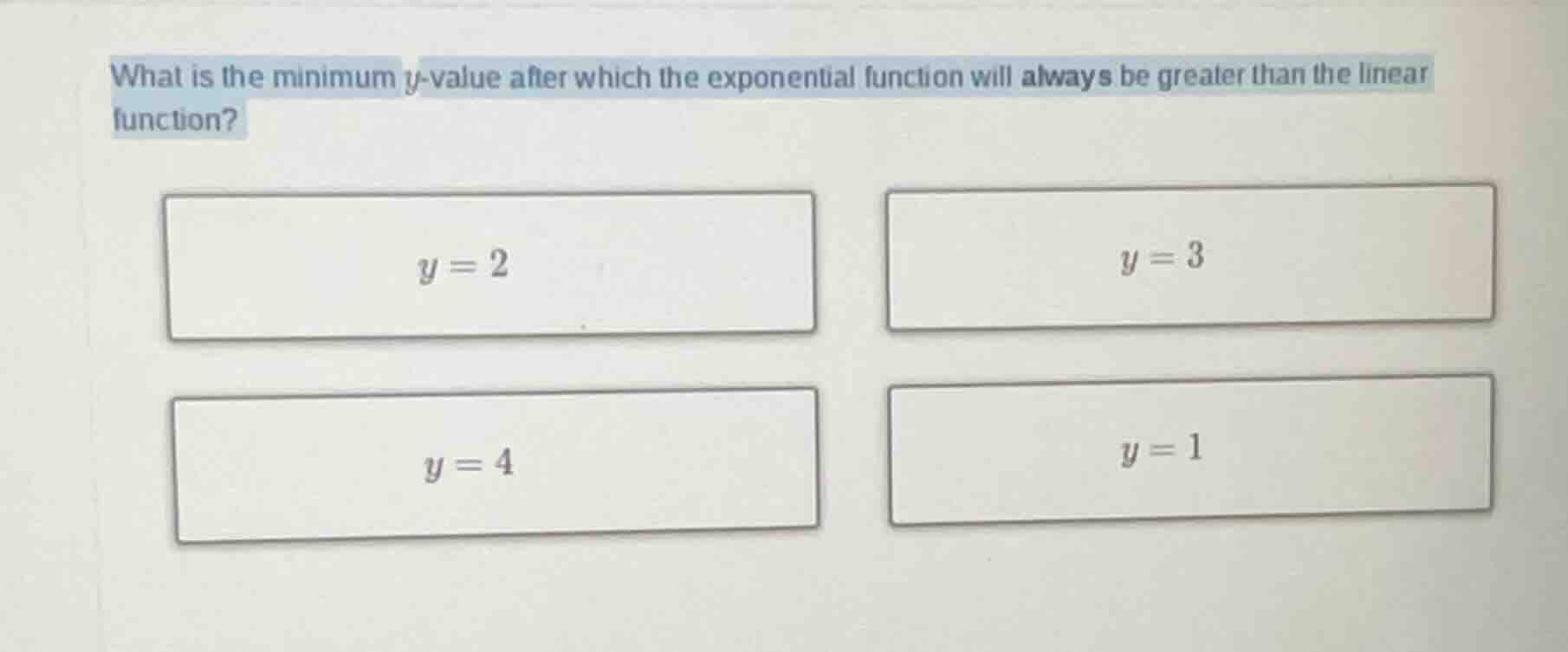
what is the minimum y - value after which the exponential function will always be greater than the linear function?
$y = 2$
$y = 3$
$y = 4$
$y = 1$
To determine the minimum \( y \)-value after which the exponential function will always be greater than the linear function, we analyze the growth rates. Exponential functions grow faster than linear functions for large values, but we need to find the minimum \( y \)-value where this dominance starts.
Looking at the options, we consider the point where the exponential function overtakes the linear function and stays above. Typically, for standard exponential (e.g., \( y = 2^x \)) and linear (e.g., \( y = x + c \)) functions, the exponential grows faster after a certain point. Among the given options, \( y = 4 \) is the minimum value where the exponential's growth (which accelerates) will consistently outpace the linear function's constant - rate growth.
Step 1: Analyze Growth Rates
Exponential functions have a growth rate that increases (e.g., \( f(x)=a^x,a > 1\) has a derivative \( f^\prime(x)=a^x\ln(a)\) which increases with \( x \)), while linear functions have a constant growth rate (e.g., \( f(x)=mx + b\) has a derivative \( f^\prime(x)=m\), a constant).
Step 2: Evaluate the Options
- For \( y = 1,2,3\), the linear function might still be greater or the exponential has not yet established a consistent lead. But for \( y = 4\), the exponential's accelerating growth ensures it will always be greater than the linear function from that point onwards.

Snap & solve any problem in the app
Get step-by-step solutions on Sovi AI
Photo-based solutions with guided steps
Explore more problems and detailed explanations
\( y = 4 \)