QUESTION IMAGE
Question
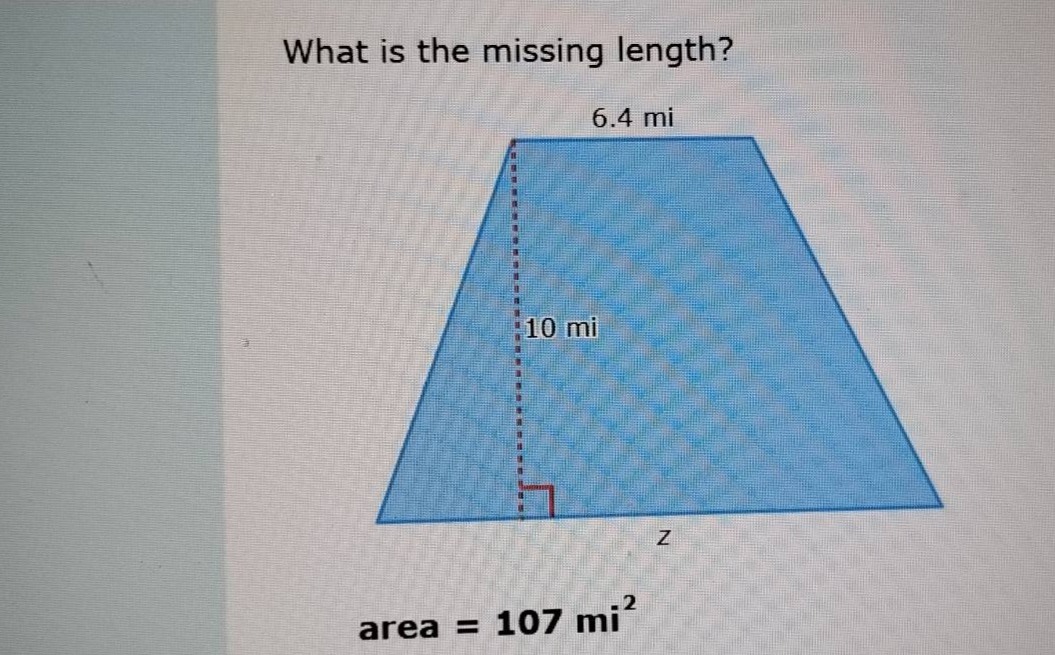
what is the missing length?
6.4 mi
10 mi
z
area = 107 mi²
Step1: Recall the trapezoid area formula
The area \( A \) of a trapezoid is given by \( A=\frac{(a + b)h}{2} \), where \( a \) and \( b \) are the lengths of the two parallel sides, and \( h \) is the height. Here, \( a = 6.4 \) mi, \( h = 10 \) mi, \( A = 107 \) mi², and the other base is \( 6.4+z \) (since the horizontal segment from the top base to the vertical line is equal to the top base, so the bottom base is \( 6.4 + z\)? Wait, no, actually, looking at the diagram, the top base is \( 6.4 \) mi, the height is \( 10 \) mi, and the bottom base is \( 6.4 + z\)? Wait, no, maybe the bottom base is \( 6.4 + z\)? Wait, no, let's re - express. Let the two parallel sides be \( b_1=6.4 \) mi and \( b_2=(6.4 + z) \) mi? Wait, no, maybe the bottom base is \( 6.4+z \), and the height \( h = 10 \). Wait, actually, the formula is \( A=\frac{(b_1 + b_2)h}{2} \), where \( b_1 \) is the top base (\( 6.4 \) mi), \( b_2 \) is the bottom base (\( 6.4 + z\)? No, wait, maybe the bottom base is \( 6.4+z \), and the height is \( 10 \). Wait, let's plug in the values.
We know that \( A = 107=\frac{(6.4+(6.4 + z))\times10}{2} \)? No, that's wrong. Wait, no, looking at the diagram, the vertical dashed line is the height, and the horizontal segment from the end of the top base to the dashed line is equal to the top base? No, maybe the bottom base is \( 6.4+z \), where \( z \) is the extension beyond the dashed line. Wait, actually, the correct way: Let the two parallel sides be \( b_1 = 6.4 \) mi and \( b_2=(6.4 + z) \) mi? No, wait, the formula is \( A=\frac{(b_1 + b_2)h}{2} \), so we can solve for \( b_2 \) first.
Step2: Solve for the sum of the two bases
From \( A=\frac{(b_1 + b_2)h}{2} \), we can re - arrange to get \( b_1 + b_2=\frac{2A}{h} \). Substituting \( A = 107 \) and \( h = 10 \), we have \( b_1 + b_2=\frac{2\times107}{10}=\frac{214}{10} = 21.4 \) mi.
Step3: Solve for the missing part of the base
We know that \( b_1 = 6.4 \) mi, and \( b_2=6.4 + z \) (wait, no, actually, \( b_2=6.4+z \)? Wait, no, \( b_1 + b_2=21.4 \), and \( b_1 = 6.4 \), so \( b_2=21.4 - 6.4=15 \) mi. But \( b_2=6.4 + z \), so \( 6.4+z = 15 \), then \( z=15 - 6.4 = 8.6 \) mi. Wait, let's check again.
Wait, the formula for the area of a trapezoid is \( A=\frac{(a + b)h}{2} \), where \( a \) and \( b \) are the two parallel sides. In the diagram, the top side is \( a = 6.4 \) mi, the height \( h = 10 \) mi, and the bottom side is \( a+z \) (because the horizontal segment from the top side to the vertical height line is equal to the top side, so the bottom side is \( 6.4 + z\)). Wait, no, maybe the bottom side is \( 6.4+z \), so:
\( 107=\frac{(6.4+(6.4 + z))\times10}{2} \)
First, multiply both sides by 2: \( 2\times107=(6.4 + 6.4+z)\times10 \)
\( 214=(12.8 + z)\times10 \)
Then divide both sides by 10: \( 21.4 = 12.8+z \)
Then subtract 12.8 from both sides: \( z=21.4 - 12.8 = 8.6 \) mi.

Snap & solve any problem in the app
Get step-by-step solutions on Sovi AI
Photo-based solutions with guided steps
Explore more problems and detailed explanations
The missing length \( z \) is \( 8.6 \) miles.