QUESTION IMAGE
Question
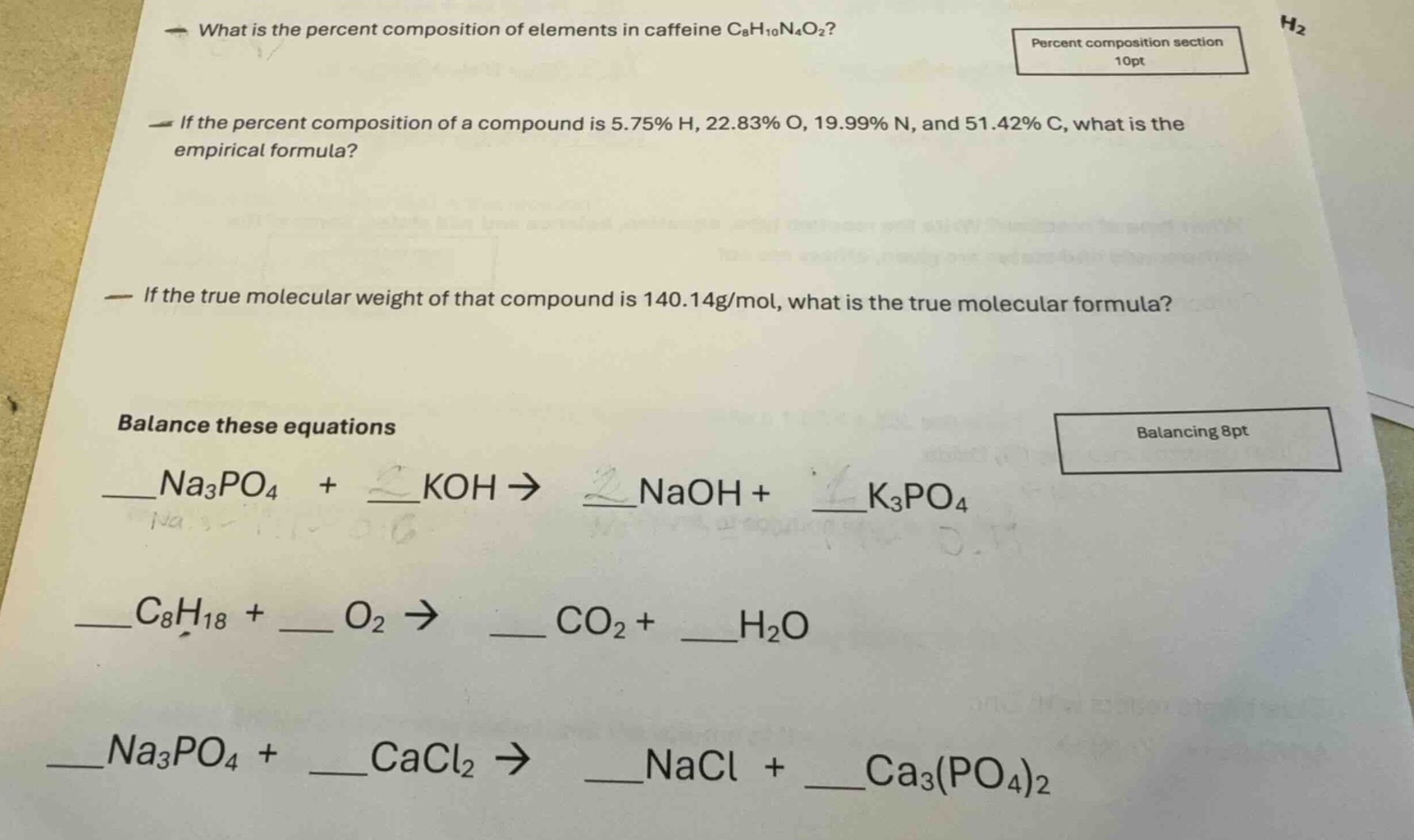
what is the percent composition of elements in caffeine c₈h₁₀n₄o₂?
percent composition section
10pt
if the percent composition of a compound is 5.75% h, 22.83% o, 19.99% n, and 51.42% c, what is the empirical formula?
if the true molecular weight of that compound is 140.14g/mol, what is the true molecular formula?
balance these equations
balancing 8pt
na₃po₄ + koh → naoh + k₃po₄
c₈h₁₈ + o₂ → co₂ + h₂o
na₃po₄ + cacl₂ → nacl + ca₃(po₄)₂
First Set: Percent Composition & Formulas
---
Part 1: Percent Composition of Caffeine ($\text{C}_8\text{H}_{10}\text{N}_4\text{O}_2$)
Step1: Calculate molar mass of caffeine
First, find atomic masses: $\text{C}=12.01$, $\text{H}=1.008$, $\text{N}=14.01$, $\text{O}=16.00$.
Step2: % of Carbon
$$\% \text{C} = \frac{8 \times 12.01}{194.20} \times 100 = \frac{96.08}{194.20} \times 100 \approx 49.47\%$$
Step3: % of Hydrogen
$$\% \text{H} = \frac{10 \times 1.008}{194.20} \times 100 = \frac{10.08}{194.20} \times 100 \approx 5.19\%$$
Step4: % of Nitrogen
$$\% \text{N} = \frac{4 \times 14.01}{194.20} \times 100 = \frac{56.04}{194.20} \times 100 \approx 28.86\%$$
Step5: % of Oxygen
$$\% \text{O} = \frac{2 \times 16.00}{194.20} \times 100 = \frac{32.00}{194.20} \times 100 \approx 16.48\%$$
---
Part 2: Empirical Formula from % Composition
Step1: Convert % to moles (assume 100g sample)
Step2: Divide by smallest mole value
Smallest mole = 1.43 mol
---
Part 3: Molecular Formula from Empirical Formula
Step1: Calculate empirical formula mass
Empirical formula = $\text{C}_3\text{H}_4\text{NO}$
Step2: Find ratio of molecular to empirical mass
$$n = \frac{\text{Molecular mass}}{\text{Empirical mass}} = \frac{140.14}{70.08} \approx 2$$
Step3: Multiply empirical formula by n
$$\text{Molecular formula} = 2 \times (\text{C}_3\text{H}_4\text{NO})$$
---
Second Set: Balancing Chemical Equations
---
Equation 1: $\text{Na}_3\text{PO}_4 + \text{KOH}
ightarrow \text{NaOH} + \text{K}_3\text{PO}_4$
Step1: Balance K atoms
Add coefficient 3 to KOH:
Step2: Balance Na and OH atoms
Add coefficient 3 to NaOH:
---
Equation 2: $\text{C}_8\text{H}_{18} + \text{O}_2
ightarrow \text{CO}_2 + \text{H}_2\text{O}$
Step1: Balance C and H atoms
Add coefficient 8 to $\text{CO}_2$, 9 to $\text{H}_2\text{O}$:
Step2: Balance O atoms
Total O on right = $(8 \times 2) + 9 = 25$, so add $\frac{25}{2}$ to $\text{O}_2$, then multiply all coefficients by 2 to eliminate fractions:
---
Equation 3: $\text{Na}_3\text{PO}_4 + \text{CaCl}_2
ightarrow \text{NaCl} + \text{Ca}_3(\text{PO}_4)_2$
Step1: Balance $\text{PO}_4$ and Ca atoms
Add coefficient 2 to $\text{Na}_3\text{PO}_4$, 3 to $\text{CaCl}_2$:
Step2: Balance Na and Cl atoms
Add coefficient 6 to NaCl:
---

Snap & solve any problem in the app
Get step-by-step solutions on Sovi AI
Photo-based solutions with guided steps
Explore more problems and detailed explanations
Percent Composition & Formulas
- Percent composition of caffeine:
- Carbon: 49.47%
- Hydrogen: 5.19%
- Nitrogen: 28.86%
- Oxygen: 16.48%
- Empirical formula: $\text{C}_3\text{H}_4\text{NO}$
- Molecular formula: $\text{C}_6\text{H}_8\text{N}_2\text{O}_2$
Balanced Chemical Equations
- $\boldsymbol{1}\text{Na}_3\text{PO}_4 + \boldsymbol{3}\text{KOH}
ightarrow \boldsymbol{3}\text{NaOH} + \boldsymbol{1}\text{K}_3\text{PO}_4$
- $\boldsymbol{2}\text{C}_8\text{H}_{18} + \boldsymbol{25}\text{O}_2
ightarrow \boldsymbol{16}\text{CO}_2 + \boldsymbol{18}\text{H}_2\text{O}$
- $\boldsymbol{2}\text{Na}_3\text{PO}_4 + \boldsymbol{3}\text{CaCl}_2
ightarrow \boldsymbol{6}\text{NaCl} + \boldsymbol{1}\text{Ca}_3(\text{PO}_4)_2$