QUESTION IMAGE
Question
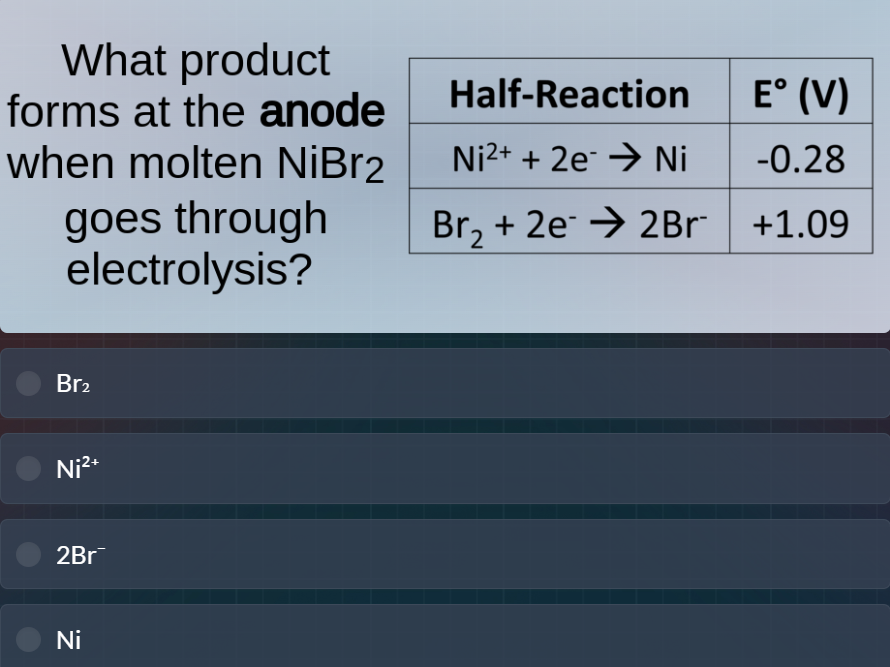
what product forms at the anode when molten nibr₂ goes through electrolysis?
half-reaction | e° (v)
ni²⁺ + 2e⁻ → ni | -0.28
br₂ + 2e⁻ → 2br⁻ | +1.09
options: br₂, ni²⁺, 2br⁻, ni
Step1: Recall anode reaction in electrolysis
At anode, oxidation occurs (loss of electrons). We need to find the half - reaction that is an oxidation (reverse of the given reduction half - reactions).
The given reduction half - reactions are:
- $\ce{Ni^{2+} + 2e^- \to Ni}$ ($E^o=- 0.28\ V$)
- $\ce{Br_2 + 2e^- \to 2Br^-}$ ($E^o = + 1.09\ V$)
Step2: Determine the oxidation half - reaction
For oxidation, we reverse the reduction half - reactions:
- Reverse of $\ce{Ni^{2+}+2e^-\to Ni}$ is $\ce{Ni\to Ni^{2+}+2e^-}$, and the oxidation potential $E_{ox}^o=-E_{red}^o = 0.28\ V$ (since oxidation is reverse of reduction)
- Reverse of $\ce{Br_2 + 2e^-\to 2Br^-}$ is $\ce{2Br^-\to Br_2 + 2e^-}$, and the oxidation potential $E_{ox}^o=-E_{red}^o=- 1.09\ V$
In electrolysis of molten salts, the reaction with the less negative (or more positive) oxidation potential will occur at the anode. Since $0.28\ V>- 1.09\ V$? Wait, no. Wait, the oxidation of $\ce{Br^-}$ (reverse of $\ce{Br_2 + 2e^-\to 2Br^-}$) has an oxidation potential of $E_{ox}=- 1.09\ V$ and oxidation of $\ce{Ni}$ (reverse of $\ce{Ni^{2+}+2e^-\to Ni}$) has $E_{ox}=0.28\ V$. But in molten $\ce{NiBr_2}$, the species present are $\ce{Ni^{2+}}$ and $\ce{Br^-}$. So the possible oxidation reactions are:
- Oxidation of $\ce{Br^-}$: $\ce{2Br^-\to Br_2 + 2e^-}$ (oxidation, loss of electrons)
- Oxidation of $\ce{Ni}$ is not possible here as the species is $\ce{Ni^{2+}}$ (we have $\ce{Ni^{2+}}$ and $\ce{Br^-}$ in molten $\ce{NiBr_2}$). Wait, actually, in molten $\ce{NiBr_2}$, the ions are $\ce{Ni^{2+}}$ and $\ce{Br^-}$. At the anode, the anion ($\ce{Br^-}$) will undergo oxidation. The oxidation of $\ce{Br^-}$ to $\ce{Br_2}$ is the reaction that occurs at the anode because the other possible oxidation (of $\ce{Ni^{2+}}$ to a higher oxidation state, but $\ce{Ni^{2+}}$ is already a cation, and we are dealing with molten salt where the anions are $\ce{Br^-}$ and cations are $\ce{Ni^{2+}}$). So the oxidation of $\ce{Br^-}$ (anion) occurs at the anode, producing $\ce{Br_2}$.

Snap & solve any problem in the app
Get step-by-step solutions on Sovi AI
Photo-based solutions with guided steps
Explore more problems and detailed explanations
$\ce{Br_2}$ (the option corresponding to $\ce{Br_2}$)