QUESTION IMAGE
Question
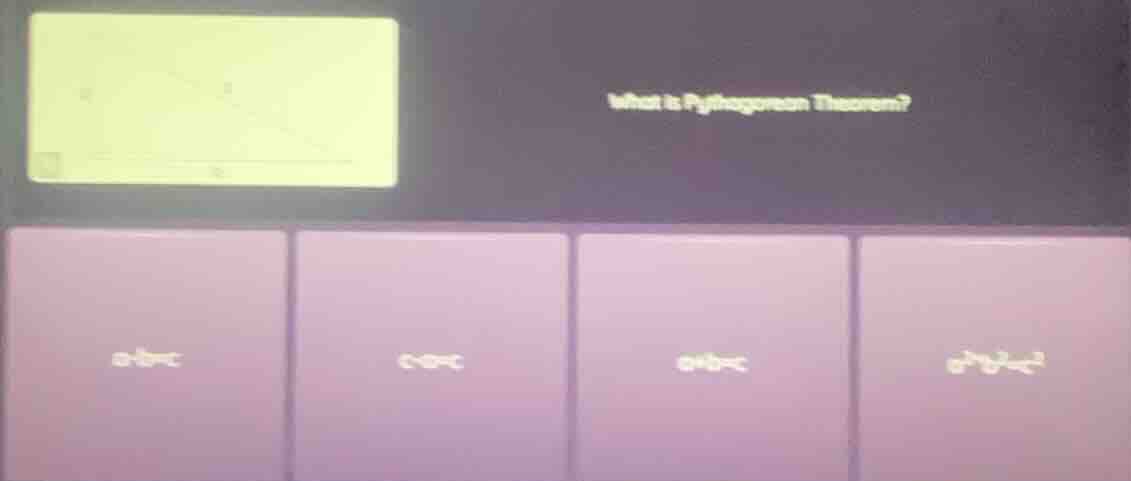
what is pythagorean theorem?
a - b = c
c - a = c
a + b = c
a² + b² = c²
The Pythagorean Theorem states that in a right - triangle, the square of the length of the hypotenuse (the side opposite the right angle, usually denoted as \( c \)) is equal to the sum of the squares of the lengths of the other two sides (usually denoted as \( a \) and \( b \)). Mathematically, this is expressed as \( a^{2}+b^{2}=c^{2} \). The other options do not represent the Pythagorean Theorem. The first option \( a - b = c \) is not a valid relation for a right - triangle, the second \( c - b = c \) is incorrect (it would imply \( b = 0 \) which is not possible for a triangle with non - zero side lengths), and the third \( a + b = c \) also does not hold as the sum of the two shorter sides in a triangle must be greater than the longest side, and in a right - triangle, the hypotenuse is the longest side.

Snap & solve any problem in the app
Get step-by-step solutions on Sovi AI
Photo-based solutions with guided steps
Explore more problems and detailed explanations
The option with \( a^{2}+b^{2}=c^{2} \) (the fourth option)