QUESTION IMAGE
Question
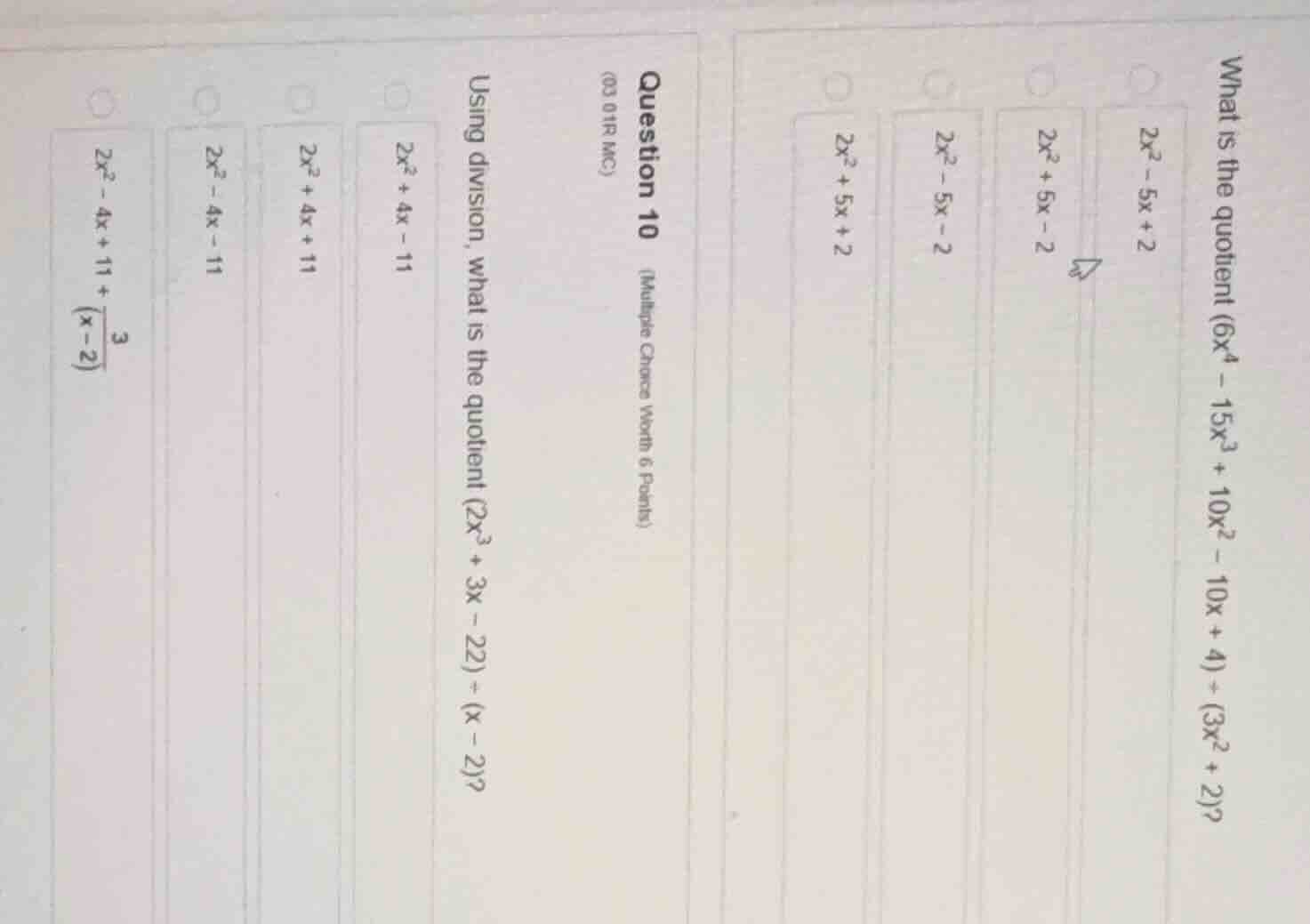
what is the quotient $(6x^4 - 15x^3 + 10x^2 - 10x + 4) \div (3x^2 + 2)$?\
$2x^2 - 5x + 2$\
$2x^2 + 5x - 2$\
$2x^2 - 5x - 2$\
$2x^2 + 5x + 2$\
\
question 10 (multiple choice worth 6 points)\
(03.01r mc)\
using division, what is the quotient $(2x^3 + 3x - 22) \div (x - 2)$?\
$2x^2 + 4x - 11$\
$2x^2 + 4x + 11$\
$2x^2 - 4x - 11$\
$2x^2 - 4x + 11 + \frac{3}{(x - 2)}$
First Question (Quotient of \((6x^4 - 15x^3 + 10x^2 - 10x + 4) \div (3x^2 + 2)\))
Step 1: Divide the leading terms
Divide the leading term of the dividend \(6x^4\) by the leading term of the divisor \(3x^2\). So, \(\frac{6x^4}{3x^2} = 2x^2\).
Step 2: Multiply and subtract
Multiply the divisor \(3x^2 + 2\) by \(2x^2\) to get \(6x^4 + 4x^2\). Subtract this from the dividend:
\[
\]
Step 3: Divide the new leading term
Divide the leading term of the new dividend \(-15x^3\) by the leading term of the divisor \(3x^2\). So, \(\frac{-15x^3}{3x^2} = -5x\).
Step 4: Multiply and subtract again
Multiply the divisor \(3x^2 + 2\) by \(-5x\) to get \(-15x^3 - 10x\). Subtract this from the new dividend:
\[
\]
Step 5: Divide the next leading term
Divide the leading term of the new dividend \(6x^2\) by the leading term of the divisor \(3x^2\). So, \(\frac{6x^2}{3x^2} = 2\).
Step 6: Multiply and subtract the last time
Multiply the divisor \(3x^2 + 2\) by \(2\) to get \(6x^2 + 4\). Subtract this from the new dividend:
\[
\]
Now, combine the results from each division step: \(2x^2 - 5x + 2\).
Second Question (Quotient of \((2x^3 + 3x - 22) \div (x - 2)\))
We can use polynomial long division or synthetic division. Let's use synthetic division with root \(x = 2\).
The coefficients of the dividend \(2x^3 + 0x^2 + 3x - 22\) are \(2, 0, 3, -22\).
Step 1: Bring down the leading coefficient
Bring down \(2\).
Step 2: Multiply and add
Multiply \(2\) by \(2\) to get \(4\). Add to the next coefficient: \(0 + 4 = 4\).
Step 3: Multiply and add again
Multiply \(4\) by \(2\) to get \(8\). Add to the next coefficient: \(3 + 8 = 11\).
Step 4: Multiply and add the last time
Multiply \(11\) by \(2\) to get \(22\). Add to the last coefficient: \(-22 + 22 = 0\).
The result of synthetic division gives us the coefficients of the quotient polynomial: \(2x^2 + 4x + 11\) (since the degree of the quotient is one less than the dividend, and the remainder is \(0\)).
First Question Answer:
A. \(2x^2 - 5x + 2\)
Second Question Answer:
\(2x^2 + 4x + 11\) (corresponding to the option \(2x^2 + 4x + 11\))

Snap & solve any problem in the app
Get step-by-step solutions on Sovi AI
Photo-based solutions with guided steps
Explore more problems and detailed explanations
We can use polynomial long division or synthetic division. Let's use synthetic division with root \(x = 2\).
The coefficients of the dividend \(2x^3 + 0x^2 + 3x - 22\) are \(2, 0, 3, -22\).
Step 1: Bring down the leading coefficient
Bring down \(2\).
Step 2: Multiply and add
Multiply \(2\) by \(2\) to get \(4\). Add to the next coefficient: \(0 + 4 = 4\).
Step 3: Multiply and add again
Multiply \(4\) by \(2\) to get \(8\). Add to the next coefficient: \(3 + 8 = 11\).
Step 4: Multiply and add the last time
Multiply \(11\) by \(2\) to get \(22\). Add to the last coefficient: \(-22 + 22 = 0\).
The result of synthetic division gives us the coefficients of the quotient polynomial: \(2x^2 + 4x + 11\) (since the degree of the quotient is one less than the dividend, and the remainder is \(0\)).
First Question Answer:
A. \(2x^2 - 5x + 2\)
Second Question Answer:
\(2x^2 + 4x + 11\) (corresponding to the option \(2x^2 + 4x + 11\))