QUESTION IMAGE
Question
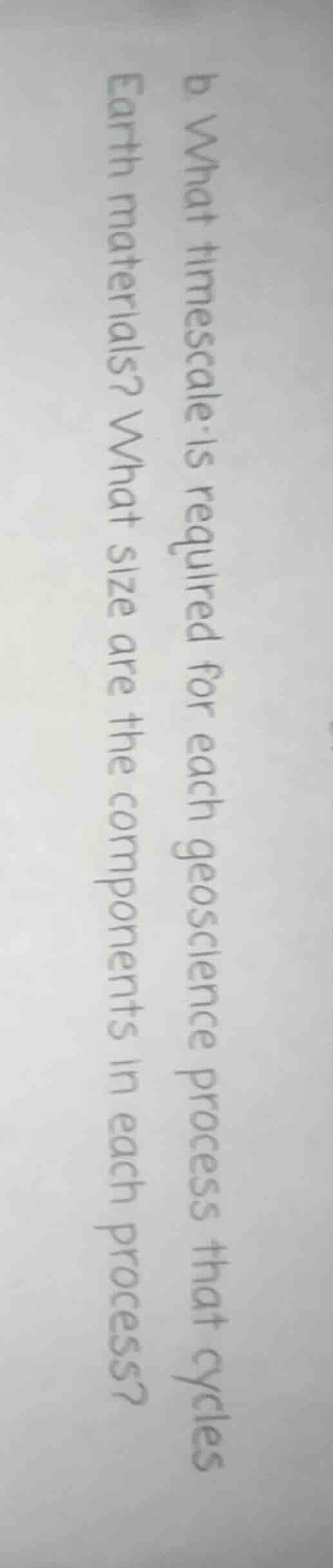
b what timescale is required for each geoscience process that cycles earth materials? what size are the components in each process?
The question is about geoscience processes related to Earth materials and their timescales, which falls under Natural Science, specifically Geography (or a related geoscience subfield). Geoscience processes like the rock cycle, water cycle, or carbon cycle have different timescales (e.g., rock cycle can take millions of years, water cycle days to millennia) and components (e.g., rock cycle has igneous, sedimentary, metamorphic rocks; water cycle has evaporation, condensation, precipitation). The size of components varies—rock particles can be from microscopic (clay) to large boulders, water cycle components like water droplets range from tiny to large raindrops.

Snap & solve any problem in the app
Get step-by-step solutions on Sovi AI
Photo-based solutions with guided steps
Explore more problems and detailed explanations
Geoscience processes (e.g., rock, water, carbon cycles) have varied timescales: rock cycle (millions of years), water cycle (days to millennia), carbon cycle (decades to millions of years). Components: Rock cycle - igneous (magma/lava), sedimentary (sediments, fossils), metamorphic (minerals, rocks); Water cycle - water vapor, liquid water, ice; sizes: Rock particles (clay: <4 μm, sand: 0.0625–2 mm), water droplets (1–1000 μm).