QUESTION IMAGE
Question
what is the value of x?
- 10
- 28
- 32
- 40
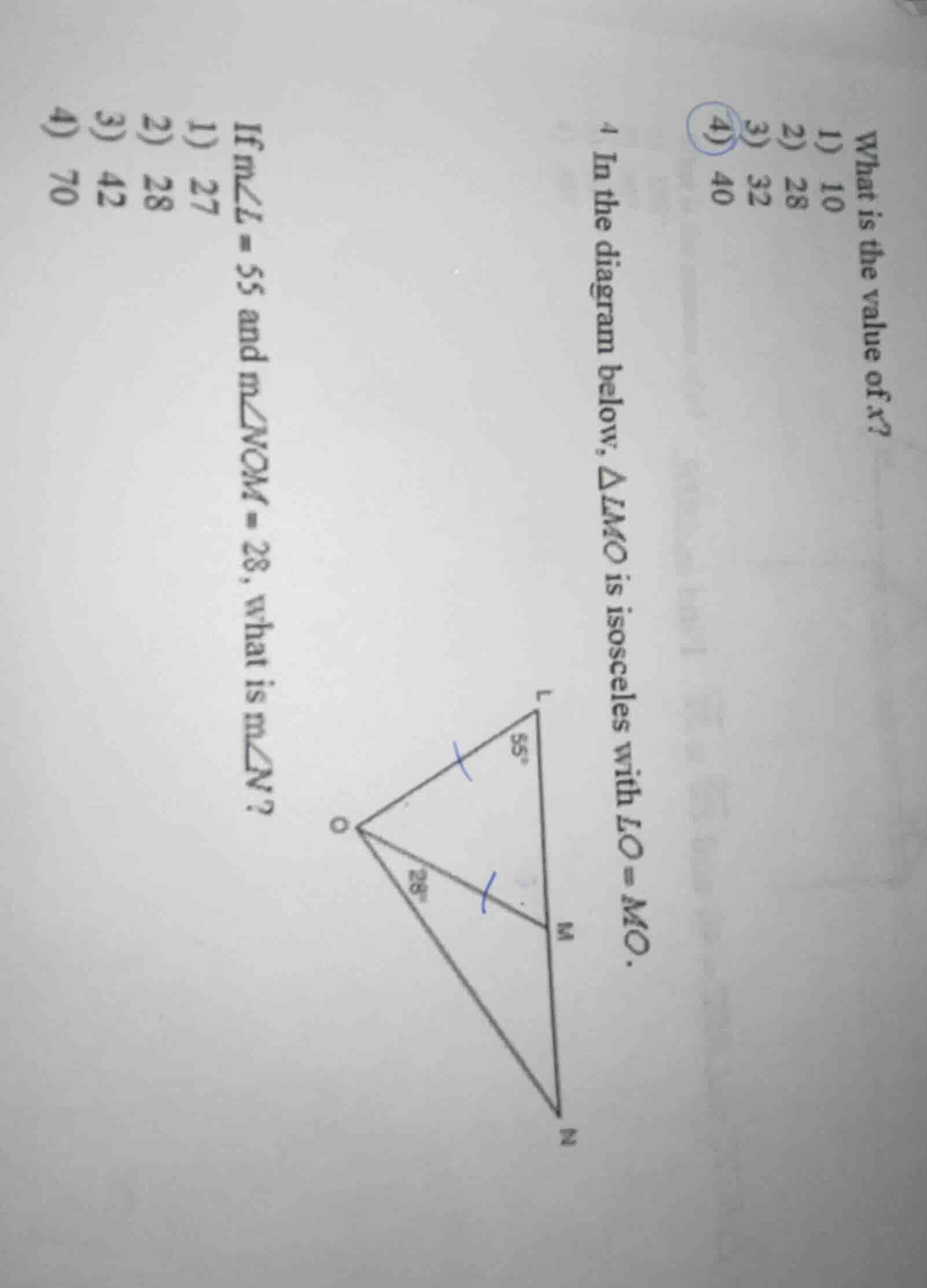
4 in the diagram below, $\triangle lmo$ is isosceles with $lo = mo$.
if $m\angle l = 55$ and $m\angle nom = 28$, what is $m\angle n$?
- 27
- 28
- 42
- 70
Step1: Find ∠LMO in isosceles ΔLMO
Since \( LO = MO \), \( \triangle LMO \) is isosceles with \( \angle L=\angle LMO = 55^\circ \).
Step2: Find ∠OMN (supplementary to ∠LMO)
\( \angle OMN = 180^\circ - 55^\circ=125^\circ \) (linear pair).
Step3: Use triangle angle - sum in ΔOMN
In \( \triangle OMN \), sum of angles is \( 180^\circ \). Given \( \angle MOM = 28^\circ \) (wait, should be \( \angle MON = 28^\circ \)), so \( m\angle N=180^\circ-(125^\circ + 28^\circ)=180 - 153=27^\circ \)? Wait, no, wait the first step: Wait, \( LO = MO \), so \( \angle L=\angle OML = 55^\circ \), then \( \angle OMN = 180 - 55=125^\circ \)? Wait, no, maybe I misread the angle. Wait, the problem says \( m\angle L = 55^\circ \) and \( m\angle MON=28^\circ \), find \( m\angle N \). Wait, in \( \triangle LMO \), \( LO = MO \), so \( \angle L=\angle OML = 55^\circ \), so \( \angle LOM=180 - 55 - 55 = 70^\circ \)? Wait, maybe I made a mistake. Wait, let's re - examine:
Wait, \( \triangle LMO \) is isosceles with \( LO = MO \), so base angles are \( \angle L \) and \( \angle OML \). So \( \angle L=\angle OML = 55^\circ \), then \( \angle LOM=180-(55 + 55)=70^\circ \). Then \( \angle MON = 28^\circ \), so \( \angle LON=\angle LOM+\angle MON=70 + 28 = 98^\circ \)? No, that's not right. Wait, maybe the triangle is \( \triangle LMN \) with \( O \) inside. Wait, the diagram shows \( O \) connected to \( M \) and \( N \), and \( \triangle LMO \) is isosceles with \( LO = MO \), \( \angle L = 55^\circ \), \( \angle MON = 28^\circ \).
Wait, correct approach:
- In \( \triangle LMO \), \( LO = MO \), so \( \angle L=\angle OML = 55^\circ \).
- Then \( \angle LOM=180 - 55 - 55=70^\circ \)? No, wait, if \( LO = MO \), then the equal sides are \( LO \) and \( MO \), so the equal angles are \( \angle L \) and \( \angle OML \). So \( \angle L=\angle OML = 55^\circ \), so \( \angle LOM = 180-(55 + 55)=70^\circ \). But the problem says \( \angle MON = 28^\circ \), so \( \angle LON=\angle LOM+\angle MON = 70 + 28=98^\circ \)? No, that's not helpful. Wait, maybe the angle at \( M \) for \( \triangle OMN \):
Wait, \( \angle OML = 55^\circ \), so \( \angle OMN = 180 - 55=125^\circ \) (since \( L - M - N \) are colinear? If \( M \) is on \( LN \), then \( \angle OML+\angle OMN = 180^\circ \)). Then in \( \triangle OMN \), angles are \( \angle OMN = 125^\circ \), \( \angle MON = 28^\circ \), so \( \angle N=180-(125 + 28)=27^\circ \).

Snap & solve any problem in the app
Get step-by-step solutions on Sovi AI
Photo-based solutions with guided steps
Explore more problems and detailed explanations
- 27