QUESTION IMAGE
Question
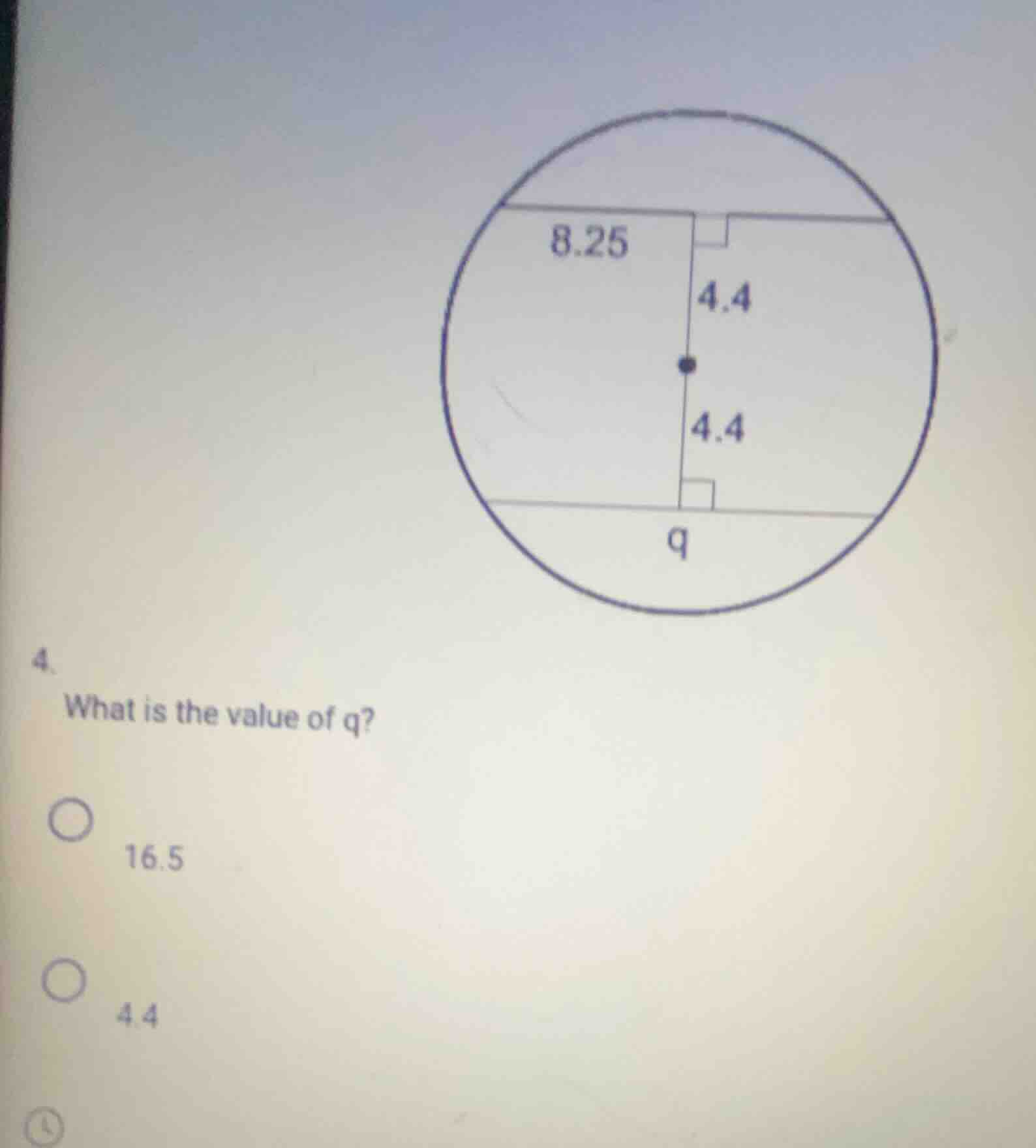
- what is the value of q? 16.5 4.4 (circle diagram with a vertical line through the center, two horizontal chords perpendicular to the vertical line, upper chord segment 8.25, two segments of 4.4 from center to each chord)
Step1: Recall the theorem about chords in a circle
In a circle, if two chords are equidistant from the center, then they are congruent (have the same length). Here, the two chords are both perpendicular to the same diameter (the vertical line through the center), and the distance from the center to each chord is \( 4.4 \), so the chords are equidistant from the center. Therefore, the length of the chord with segment \( 8.25 \) (half of its length) should be equal to half of the length of the chord labeled \( q \). Wait, actually, the perpendicular from the center to a chord bisects the chord. So the length of the upper chord is \( 2\times8.25 = 16.5 \)? Wait, no, wait. Wait, the upper chord: the distance from the center to the upper chord is \( 4.4 \), and the segment from the center to the chord is perpendicular, so the length of the upper chord is \( 2\times8.25 \)? Wait, no, the \( 8.25 \) is half of the upper chord? Wait, no, looking at the diagram, the upper chord has a segment from the center (the vertical line) to the chord, with length \( 8.25 \)? Wait, no, the diagram shows a right angle, so the \( 8.25 \) is half of the upper chord. Wait, no, the vertical line is the diameter, and the two chords are horizontal, each perpendicular to the diameter. The distance from the center to each chord is \( 4.4 \), so the chords are congruent. Therefore, the length of the lower chord (which is \( q \)) should be equal to the length of the upper chord. The upper chord: the segment from the diameter to the chord is \( 8.25 \), and since the perpendicular from the center bisects the chord, the length of the upper chord is \( 2\times8.25 = 16.5 \)? Wait, no, wait, maybe I got it wrong. Wait, the upper chord: the horizontal segment from the vertical diameter to the chord is \( 8.25 \), so the full length of the upper chord is \( 2\times8.25 = 16.5 \). Then, since the two chords are equidistant from the center (both \( 4.4 \) units from the center), they must be congruent. Therefore, the length of the lower chord ( \( q \)) is equal to the length of the upper chord, which is \( 16.5 \). Wait, but let's check again. The perpendicular from the center to a chord bisects the chord. So for the upper chord, the distance from the center to the chord is \( 4.4 \), and the half - length of the upper chord is \( 8.25 \), so the full length of the upper chord is \( 2\times8.25=16.5 \). For the lower chord, since it is also \( 4.4 \) units from the center (same distance as the upper chord), its length should be equal to the length of the upper chord. Therefore, \( q = 16.5 \).
Step2: Verify using the chord - distance theorem
The theorem states that in a circle, chords equidistant from the center are equal in length. The distance from the center to each chord is \( 4.4 \), so the chords are equidistant. The length of the upper chord is \( 2\times8.25 = 16.5 \), so the lower chord ( \( q \)) must also be \( 16.5 \) because they are equidistant from the center and thus congruent.

Snap & solve any problem in the app
Get step-by-step solutions on Sovi AI
Photo-based solutions with guided steps
Explore more problems and detailed explanations
\( 16.5 \) (corresponding to the option with \( 16.5 \))