QUESTION IMAGE
Question
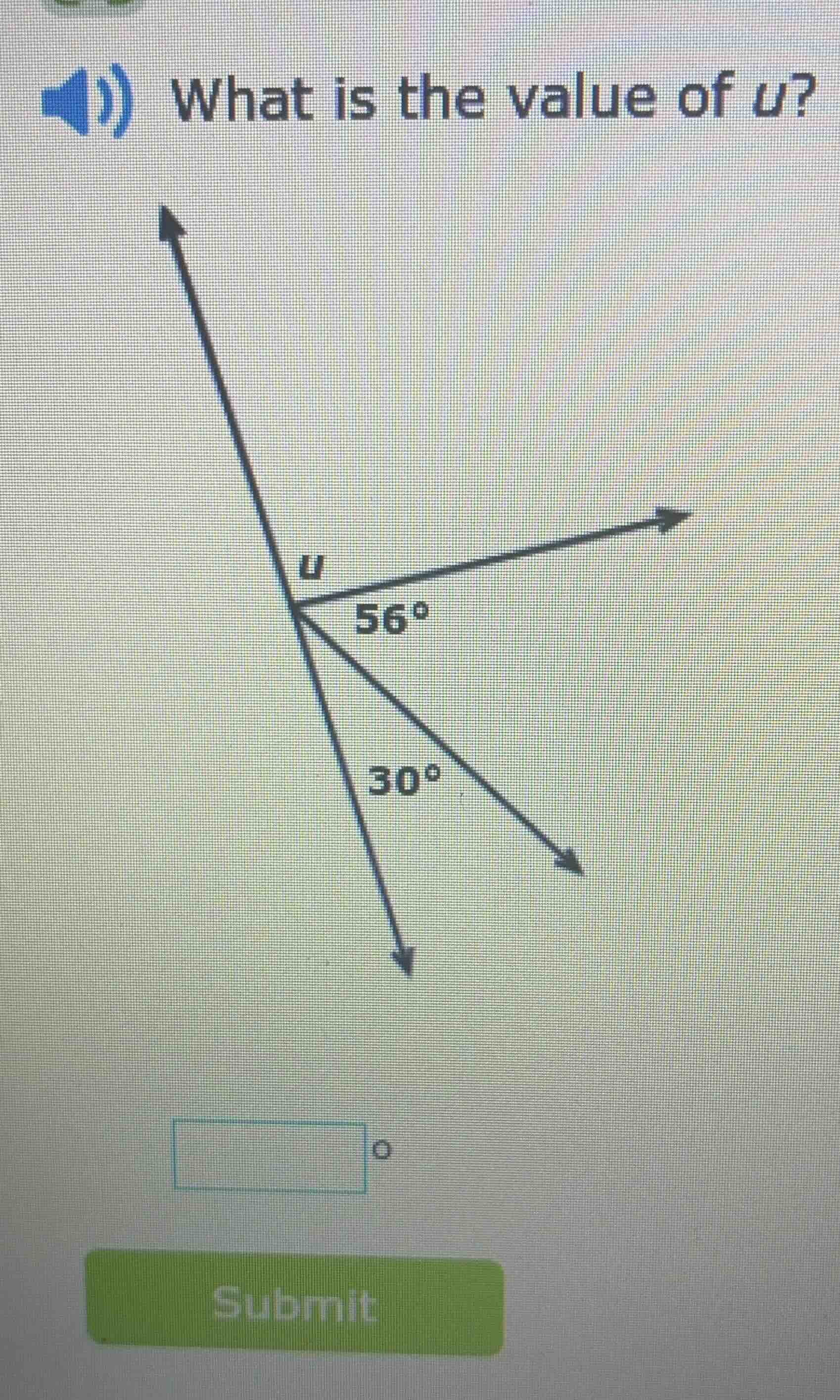
what is the value of u? 56° 30°
Step1: Identify angle sum property
The angles on a straight line sum to \(180^\circ\), but here we have a straight line split into \(u\), \(56^\circ\), and \(30^\circ\). Wait, actually, the sum of angles around a point on a straight line (supplementary angles) should satisfy \(u + 56^\circ+ 30^\circ= 180^\circ\)? Wait, no, looking at the diagram, the three angles (u, 56°, 30°) are on a straight line, so their sum is \(180^\circ\). Wait, no, maybe the vertical angles? Wait, no, the diagram shows that the angle \(u\) is adjacent to \(56^\circ\) and \(30^\circ\) on a straight line. So the sum of \(u\), \(56^\circ\), and \(30^\circ\) should be \(180^\circ\)? Wait, no, maybe I misread. Wait, actually, the straight line means that the sum of angles on one side is \(180^\circ\). So \(u + 56^\circ+ 30^\circ= 180^\circ\)? Wait, no, let's check again. Wait, the angle \(u\) is adjacent to the other two angles, so \(u = 180^\circ - 56^\circ - 30^\circ\)? Wait, no, wait, maybe the angles are supplementary. Wait, no, the correct approach: the sum of angles on a straight line is \(180^\circ\). So if we have three angles: \(u\), \(56^\circ\), and \(30^\circ\) forming a straight line, then \(u + 56^\circ+ 30^\circ= 180^\circ\). Wait, no, that would mean \(u = 180 - 56 - 30\). Wait, let's calculate that.
Step2: Calculate \(u\)
First, sum the known angles: \(56^\circ + 30^\circ = 86^\circ\). Then, since the total is \(180^\circ\) (straight line), \(u = 180^\circ - 86^\circ\).
\(u = 94^\circ\)? Wait, no, wait, maybe I made a mistake. Wait, no, wait, the diagram: the angle \(u\) is adjacent to \(56^\circ\) and \(30^\circ\), so the sum of \(u\), \(56^\circ\), and \(30^\circ\) is \(180^\circ\). So \(u = 180 - 56 - 30\). Let's compute \(56 + 30 = 86\), then \(180 - 86 = 94\). Wait, but that seems off. Wait, no, maybe the angles are vertical? Wait, no, the diagram shows a straight line with three angles: u, 56°, 30°. So the sum is 180°. So \(u = 180 - 56 - 30 = 94\)? Wait, no, wait, maybe I misread the angles. Wait, maybe the angle is \(u + 56 + 30 = 180\), so \(u = 180 - 86 = 94\). Wait, but let's check again.
Wait, no, maybe the correct approach is that the angle \(u\) is supplementary to the sum of \(56^\circ\) and \(30^\circ\). So \(u = 180 - (56 + 30) = 180 - 86 = 94\). So the value of \(u\) is \(94^\circ\).

Snap & solve any problem in the app
Get step-by-step solutions on Sovi AI
Photo-based solutions with guided steps
Explore more problems and detailed explanations
\(94\)