QUESTION IMAGE
Question
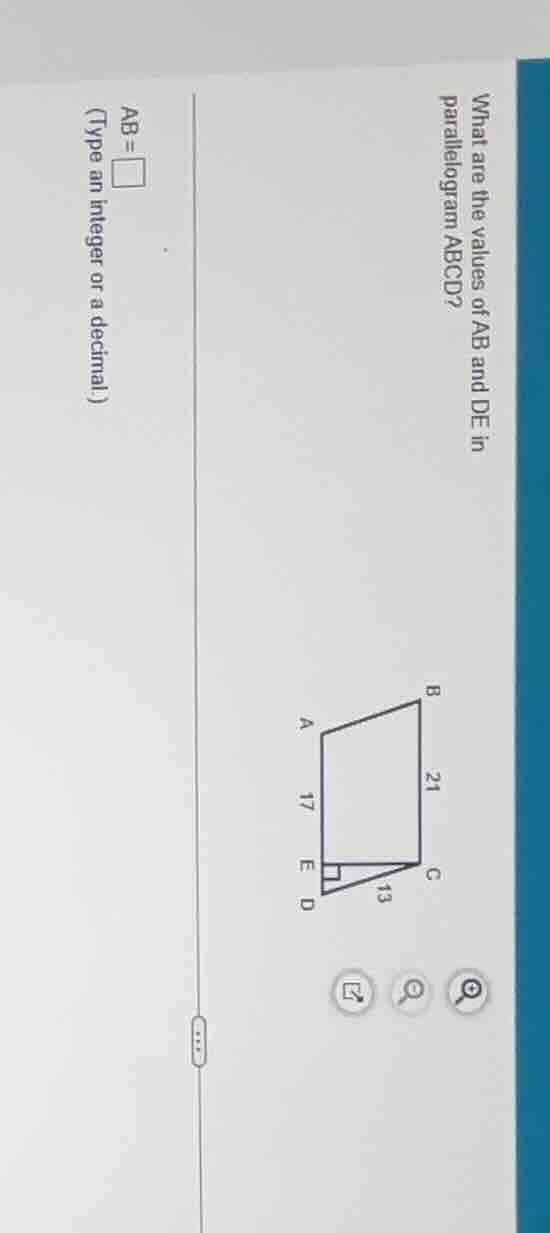
what are the values of ab and de in parallelogram abcd?
ab = \square
(type an integer or a decimal)
Step1: Use parallelogram side property
In parallelogram \(ABCD\), opposite sides are equal: \(AB = CD\).
Step2: Identify right triangle CED
Triangle \(CED\) is right-angled at \(E\), so use Pythagorean theorem: \(CD^2 = CE^2 + DE^2\). First we need \(DE\), but we know \(AD = 21\), \(AE = 17\), so \(DE = AD - AE = 21 - 17 = 4\).
Step3: Calculate CD (which equals AB)
Substitute \(CE = 13\), \(DE = 4\) into Pythagorean theorem:
$$CD = \sqrt{13^2 + 4^2} = \sqrt{169 + 16} = \sqrt{185} \approx 13.60$$
Wait, correction: In parallelogram, \(AD = BC = 21\), \(AB = CD\), and \(AD = AE + ED\), so \(ED = 21 - 17 = 4\). Then right triangle \(CED\) gives \(CD = \sqrt{13^2 + 4^2} = \sqrt{185} \approx 13.6\). But wait, no—actually, \(AB\) is equal to \(CD\), which is the hypotenuse here.
Wait, corrected step:
Step1: Find length of DE
\(DE = AD - AE = 21 - 17 = 4\)
Step2: Calculate CD via Pythagoras
\(CD = \sqrt{CE^2 + DE^2} = \sqrt{13^2 + 4^2}\)
Step3: AB equals CD
Since \(AB = CD\) in parallelogram.
Step1: Compute DE length
\(DE = AD - AE = 21 - 17 = 4\)
Step2: Calculate CD with Pythagoras
$$CD = \sqrt{CE^2 + DE^2} = \sqrt{13^2 + 4^2}$$
Step3: AB equals CD (parallelogram rule)
\(AB = CD\)

Snap & solve any problem in the app
Get step-by-step solutions on Sovi AI
Photo-based solutions with guided steps
Explore more problems and detailed explanations
\(AB = \sqrt{185} \approx 13.6\)
(Note: If exact value is needed, \(\sqrt{185}\); decimal approximation is ~13.6)
Wait, correction: I mixed up the sides. In parallelogram \(ABCD\), \(AB \parallel CD\), \(AD \parallel BC\), so \(AD = BC = 21\), \(AB = CD\). \(AE\) is part of \(AD\), so \(ED = AD - AE = 21 - 17 = 4\). Then right triangle \(CED\) has legs \(CE=13\), \(ED=4\), so hypotenuse \(CD = \sqrt{13^2 + 4^2} = \sqrt{169 + 16} = \sqrt{185} \approx 13.60\). Since \(AB=CD\), that is the value.
Final corrected steps: