QUESTION IMAGE
Question
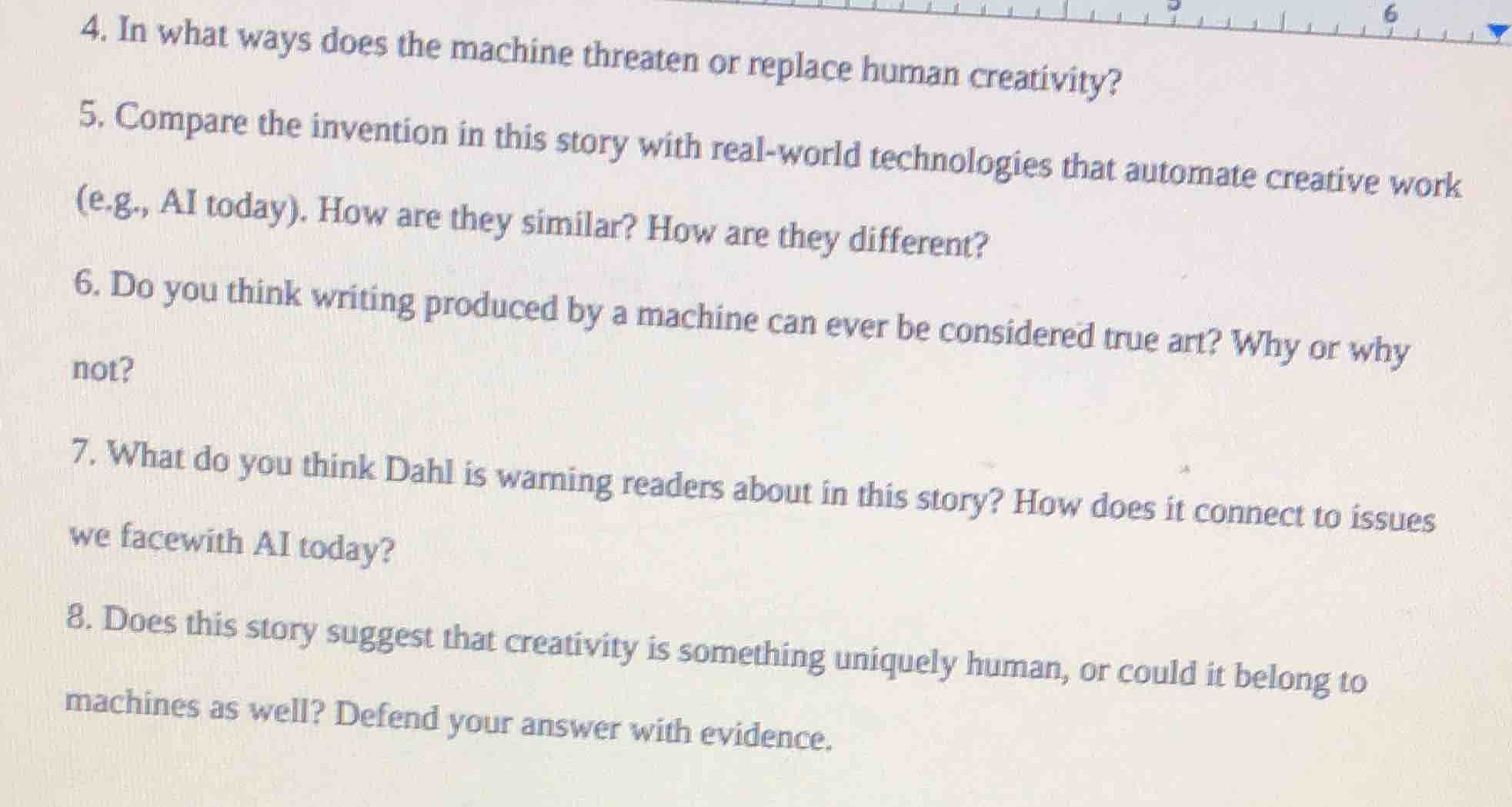
- in what ways does the machine threaten or replace human creativity?
- compare the invention in this story with real - world technologies that automate creative work (e.g., ai today). how are they similar? how are they different?
- do you think writing produced by a machine can ever be considered true art? why or why not?
- what do you think dahl is warning readers about in this story? how does it connect to issues we face with ai today?
- does this story suggest that creativity is something uniquely human, or could it belong to machines as well? defend your answer with evidence.
These are a set of questions related to analyzing a story (likely a work by Dahl) and its connections to technology, creativity, and AI. Since you haven't specified which question you want to address, here's a sample response for question 6:
To determine if machine - written work is true art, we consider the definition of art. Art is often seen as an expression of human emotion, experience, and creativity, emerging from human consciousness, intent, and the unique perspective of an individual. Machines, like AI, generate writing based on algorithms and data they've been trained on. They lack true consciousness, emotions, and personal experiences. For example, a human poet writes from their own joys, sorrows, and unique view of the world, while an AI - generated poem is a combination of patterns it has learned from existing poems. However, some might argue that if the output evokes an artistic response (like emotion or thought) in the viewer/reader, it could be considered art. But fundamentally, without the human element of creation (the internal, subjective, experiential drive), it's not true art in the traditional sense.

Snap & solve any problem in the app
Get step-by-step solutions on Sovi AI
Photo-based solutions with guided steps
Explore more problems and detailed explanations
Machine - written work cannot be considered true art. Art is rooted in human consciousness, emotion, and personal experience. Machines generate content based on algorithms and learned patterns, lacking the subjective, experiential drive that underlies human artistic creation. While machine - generated writing may evoke an artistic response, it does not originate from the human - centric creative process that defines true art.