QUESTION IMAGE
Question
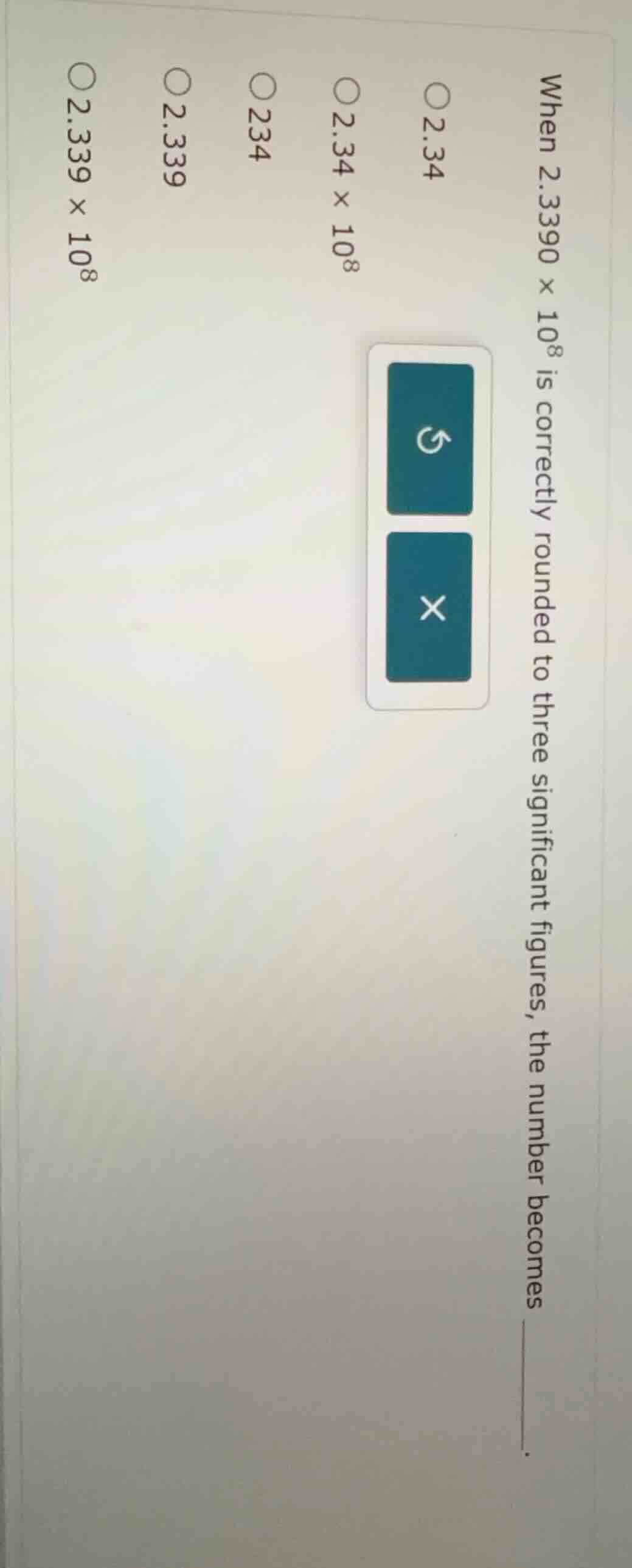
when 2.3390 × 10⁸ is correctly rounded to three significant figures, the number becomes ______.
○ 2.34
○ 2.34 × 10⁸
○ 234
○ 2.339
○ 2.339 × 10⁸
Step1: Identify significant figures
The number is \(2.3390\times10^{8}\). We need to round to three significant figures. The first three significant figures are 2, 3, 3 (the fourth is 9).
Step2: Round the number
Since the fourth significant figure (9) is greater than or equal to 5, we round up the third significant figure. So \(2.3390\) rounded to three significant figures is \(2.34\). Then we keep the \(10^{8}\) part, so the number becomes \(2.34\times10^{8}\)? Wait, no, wait. Wait, the original number is \(2.3390\times10^{8}\). Let's re - examine. The first significant figure is 2, second 3, third 3, fourth 9. When rounding to three significant figures, we look at the digit after the third (the fourth digit). Since 9 ≥ 5, we add 1 to the third digit. So 3 (third digit) + 1 = 4. So \(2.3390\) rounded to three significant figures is \(2.34\)? Wait, no, \(2.3390\) has five significant figures. Rounding to three: the first three are 2, 3, 3. The next digit is 9, so we round the third digit up. So 3 becomes 4, and the digits after are dropped. So \(2.3390\approx2.34\) when rounded to three significant figures? Wait, no, \(2.3390\) is \(2.3390\times10^{8}\). Let's write it as 233900000 (since \(10^{8}=100000000\), so \(2.3390\times10^{8}=2.3390\times100000000 = 233900000\)). Now, rounding 233900000 to three significant figures. The first three significant figures are 2, 3, 3 (from 233900000). The next digit is 9, so we round up the third significant figure. So 3 (the third) becomes 4, and the rest of the digits are replaced with zeros. So 234000000, which is \(2.34\times10^{8}\)? Wait, but wait, the original number is \(2.3390\times10^{8}\). Let's do it in scientific notation. \(2.3390\times10^{8}\). To three significant figures: look at the fourth digit after the decimal in the coefficient (since in scientific notation, the coefficient is \(a\times10^{n}\) where \(1\leq a<10\)). The coefficient is 2.3390. We need three significant figures, so we look at the fourth digit (9) to round the third (3). Since 9 ≥ 5, we add 1 to the third significant figure. So 2.3390 rounded to three significant figures is 2.34 (because 2.3390: first three sig figs 2,3,3; fourth is 9, so round up the third 3 to 4, getting 2.34). Then we keep the \(10^{8}\), so the number is \(2.34\times10^{8}\)? Wait, but one of the options is \(2.339\times10^{8}\), no. Wait, maybe I made a mistake. Wait, the original number is \(2.3390\times10^{8}\). Let's count the significant figures in the coefficient: 2,3,3,9,0. So five significant figures. We need three. So we take the first three: 2,3,3. The next digit is 9, which is more than 5, so we round the third digit up. So 3 becomes 4, and the digits after are dropped. So the coefficient becomes 2.34, and the exponent remains \(10^{8}\). So the number is \(2.34\times10^{8}\)? But wait, another option is \(2.339\times10^{8}\), but that's four significant figures. Wait, no, let's check again. Wait, \(2.3390\times10^{8}\): the coefficient is 2.3390. Rounding to three significant figures: the first three are 2,3,3. The next digit is 9, so we round the third 3 up to 4, so 2.34. So the number is \(2.34\times10^{8}\)? But wait, the option \(2.34\times10^{8}\) is there, and also \(2.34\) (without the \(10^{8}\)) which is wrong because the original number has a factor of \(10^{8}\). Wait, the original number is \(2.3390\times10^{8}\), so when we round the coefficient to three significant figures, we get 2.34, so the number is \(2.34\times10^{8}\). But wait, let's check the value. \(2.3390\times10^{8}=233900000\). Rounding to three…

Snap & solve any problem in the app
Get step-by-step solutions on Sovi AI
Photo-based solutions with guided steps
Explore more problems and detailed explanations
\(2.34\times10^{8}\) (the option corresponding to this is the one labeled "2.34 × 10⁸")