QUESTION IMAGE
Question
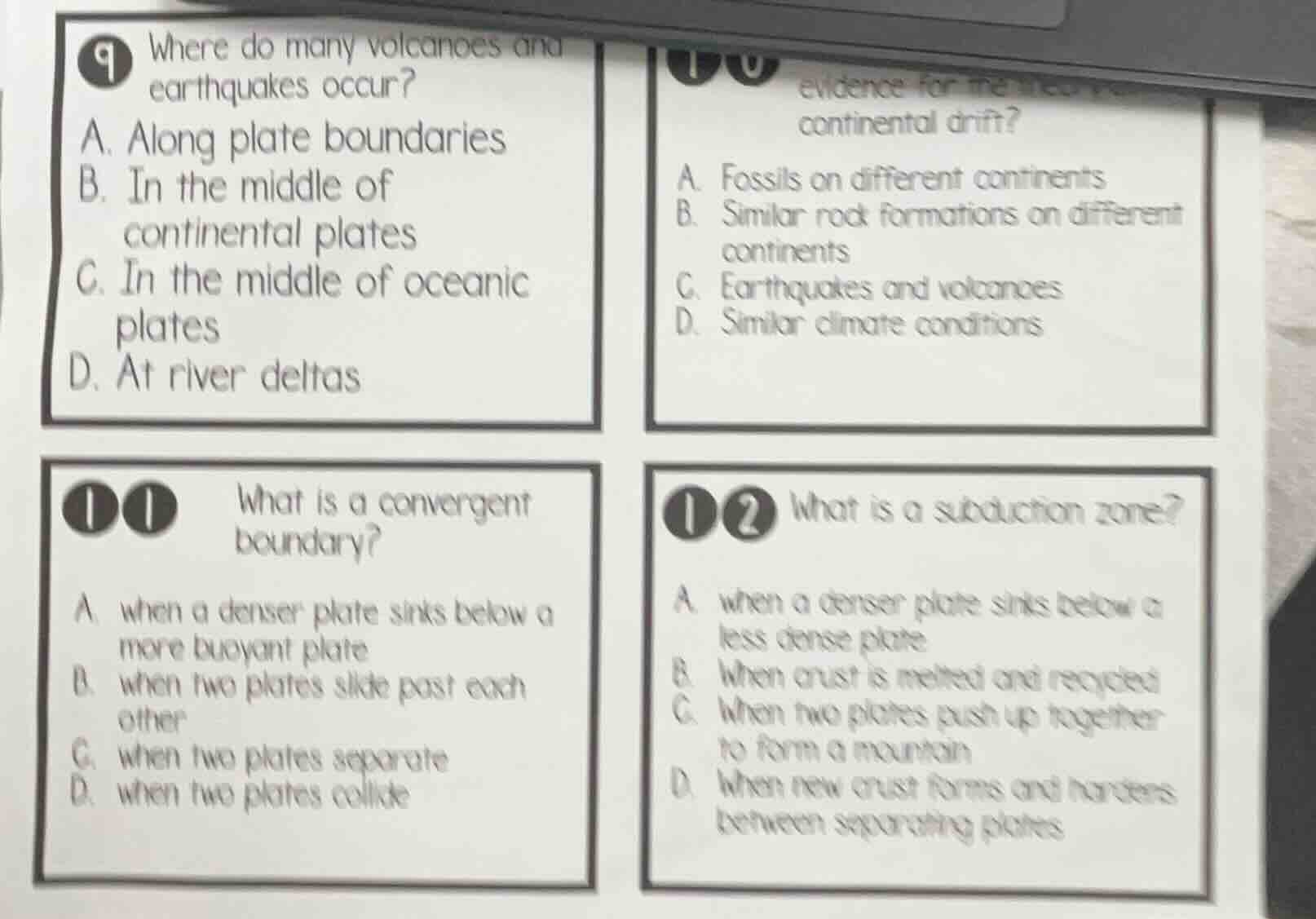
9 where do many volcanoes and earthquakes occur? a. along plate boundaries b. in the middle of continental plates c. in the middle of oceanic plates d. at river deltas 10 evidence for continental drift? a. fossils on different continents b. similar rock formations on different continents c. earthquakes and volcanoes d. similar climate conditions 11 what is a convergent boundary? a. when a denser plate sinks below a more buoyant plate b. when two plates slide past each other c. when two plates separate d. when two plates collide 12 what is a subduction zone? a. when a denser plate sinks below a less dense plate b. when crust is melted and recycled c. when two plates push up together to form a mountain d. when new crust forms and hardens between separating plates
Question 9
Volcanoes and earthquakes are mostly associated with plate boundaries because this is where tectonic plates interact (collide, move apart, or slide past), causing geological activity. Options B, C, and D are incorrect as the middle of plates (continental or oceanic) and river deltas have less tectonic activity.
Fossils on different continents (A), similar rock formations (B), and earthquakes/volcanoes (C) support continental drift. Similar climate conditions (D) do not directly support continental drift as climate can be influenced by other factors. But among the options, if we consider, for example, fossils (A) and rock formations (B) are strong evidence, but if we take the options, let's analyze: Fossils of the same species on different continents suggest they were once connected. Similar rock formations too. But if the question is about evidence, let's check the options. Wait, maybe the question is "Which is NOT evidence?" But the original question is "evidence for continental drift?". Let's re - check: Fossils (A) – same fossils on different continents (e.g., Mesosaurus) support drift. Similar rock formations (B) – same rock layers on different continents. Earthquakes and volcanoes (C) – occur at plate boundaries which is related to continental drift. Similar climate conditions (D) – climate can change over time and is not a direct evidence of continents moving. So if the question is which is evidence, A, B, C are evidence, D is not. But if the question is which is NOT evidence, then D. But the original question is "evidence for continental drift?". Let's assume the question is asking for evidence, and maybe there was a typo. But based on standard knowledge, fossils (A), rock formations (B), and tectonic activity (C) are evidence. Similar climate (D) is not. So if the question is which is evidence, A, B, C are correct, but if we have to choose one, maybe A or B. But let's proceed.
A convergent boundary is where two tectonic plates collide. Option A describes subduction (a type of convergent boundary but not the definition of convergent boundary in general), B is a transform boundary, C is a divergent boundary. So D (when two plates collide) is the correct definition of a convergent boundary.

Snap & solve any problem in the app
Get step-by-step solutions on Sovi AI
Photo-based solutions with guided steps
Explore more problems and detailed explanations
A. Along plate boundaries