QUESTION IMAGE
Question
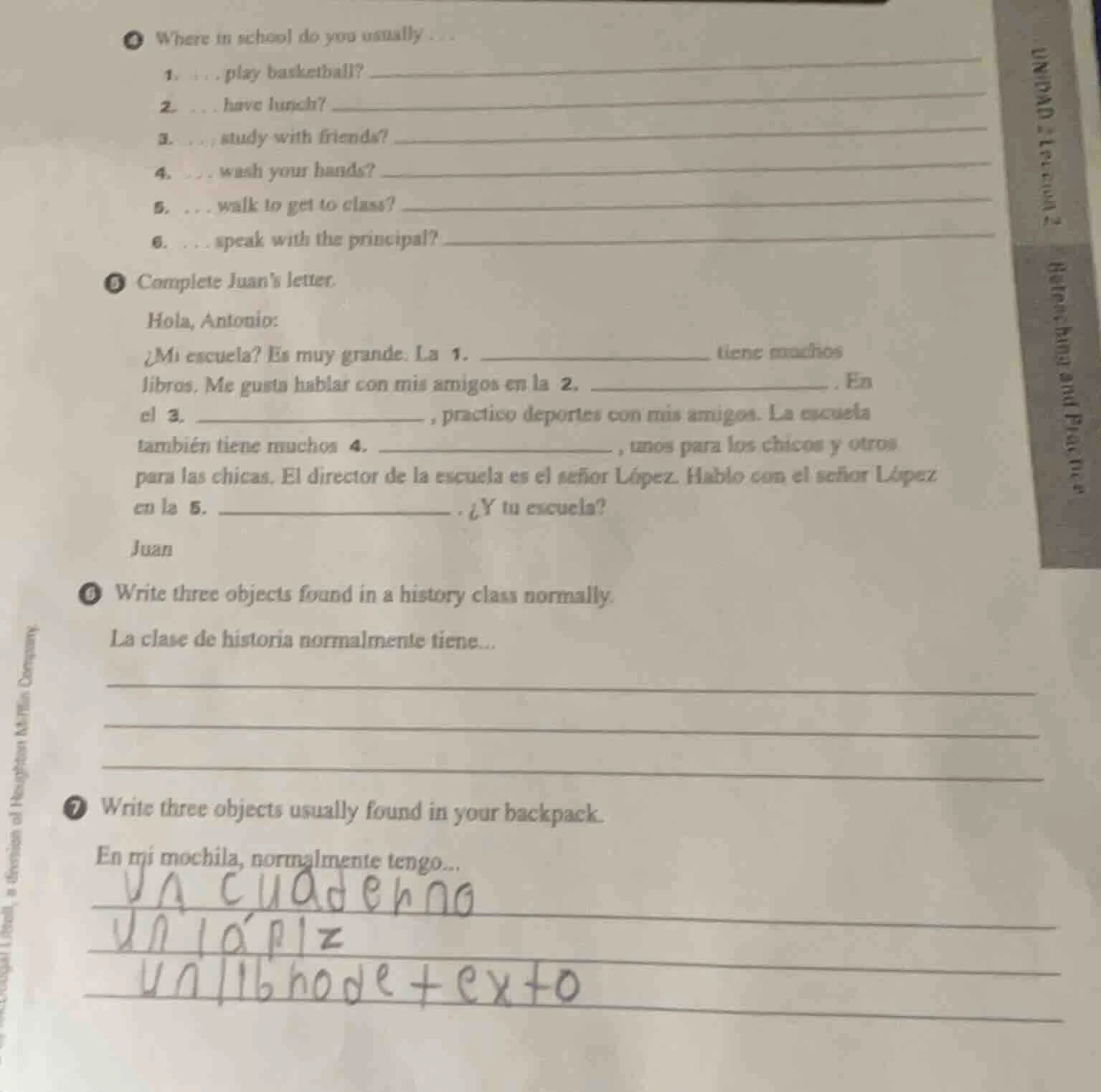
4 where in school do you usually...
- ...play basketball? ______
- ...have lunch? ______
- ...study with friends? ______
- ...wash your hands? ______
- ...walk to get to class? ______
- ...speak with the principal? ______
5 complete juan’s letter.
hola, antonio:
¿mi escuela? es muy grande. la 1. ________ tiene muchos libros. me gusta hablar con mis amigos en la 2. ______. en el 3. ______, practico deportes con mis amigos. la escuela también tiene muchos 4. ______, unos para los chicos y otros para las chicas. el director de la escuela es el señor lópez. hablo con el señor lópez en la 5. ________. ¿y tu escuela?
juan
6 write three objects found in a history class normally.
la clase de historia normalmente tiene...
______
______
______
7 write three objects usually found in your backpack.
en mi mochila, normalmente tengo...
un cuaderno
un lápiz
un libro de texto
Question 4 (Answering where in school for each activity)
- For "…play basketball?"
In a school, the place to play basketball is typically the basketball court (la cancha de baloncesto in Spanish, but in English context, "basketball court" is the answer).
- For "…have lunch?"
Students usually have lunch in the cafeteria (or "dining hall", "lunchroom").
- For "…study with friends?"
A common place to study with friends is the library or a study room (or "classroom" if during study time).
- For "…wash your hands?"
The place to wash hands is the bathroom (or "restroom", "washroom").
- For "…walk to get to class?"
Students walk in the hallway (or "corridor") to get to class.
- For "…speak with the principal?"
To speak with the principal, you go to the principal’s office (or "office").
Question 5 (Completing Juan’s letter in Spanish)
To complete the letter, we use common school-related Spanish nouns:
- "La __ tiene muchos libros" → biblioteca (library, as it has many books).
- "Me gusta hablar con mis amigos en la __" → patio (courtyard) or sala de estudio (study room), but "patio" (courtyard) is common for socializing. Alternatively, pasillo (hallway) but "patio" is better.
- "En el __, practico deportes" → campo de deportes (sports field) or cancha de deportes (sports court). "Cancha de baloncesto" is specific, but "campo de deportes" is general.
- "La escuela también tiene muchos __, unos para los chicos y otros para las chicas" → baños (bathrooms) or lockers (casilleros). "Baños" fits (separate for boys/girls).
- "Hablo con el señor López en la __" → oficina del director (principal’s office) or oficina (office).
Question 6 (Three objects in a history class)
A history class typically has:
- Textbooks (to study historical content).
- Notebooks (to take notes).
- Maps (to study geography/historical locations).
Question 7 (Three objects in your backpack)
In a backpack, you usually have:
- Pencils/Pens (for writing).
- Notebook (for notes).
- Calculator (for math, or "textbook" for classes).
Final Answers (Key Parts)
- Q4: 1. Basketball court 2. Cafeteria 3. Library 4. Bathroom 5. Hallway 6. Principal’s office
- Q5: 1. biblioteca 2. patio 3. campo de deportes 4. baños 5. oficina del director
- Q6: Textbooks, Notebooks, Maps
- Q7: Pencils, Notebook, Calculator

Snap & solve any problem in the app
Get step-by-step solutions on Sovi AI
Photo-based solutions with guided steps
Explore more problems and detailed explanations
Question 4 (Answering where in school for each activity)
- For "…play basketball?"
In a school, the place to play basketball is typically the basketball court (la cancha de baloncesto in Spanish, but in English context, "basketball court" is the answer).
- For "…have lunch?"
Students usually have lunch in the cafeteria (or "dining hall", "lunchroom").
- For "…study with friends?"
A common place to study with friends is the library or a study room (or "classroom" if during study time).
- For "…wash your hands?"
The place to wash hands is the bathroom (or "restroom", "washroom").
- For "…walk to get to class?"
Students walk in the hallway (or "corridor") to get to class.
- For "…speak with the principal?"
To speak with the principal, you go to the principal’s office (or "office").
Question 5 (Completing Juan’s letter in Spanish)
To complete the letter, we use common school-related Spanish nouns:
- "La __ tiene muchos libros" → biblioteca (library, as it has many books).
- "Me gusta hablar con mis amigos en la __" → patio (courtyard) or sala de estudio (study room), but "patio" (courtyard) is common for socializing. Alternatively, pasillo (hallway) but "patio" is better.
- "En el __, practico deportes" → campo de deportes (sports field) or cancha de deportes (sports court). "Cancha de baloncesto" is specific, but "campo de deportes" is general.
- "La escuela también tiene muchos __, unos para los chicos y otros para las chicas" → baños (bathrooms) or lockers (casilleros). "Baños" fits (separate for boys/girls).
- "Hablo con el señor López en la __" → oficina del director (principal’s office) or oficina (office).
Question 6 (Three objects in a history class)
A history class typically has:
- Textbooks (to study historical content).
- Notebooks (to take notes).
- Maps (to study geography/historical locations).
Question 7 (Three objects in your backpack)
In a backpack, you usually have:
- Pencils/Pens (for writing).
- Notebook (for notes).
- Calculator (for math, or "textbook" for classes).
Final Answers (Key Parts)
- Q4: 1. Basketball court 2. Cafeteria 3. Library 4. Bathroom 5. Hallway 6. Principal’s office
- Q5: 1. biblioteca 2. patio 3. campo de deportes 4. baños 5. oficina del director
- Q6: Textbooks, Notebooks, Maps
- Q7: Pencils, Notebook, Calculator