QUESTION IMAGE
Question
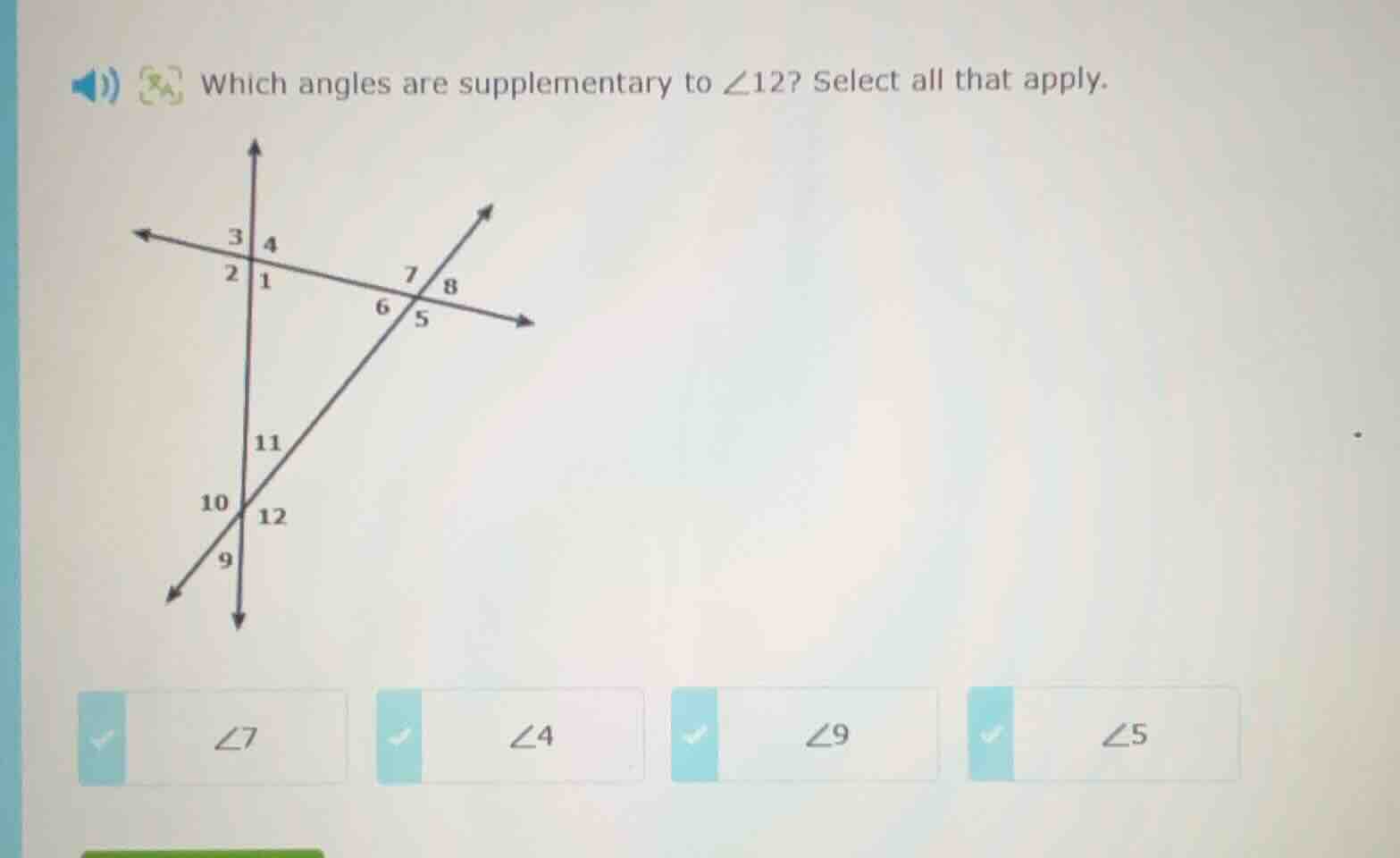
which angles are supplementary to $\angle 12$? select all that apply.
Step1: Recall Supplementary Angles
Supplementary angles are two angles whose sum is \(180^\circ\) (a straight angle). We need to find angles that form a linear pair with \(\angle12\) or are congruent to angles that are supplementary to \(\angle12\) (using vertical angles, corresponding angles, etc.).
Step2: Analyze \(\angle12\) and Vertical Angles
First, \(\angle12\) and \(\angle10\) are vertical angles, but we focus on supplementary. \(\angle12\) and \(\angle11\) form a linear pair? Wait, no, let's look at the transversals. Wait, maybe better to see which angles are equal to \(\angle12\) or form a straight line.
Wait, \(\angle12\) and \(\angle1\) are vertical? No, wait the diagram: the vertical line and the slanted line intersect at a point, creating \(\angle10\), \(\angle11\), \(\angle12\), and another angle? Wait, maybe \(\angle12\) and \(\angle4\): if the vertical line and the horizontal line are perpendicular? No, wait, let's check the angles.
Wait, \(\angle12\) and \(\angle4\): if the horizontal line (with \(\angle3\), \(\angle4\), \(\angle1\), \(\angle2\)) and the vertical line intersect, then \(\angle1 + \angle4 = 180^\circ\) (linear pair). But \(\angle12\) and \(\angle1\) are vertical angles? Wait, no, maybe \(\angle12\) is equal to \(\angle1\) (vertical angles). Then \(\angle1 + \angle4 = 180^\circ\), so \(\angle12 + \angle4 = 180^\circ\), so \(\angle4\) is supplementary.
Then \(\angle12\) and \(\angle9\): \(\angle12\) and \(\angle9\) are vertical angles? No, \(\angle12\) and \(\angle9\) form a linear pair? Wait, the slanted line and the vertical line: \(\angle9\), \(\angle10\), \(\angle11\), \(\angle12\) – so \(\angle12 + \angle9 = 180^\circ\) (linear pair), so \(\angle9\) is supplementary.
Then \(\angle12\) and \(\angle7\): \(\angle12\) is equal to \(\angle1\) (vertical), and \(\angle1\) and \(\angle7\) – wait, \(\angle1\) and \(\angle7\) are corresponding angles? If the two lines (vertical and slanted) are cut by the horizontal transversal, then \(\angle1\) and \(\angle7\) are same - side? No, maybe \(\angle12\) is equal to \(\angle1\), and \(\angle1 + \angle7 = 180^\circ\) (linear pair on the horizontal transversal and slanted line). Wait, \(\angle6\), \(\angle7\), \(\angle8\), \(\angle5\): \(\angle6 + \angle7 = 180^\circ\), and \(\angle1 = \angle6\) (corresponding angles), so \(\angle1 + \angle7 = 180^\circ\), so \(\angle12 + \angle7 = 180^\circ\), so \(\angle7\) is supplementary.
Then \(\angle12\) and \(\angle5\): \(\angle5\) is equal to \(\angle7\) (vertical angles), so \(\angle5 = \angle7\), and since \(\angle12 + \angle7 = 180^\circ\), then \(\angle12 + \angle5 = 180^\circ\), so \(\angle5\) is supplementary.
So the angles supplementary to \(\angle12\) are \(\angle4\), \(\angle9\), \(\angle7\), \(\angle5\).

Snap & solve any problem in the app
Get step-by-step solutions on Sovi AI
Photo-based solutions with guided steps
Explore more problems and detailed explanations
\(\angle4\), \(\angle9\), \(\angle7\), \(\angle5\)