QUESTION IMAGE
Question
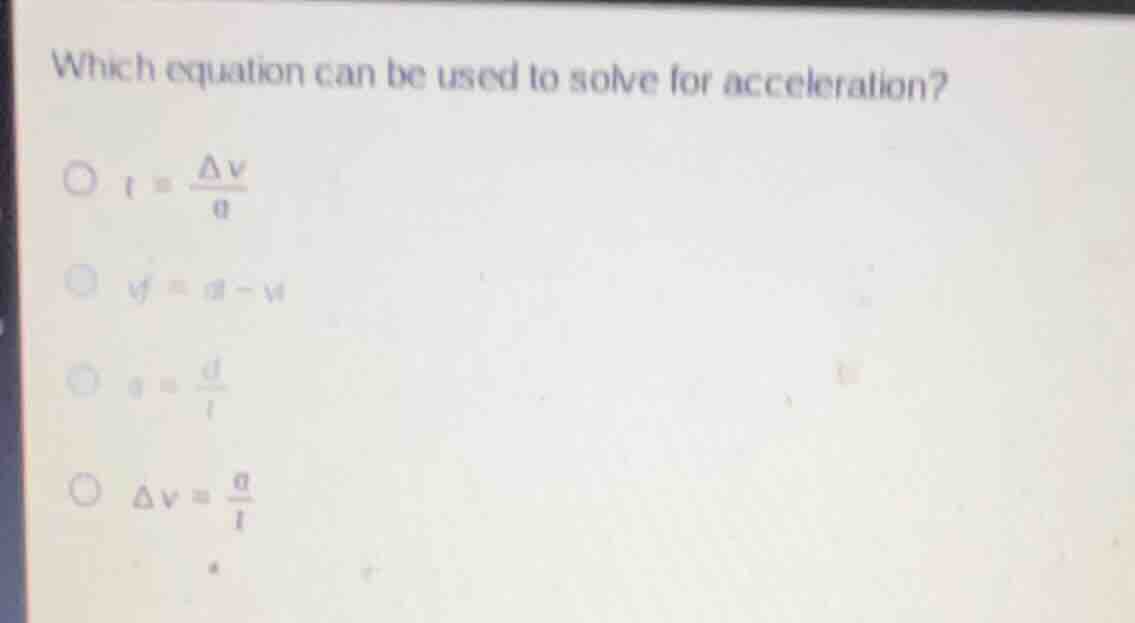
which equation can be used to solve for acceleration?
\\( t = \frac{\delta v}{a} \\)
\\( v_f = a - v_i \\)
\\( a = \frac{d}{t} \\)
\\( \delta v = \frac{a}{t} \\)
Step1: Recall the definition of acceleration
Acceleration \( a \) is defined as the change in velocity \( \Delta v \) over time \( t \), so the formula is \( a=\frac{\Delta v}{t} \), which can be rearranged. Let's analyze each option:
Step2: Analyze Option 1 (\( t = \frac{\Delta v}{a} \))
Starting from the acceleration formula \( a=\frac{\Delta v}{t} \), we can rearrange it by cross - multiplying. Multiply both sides by \( t \): \( a\times t=\Delta v \), then divide both sides by \( a \): \( t = \frac{\Delta v}{a} \). This equation can be used to solve for time, but if we rearrange it again (multiply both sides by \( a \) and divide by \( t \)), we can also see the relationship for acceleration. Wait, no, let's check the other options.
Step3: Analyze Option 2 (\( v_f=a - v_i \))
The correct formula for final velocity in terms of initial velocity, acceleration and time is \( v_f=v_i + a\times t \), and the change in velocity \( \Delta v=v_f - v_i=a\times t \). The equation \( v_f=a - v_i \) is incorrect and does not relate to the correct acceleration formula.
Step4: Analyze Option 3 (\( a=\frac{d}{t} \))
The formula \( a = \frac{d}{t} \) is incorrect. The formula \( v=\frac{d}{t} \) is for velocity (distance over time), not acceleration.
Step5: Analyze Option 4 (\( \Delta v=\frac{a}{t} \))
From the correct acceleration formula \( a=\frac{\Delta v}{t} \), we can cross - multiply to get \( \Delta v=a\times t \), not \( \Delta v=\frac{a}{t} \). So this is incorrect.
Wait, maybe I made a mistake. Wait, the first option is \( t=\frac{\Delta v}{a} \), which is derived from \( a = \frac{\Delta v}{t} \). If we have \( t=\frac{\Delta v}{a} \), we can solve for \( a \) by rearranging: \( a=\frac{\Delta v}{t} \). So this equation can be used to solve for acceleration (by rearranging it). Let's re - check:
Starting with \( t=\frac{\Delta v}{a} \), multiply both sides by \( a \): \( a\times t=\Delta v \), then divide both sides by \( t \): \( a=\frac{\Delta v}{t} \), which is the correct formula for acceleration. So the equation \( t=\frac{\Delta v}{a} \) can be used to solve for acceleration (by algebraic rearrangement).

Snap & solve any problem in the app
Get step-by-step solutions on Sovi AI
Photo-based solutions with guided steps
Explore more problems and detailed explanations
The equation that can be used to solve for acceleration (after rearrangement) is \( \boldsymbol{t=\frac{\Delta v}{a}} \) (the first option).