QUESTION IMAGE
Question
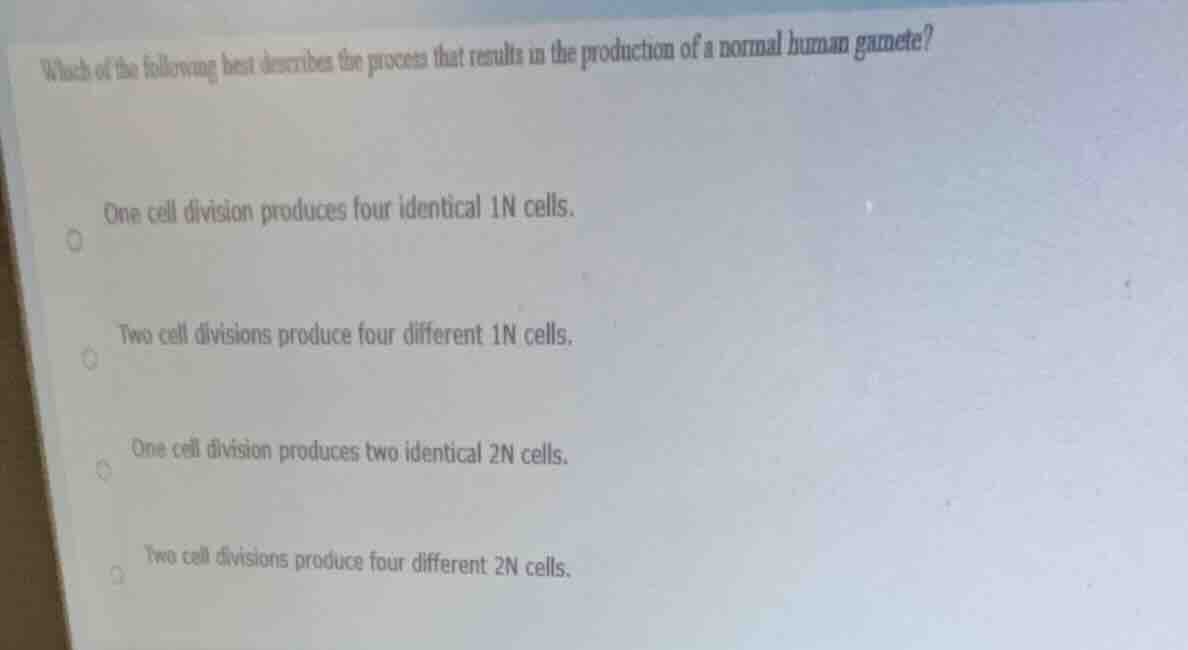
which of the following best describes the process that results in the production of a normal human gamete? one cell division produces four identical 1n cells. two cell divisions produce four different 1n cells. one cell division produces two identical 2n cells. two cell divisions produce four different 2n cells.
Brief Explanations
To determine the correct option, we analyze the process of gamete production (meiosis) in humans:
- Gametes (sperm/egg) are produced via meiosis. Meiosis involves two cell divisions (meiosis I and meiosis II).
- Normal human cells are diploid (2N, with 46 chromosomes). Gametes are haploid (1N, with 23 chromosomes) because they must fuse during fertilization to form a diploid zygote.
- In meiosis, crossing over (exchange of genetic material between homologous chromosomes) and independent assortment (random distribution of homologous chromosomes) during meiosis I result in four genetically distinct haploid (1N) cells at the end of meiosis II.
- Analyzing the options:
- "One cell division produces four identical 1N cells": Meiosis has two divisions, and gametes are not identical (due to crossing over/independent assortment). Eliminate.
- "Two cell divisions produce four different 1N cells": Matches meiosis: two divisions, four haploid (1N) cells, and genetic variation (different) from crossing over/independent assortment.
- "One cell division produces two identical 2N cells": This describes mitosis (cell division for growth/repair), not gamete production. Gametes are 1N, not 2N. Eliminate.
- "Two cell divisions produce four different 2N cells": Gametes are haploid (1N), not diploid (2N). Eliminate.

Snap & solve any problem in the app
Get step-by-step solutions on Sovi AI
Photo-based solutions with guided steps
Explore more problems and detailed explanations
B. Two cell divisions produce four different 1N cells.