QUESTION IMAGE
Question
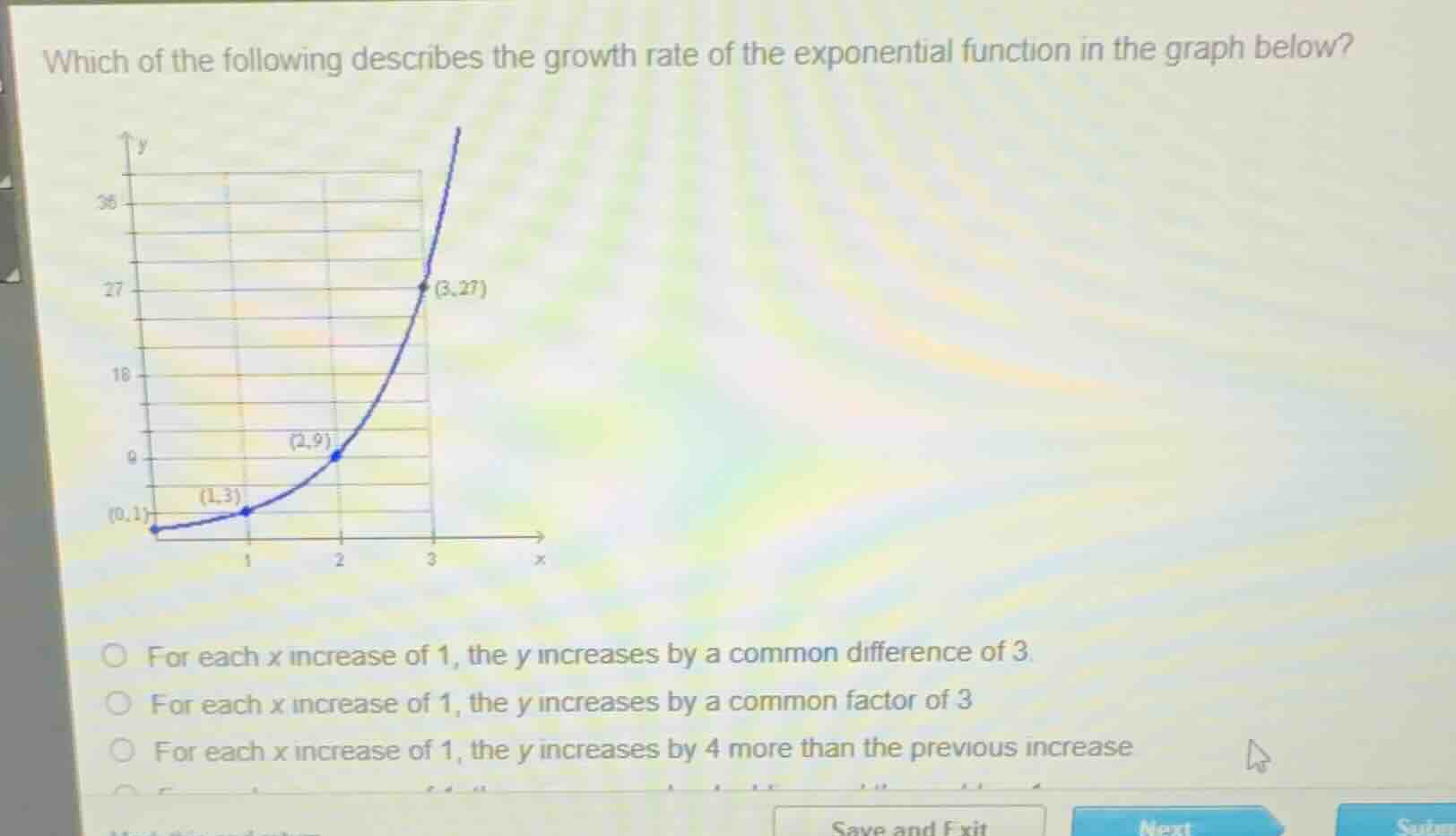
which of the following describes the growth rate of the exponential function in the graph below? the graph has points (0,1), (1,3), (2,9), (3,27). options: for each x increase of 1, the y increases by a common difference of 3; for each x increase of 1, the y increases by a common factor of 3; for each x increase of 1, the y increases by 4 more than the previous increase.
Step1: Analyze the points
We have the points \((0,1)\), \((1,3)\), \((2,9)\), \((3,27)\) on the exponential function.
Step2: Check the ratio between consecutive y - values
- From \(x = 0\) to \(x = 1\): \(\frac{y_1}{y_0}=\frac{3}{1}=3\)
- From \(x = 1\) to \(x = 2\): \(\frac{y_2}{y_1}=\frac{9}{3}=3\)
- From \(x = 2\) to \(x = 3\): \(\frac{y_3}{y_2}=\frac{27}{9}=3\)
This shows that for each increase of \(x\) by 1, \(y\) is multiplied by a common factor of 3 (which is the growth factor for exponential growth).
Now let's analyze the other options:
- Option 1: A common difference of 3 would be for linear functions (e.g., \(y = y_0+3x\)). But \(3 - 1=2\), \(9 - 3 = 6\), \(27 - 9=18\) which are not equal, so it's not a common difference.
- Option 3: The increase from \(x = 0\) to \(x = 1\) is \(3 - 1 = 2\), from \(x = 1\) to \(x = 2\) is \(9 - 3=6\), from \(x = 2\) to \(x = 3\) is \(27 - 9 = 18\). The differences are \(2,6,18\) which are not increasing by 4 more each time ( \(6-2 = 4\), \(18 - 6=12
eq4\) ), so this is incorrect.

Snap & solve any problem in the app
Get step-by-step solutions on Sovi AI
Photo-based solutions with guided steps
Explore more problems and detailed explanations
For each \(x\) increase of 1, the \(y\) increases by a common factor of 3 (the second option)