QUESTION IMAGE
Question
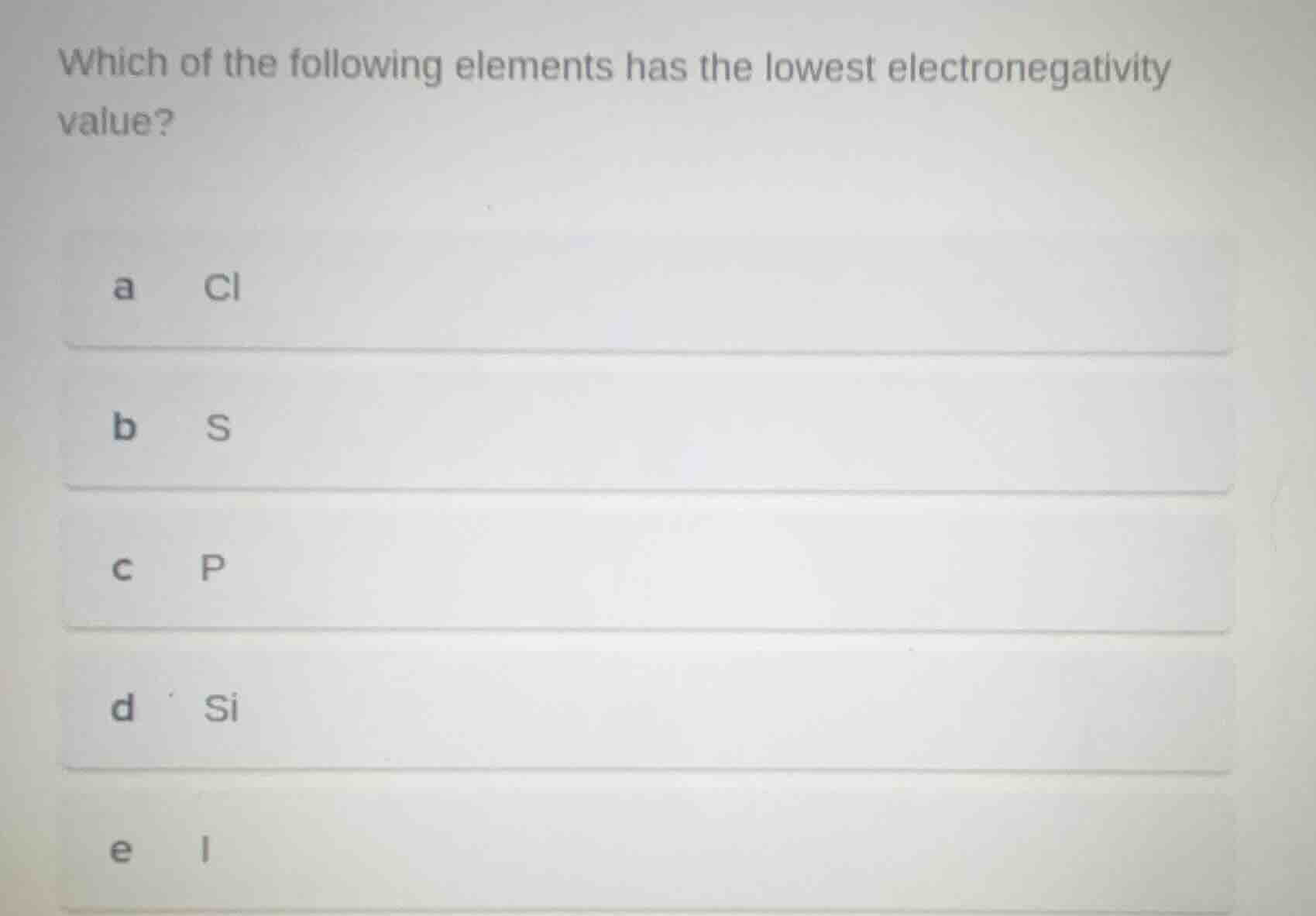
which of the following elements has the lowest electronegativity value?
a cl
b s
c p
d si
e i
To determine which element has the lowest electronegativity, we use the trend of electronegativity in the periodic table. Electronegativity generally increases from left to right across a period and decreases from top to bottom within a group.
Step 1: Identify the period and group of each element
- Cl (Chlorine): Period 3, Group 17 (Halogens)
- S (Sulfur): Period 3, Group 16 (Chalcogens)
- P (Phosphorus): Period 3, Group 15 (Pnictogens)
- Si (Silicon): Period 3, Group 14 (Carbon Group)
- I (Iodine): Period 5, Group 17 (Halogens)
Step 2: Analyze the trend across Period 3
In Period 3 (elements from left to right: Na, Mg, Al, Si, P, S, Cl), electronegativity increases as we move from left to right. So, the order of electronegativity for Period 3 elements (Si, P, S, Cl) is:
$\text{Si} < \text{P} < \text{S} < \text{Cl}$
Step 3: Compare Iodine (I) with Chlorine (Cl)
Iodine is in Group 17, same as Chlorine, but in Period 5 (below Period 3). Since electronegativity decreases down a group, $\text{I} < \text{Cl}$
Step 4: Compare Si with I
Now, we compare Si (Period 3, Group 14) and I (Period 5, Group 17). Let's recall the electronegativity values (approximate Pauling scale):
- Si: ~1.8
- I: ~2.5
So, $\text{Si} < \text{I}$
Combining all, the order from lowest to highest electronegativity among the options is:
$\text{Si} < \text{P} < \text{S} < \text{Cl}$ and $\text{Si} < \text{I}$
Thus, Si has the lowest electronegativity among the given elements.

Snap & solve any problem in the app
Get step-by-step solutions on Sovi AI
Photo-based solutions with guided steps
Explore more problems and detailed explanations
d. Si