QUESTION IMAGE
Question
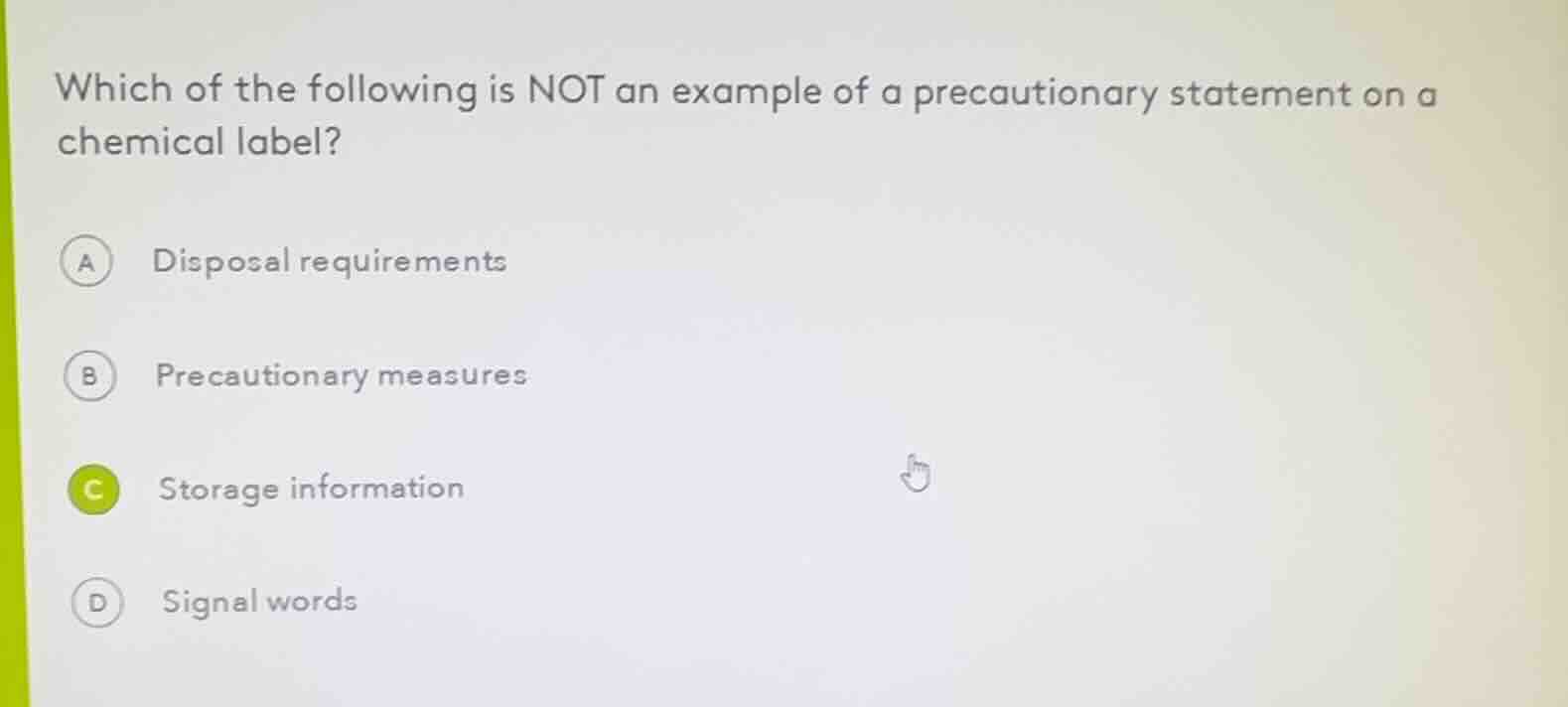
which of the following is not an example of a precautionary statement on a chemical label?
a disposal requirements
b precautionary measures
c storage information
d signal words
Precautionary statements on chemical labels include disposal requirements (A), precautionary measures (B), and storage information (C) as they relate to safety precautions. Signal words (like "Warning", "Danger") are for indicating hazard severity, not a precautionary statement in the same context. Wait, no—wait, the question is which is NOT a precautionary statement. Wait, actually, disposal requirements, precautionary measures, and storage info are part of precautionary statements? No, wait: Precautionary statements on a chemical label (per GHS) include precautionary measures (what to do to prevent harm), storage information (how to store safely), disposal requirements (how to dispose safely). Signal words (e.g., Danger, Warning) are separate from precautionary statements—they indicate the level of hazard. Wait, but the options: Let's re-express. Precautionary statements typically cover prevention (precautionary measures), response (like disposal), storage. Signal words are not precautionary statements—they are hazard communication elements. Wait, but the original question: which is NOT a precautionary statement. Wait, maybe I got it wrong. Wait, the options: A. Disposal requirements – part of precautionary (how to dispose safely). B. Precautionary measures – directly precautionary. C. Storage information – how to store safely (precautionary). D. Signal words – these are words like Danger, Warning that indicate the hazard level, not a precautionary statement. Wait, but the green circle is on C? No, maybe the user's initial marking is wrong. Wait, no—let's check GHS (Globally Harmonized System) labels. Precautionary statements are phrases that describe recommended measures to minimize or prevent adverse effects from exposure to a hazardous product or improper storage, handling, or disposal. Signal words (D) are "Danger" or "Warning" to indicate the severity of the hazard, not a precautionary statement. So the answer should be D. Wait, but the user's image has C marked, but maybe that's a mistake. Wait, let's re-express:
Precautionary statements include:
- Prevention (e.g., precautionary measures: wear gloves, etc.)
- Response (e.g., disposal requirements: how to dispose)
- Storage (e.g., storage information: keep cool, dry)
Signal words (D) are separate; they are not precautionary statements. So the correct answer is D. But maybe the user's question is different. Wait, the question is "Which of the following is NOT an example of a precautionary statement on a chemical label?"
So:
A. Disposal requirements – part of precautionary (how to dispose safely, a precaution)
B. Precautionary measures – directly a precautionary statement
C. Storage information – how to store (a precaution)
D. Signal words – these are hazard indicators (like Danger, Warning), not a precautionary statement. So D is NOT a precautionary statement.
But the user's image shows C marked, but that's incorrect. Wait, maybe I misremember. Wait, no—let's check GHS: Precautionary statements are divided into four types: Prevention, Response, Storage, and Disposal. So disposal (A), precautionary measures (B), storage (C) are all precautionary statements. Signal words (D) are not—they are part of the hazard statement or the label's hazard communication. So the answer is D.

Snap & solve any problem in the app
Get step-by-step solutions on Sovi AI
Photo-based solutions with guided steps
Explore more problems and detailed explanations
D. Signal words