QUESTION IMAGE
Question
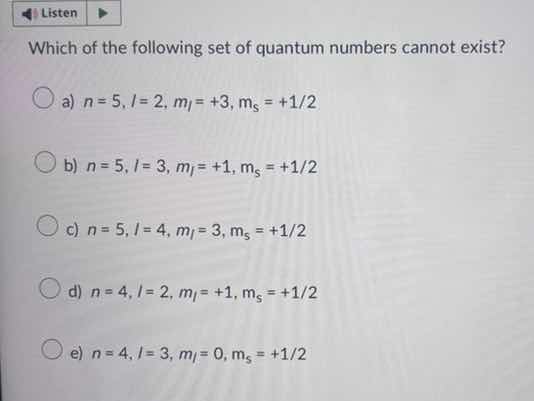
which of the following set of quantum numbers cannot exist? a) $n = 5, l = 2, m_l = +3, m_s = +1/2$ b) $n = 5, l = 3, m_l = +1, m_s = +1/2$ c) $n = 5, l = 4, m_l = 3, m_s = +1/2$ d) $n = 4, l = 2, m_l = +1, m_s = +1/2$ e) $n = 4, l = 3, m_l = 0, m_s = +1/2$
Step1: Recall $m_l$ range rule
For a given $l$, $m_l$ must satisfy $-l \leq m_l \leq +l$.
Step2: Check option a
$l=2$, so $m_l$ ranges $-2$ to $+2$. $m_l=+3$ is outside this range.
Step3: Verify other options (optional)
- Option b: $l=3$, $m_l=+1$ is within $-3$ to $+3$, valid.
- Option c: $l=4$, $m_l=3$ is within $-4$ to $+4$, valid.
- Option d: $l=2$, $m_l=+1$ is within $-2$ to $+2$, valid.
- Option e: $l=3$, $m_l=0$ is within $-3$ to $+3$, valid.

Snap & solve any problem in the app
Get step-by-step solutions on Sovi AI
Photo-based solutions with guided steps
Explore more problems and detailed explanations
a) $n = 5, l= 2, m_l= +3, m_s= +1/2$