QUESTION IMAGE
Question
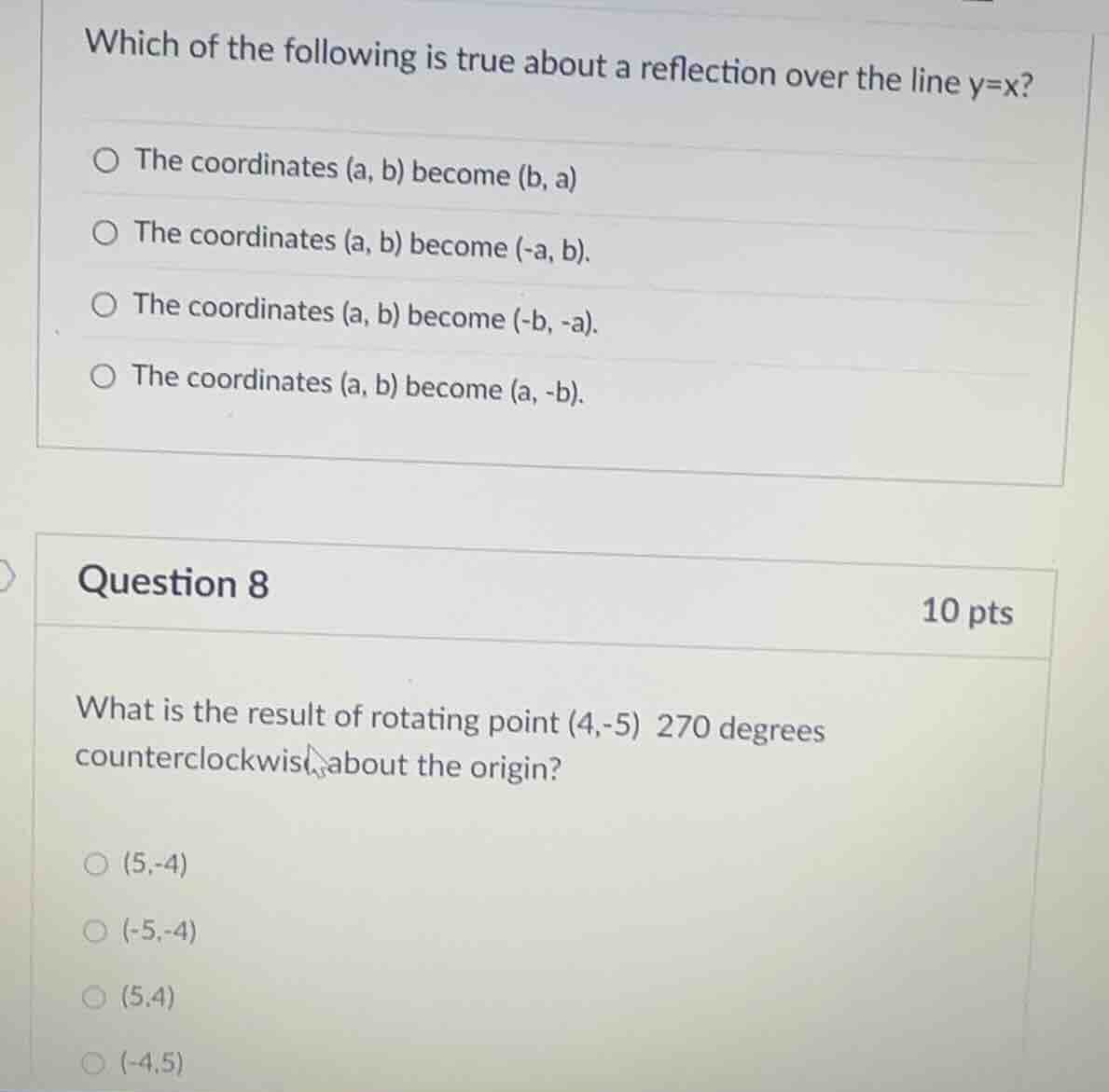
which of the following is true about a reflection over the line $y=x$?○ the coordinates (a, b) become (b, a)○ the coordinates (a, b) become (-a, b).○ the coordinates (a, b) become (-b, -a).○ the coordinates (a, b) become (a, -b).question 810 ptswhat is the result of rotating point (4,-5) 270 degrees counterclockwise about the origin?○ (5,-4)○ (-5,-4)○ (5,4)○ (-4,5)
Step1: Identify reflection rule for $y=x$
A reflection over the line $y=x$ swaps the $x$- and $y$-coordinates of a point. For a point $(a, b)$, this gives $(b, a)$.
Step2: Identify 270° counterclockwise rotation rule
A 270° counterclockwise rotation about the origin transforms a point $(x, y)$ to $(y, -x)$.
Step3: Apply rotation to $(4,-5)$
Substitute $x=4$, $y=-5$ into the rotation rule: $(y, -x) = (-5, -4)$.

Snap & solve any problem in the app
Get step-by-step solutions on Sovi AI
Photo-based solutions with guided steps
Explore more problems and detailed explanations
- The coordinates (a, b) become (b, a)
- (-5,-4)