QUESTION IMAGE
Question
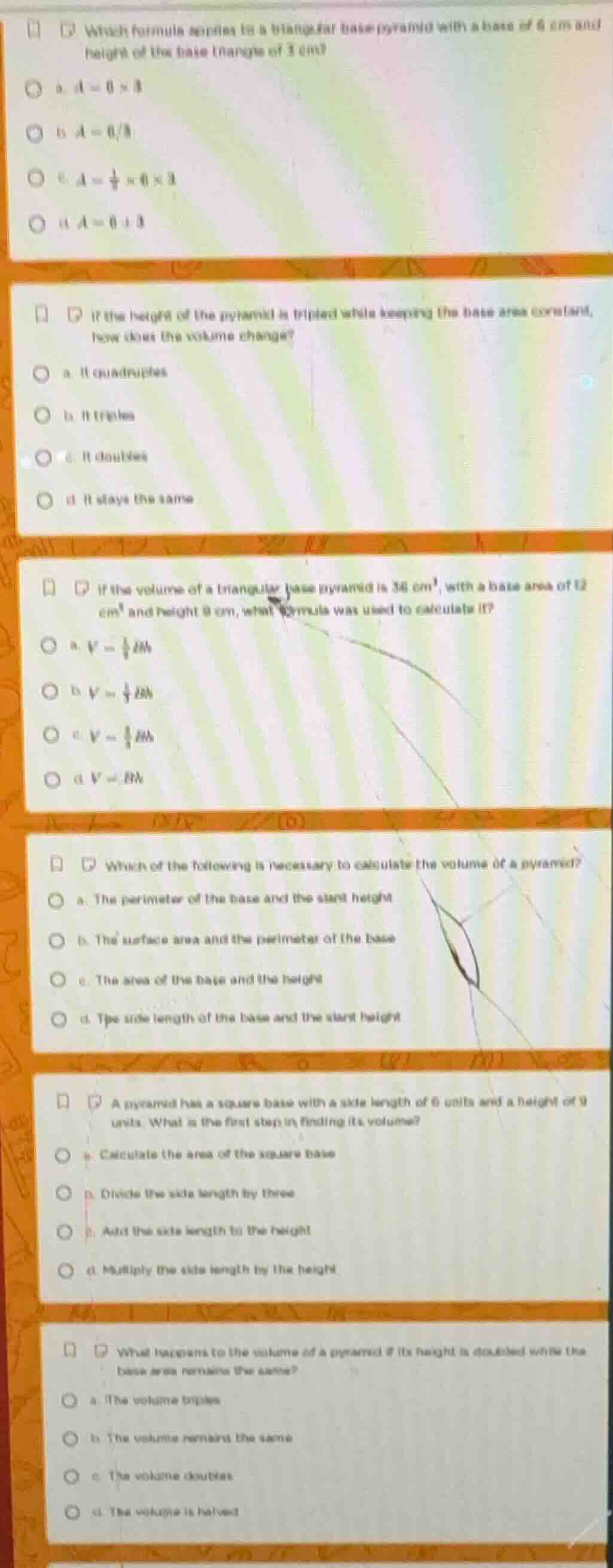
- which formula applies to a triangular base pyramid with a base of 6 cm and height of the base triangle of 3 cm?
a. ( a = 6 \times 3 )
b. ( a = 6/3 )
c. ( a = \frac{1}{2} \times 6 \times 3 )
d. ( a = 6 + 3 )
- if the height of the pyramid is tripled while keeping the base area constant, how does the volume change?
a. it quadruples
b. it triples
c. it doubles
d. it stays the same
- if the volume of a triangular base pyramid is ( 36 , \text{cm}^3 ), with a base area of ( 12 , \text{cm}^2 ) and height ( 9 , \text{cm} ), what formula was used to calculate it?
a. ( v = \frac{1}{2} bh )
b. ( v = \frac{1}{3} bh )
c. ( v = \frac{1}{4} bh )
d. ( v = bh )
- which of the following is necessary to calculate the volume of a pyramid?
a. the perimeter of the base and the slant height
b. the surface area and the perimeter of the base
c. the area of the base and the height
d. the side length of the base and the slant height
- a pyramid has a square base with a side length of 6 units and a height of 9 units. what is the first step in finding its volume?
a. calculate the area of the square base
b. divide the side length by three
c. add the side length to the height
d. multiply the side length by the height
- what happens to the volume of a pyramid if its height is doubled while the base area remains the same?
a. the volume triples
b. the volume remains the same
c. the volume doubles
d. the volume is halved
Step1: Identify base area formula
The question asks for the formula to find the area of the triangular base (base length 6 cm, height 3 cm). The area of a triangle is $\frac{1}{2} \times \text{base length} \times \text{height}$.
Step2: Match to given options
Substitute the values: $\frac{1}{2} \times 6 \times 3$. This matches option c.
---
Step1: Recall pyramid volume formula
Volume of a pyramid: $V = \frac{1}{3}Bh$, where $B$ = base area, $h$ = height.
Step2: Substitute new height
New height $h' = 3h$. New volume $V' = \frac{1}{3}B(3h) = 3 \times \frac{1}{3}Bh = 3V$. Volume triples, matching option b.
---
Step1: Verify volume formula
Given $V=36\ \text{cm}^3$, $B=12\ \text{cm}^2$, $h=9\ \text{cm}$. Test $V=\frac{1}{3}Bh$: $\frac{1}{3} \times 12 \times 9 = 36$, which matches. This is option a.
---
Step1: Reference volume formula
Volume of a pyramid is $V = \frac{1}{3}Bh$, which requires base area $B$ and height $h$. This matches option c.
---
Step1: Analyze volume calculation steps
For a square-based pyramid, first find base area $B = \text{side length}^2$. This is option a.
---
Step1: Use volume formula for change
Volume $V = \frac{1}{3}Bh$. New height $h' = 2h$. New volume $V' = \frac{1}{3}B(2h) = 2 \times \frac{1}{3}Bh = 2V$. Volume doubles, matching option c.

Snap & solve any problem in the app
Get step-by-step solutions on Sovi AI
Photo-based solutions with guided steps
Explore more problems and detailed explanations
- c. $A=\frac{1}{2} \times 6 \times 3$
- b. It triples
- a. $V=\frac{1}{3}Bh$
- c. The area of the base and the height
- a. Calculate the area of the square base
- c. The volume doubles