QUESTION IMAGE
Question
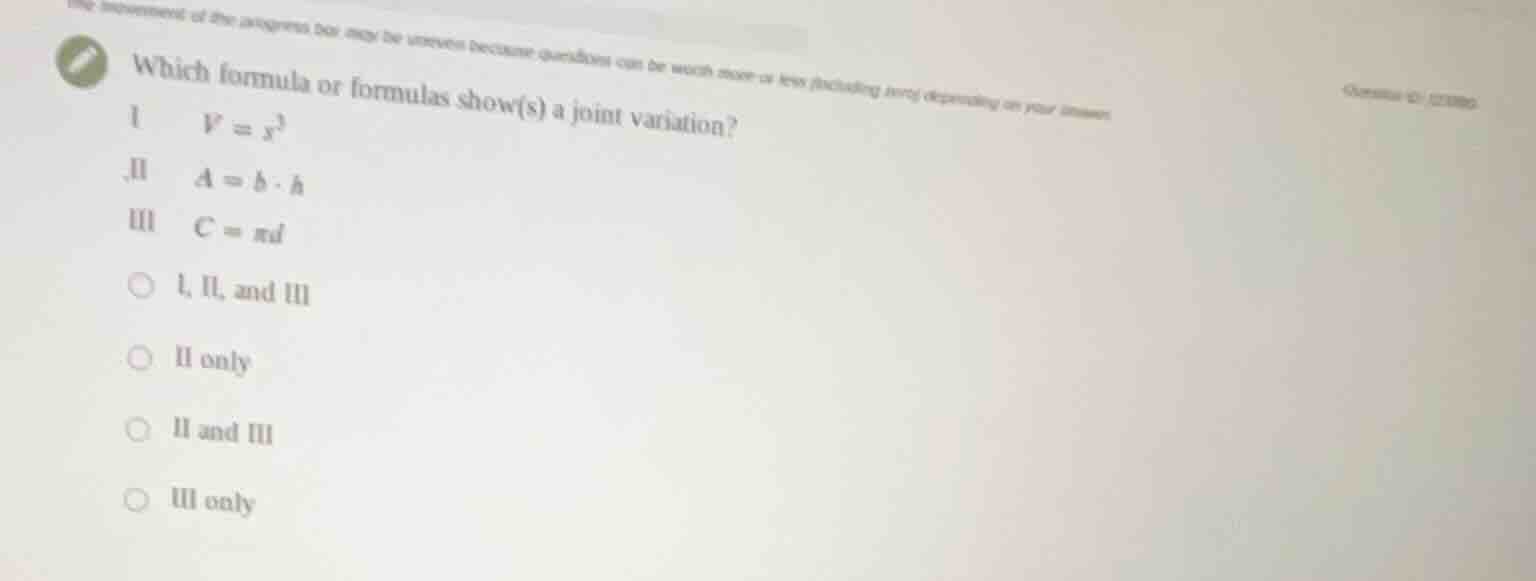
which formula or formulas show(s) a joint variation?
i ( v = x^3 )
ii ( a = b cdot h )
iii ( c = pi d )
( \bigcirc ) i, ii, and iii
( \bigcirc ) ii only
( \bigcirc ) ii and iii
( \bigcirc ) iii only
Step1: Recall Joint Variation Definition
Joint variation means a quantity varies directly as the product of two or more other quantities. So, if \( y = k \cdot a \cdot b \) (where \( k \) is a constant), \( y \) varies jointly with \( a \) and \( b \).
Step2: Analyze Formula I (\( V = x^3 \))
This is a direct variation of \( V \) with the cube of \( x \) (i.e., \( V \) varies directly as \( x^3 \)), not a joint variation (since it's only one variable \( x \) being cubed, not a product of multiple variables).
Step3: Analyze Formula II (\( A = b \cdot h \))
Here, the area \( A \) of a parallelogram (for example) varies jointly with the base \( b \) and the height \( h \). The constant of variation \( k = 1 \) here, so \( A \) is directly proportional to the product of \( b \) and \( h \), which is joint variation.
Step4: Analyze Formula III (\( C = \pi d \))
The circumference \( C \) of a circle varies directly with the diameter \( d \), with \( \pi \) as the constant of variation. This is a direct variation (only one variable \( d \)), not joint variation (since it's not a product of multiple variables).

Snap & solve any problem in the app
Get step-by-step solutions on Sovi AI
Photo-based solutions with guided steps
Explore more problems and detailed explanations
B. II only