QUESTION IMAGE
Question
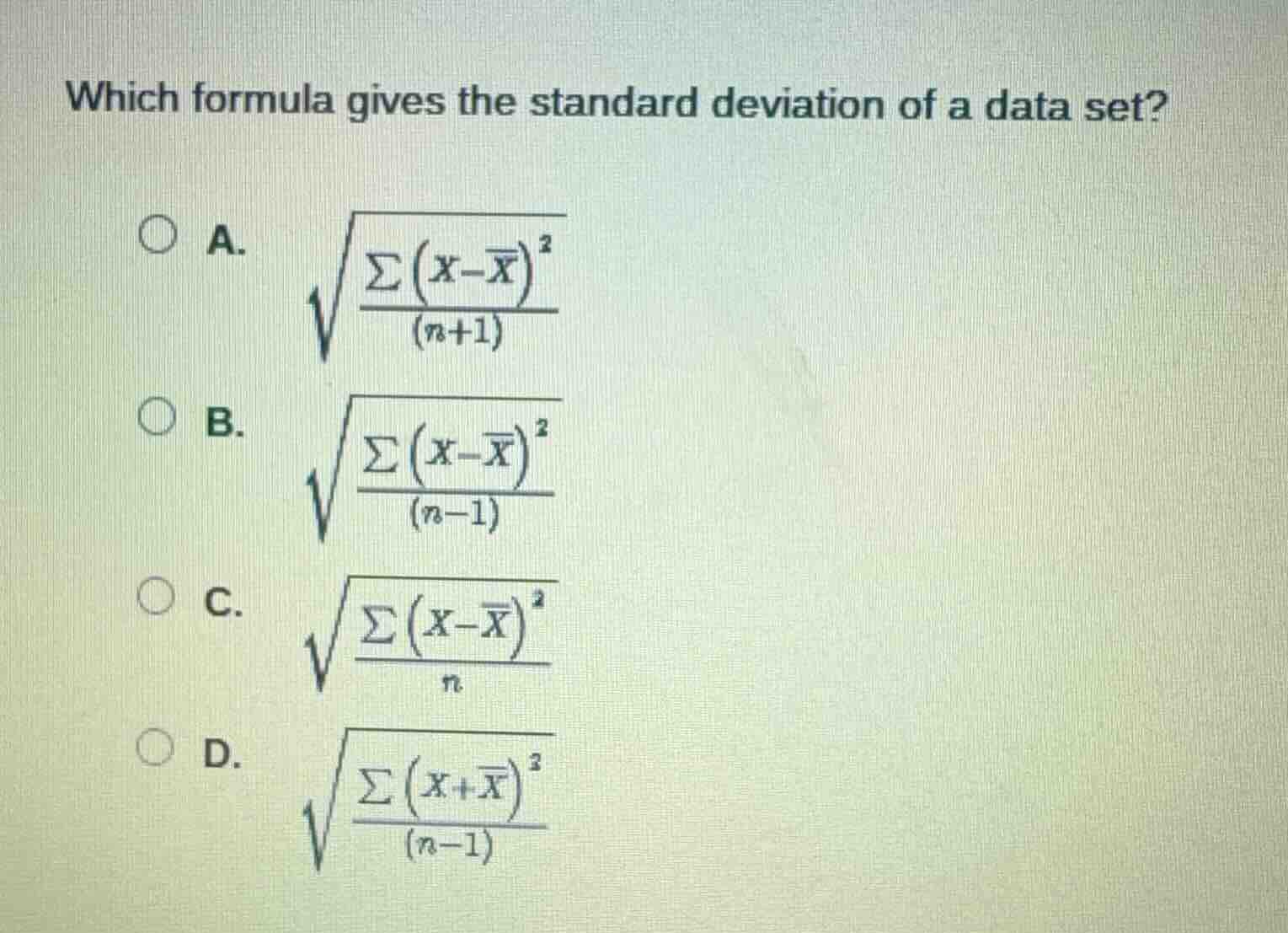
which formula gives the standard deviation of a data set?
a.
\\(\sqrt{\frac{\sum \left(x - \overline{x}\
ight)^2}{(n + 1)}}\\)
b.
\\(\sqrt{\frac{\sum \left(x - \overline{x}\
ight)^2}{(n - 1)}}\\)
c.
\\(\sqrt{\frac{\sum \left(x - \overline{x}\
ight)^2}{n}}\\)
d.
\\(\sqrt{\frac{\sum \left(x + \overline{x}\
ight)^2}{(n - 1)}}\\)
Step1: Recall standard deviation formulas
For a population standard deviation, the formula is $\sqrt{\frac{\sum (X-\bar{X})^2}{n}}$, where $n$ is the total number of data points. For a sample standard deviation, the formula uses $n-1$ (Bessel's correction) in the denominator: $\sqrt{\frac{\sum (X-\bar{X})^2}{n-1}}$. Both are valid standard deviation formulas, but option C represents the population standard deviation, which is a core standard deviation formula for a full data set.
Step2: Eliminate incorrect options
- Option A uses $n+1$ in the denominator, which is not a standard deviation formula.
- Option D uses $(X+\bar{X})^3$, which is mathematically irrelevant to standard deviation (we use squared deviations from the mean, not summed values cubed).
- While option B is sample standard deviation, option C is the standard formula for the full population data set, which is the most general answer for "a data set" when not specified as a sample.

Snap & solve any problem in the app
Get step-by-step solutions on Sovi AI
Photo-based solutions with guided steps
Explore more problems and detailed explanations
C. $\sqrt{\frac{\sum (X-\bar{X})^2}{n}}$