QUESTION IMAGE
Question
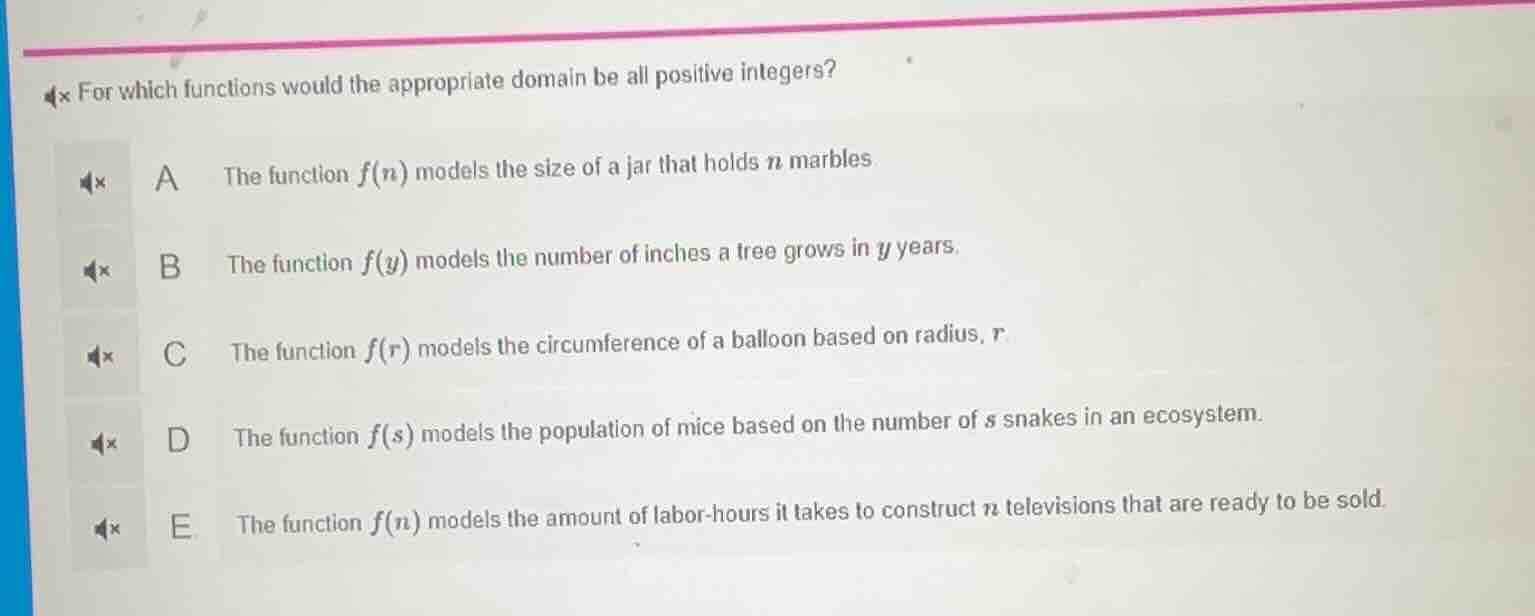
for which functions would the appropriate domain be all positive integers? a the function ( f(n) ) models the size of a jar that holds ( n ) marbles b the function ( f(y) ) models the number of inches a tree grows in ( y ) years. c the function ( f(r) ) models the circumference of a balloon based on radius, ( r ) d the function ( f(s) ) models the population of mice based on the number of ( s ) snakes in an ecosystem. e the function ( f(n) ) models the amount of labor - hours it takes to construct ( n ) televisions that are ready to be sold.
- Option A: The number of marbles \( n \) must be a positive integer (you can't have a fraction of a marble), so the domain of \( f(n) \) (modeling jar size for \( n \) marbles) is all positive integers.
- Option B: The number of years \( y \) can be a non - integer (e.g., 2.5 years), so the domain is not restricted to positive integers.
- Option C: The radius \( r \) of a balloon can be a non - integer (e.g., 1.5 cm), so the domain is not restricted to positive integers.
- Option D: The number of snakes \( s \) can be a non - integer? No, but in an ecosystem, the number of snakes is a non - negative integer, but the relationship between mice and snakes might not strictly have a domain of only positive integers (and also, the number of snakes could be zero). However, for the function modeling mice population based on snakes, the number of snakes is a non - negative integer, but the key here is that for the domain to be all positive integers, the input should represent a quantity that must be a positive integer. The number of marbles and the number of televisions (in option E) are quantities that must be positive integers. Wait, let's re - evaluate option D: The number of snakes \( s \) in an ecosystem is a non - negative integer (can be zero), so the domain of \( f(s) \) would include zero, not just positive integers.
- Option E: The number of televisions \( n \) that are constructed must be a positive integer (you can't construct a fraction of a television), so the domain of \( f(n) \) (modeling labor - hours for \( n \) televisions) is all positive integers.
Wait, let's re - check option A: The size of a jar that holds \( n \) marbles. The number of marbles \( n \) must be a positive integer (you can't have 0.5 marbles in terms of the count of marbles to hold). So \( n \) is a positive integer. For option E: The number of televisions \( n \) to construct must be a positive integer (you can't construct a fraction of a TV to sell). So both A and E? Wait, the problem says "which functions", so maybe multiple options. Wait, let's re - analyze each:
- A: \( n \) (number of marbles) must be a positive integer (you can't have a negative or fractional number of marbles to hold in a jar), so domain is positive integers.
- B: \( y \) (years) can be a non - integer (e.g., 1.2 years), so domain is not just positive integers.
- C: \( r \) (radius) can be a non - integer (e.g., 2.3 units), so domain is not just positive integers.
- D: \( s \) (number of snakes) can be zero (if there are no snakes), so domain includes zero, not just positive integers.
- E: \( n \) (number of televisions) must be a positive integer (you can't construct a fraction of a TV to sell), so domain is positive integers.
So the functions with domain all positive integers are A and E. Wait, but let's check the problem statement again. The question is "For which functions would the appropriate domain be all positive integers?"
For option A: The function \( f(n) \) models the size of a jar that holds \( n \) marbles. The number of marbles \( n \) must be a positive integer (since you can't have a negative or fractional number of marbles to hold). So \( n\in\mathbb{Z}^+ \).
For option E: The function \( f(n) \) models the amount of labor - hours it takes to construct \( n \) televisions that are ready to be sold. The number of televisions \( n \) must be a positive integer (you can't construct a fraction of a TV to sell), so \( n\in\mathbb{Z}^+ \).
For option D: The number of snakes \( s \) can be zero (if there are no snakes in th…

Snap & solve any problem in the app
Get step-by-step solutions on Sovi AI
Photo-based solutions with guided steps
Explore more problems and detailed explanations
A. The function \( f(n) \) models the size of a jar that holds \( n \) marbles, E. The function \( f(n) \) models the amount of labor - hours it takes to construct \( n \) televisions that are ready to be sold.