QUESTION IMAGE
Question
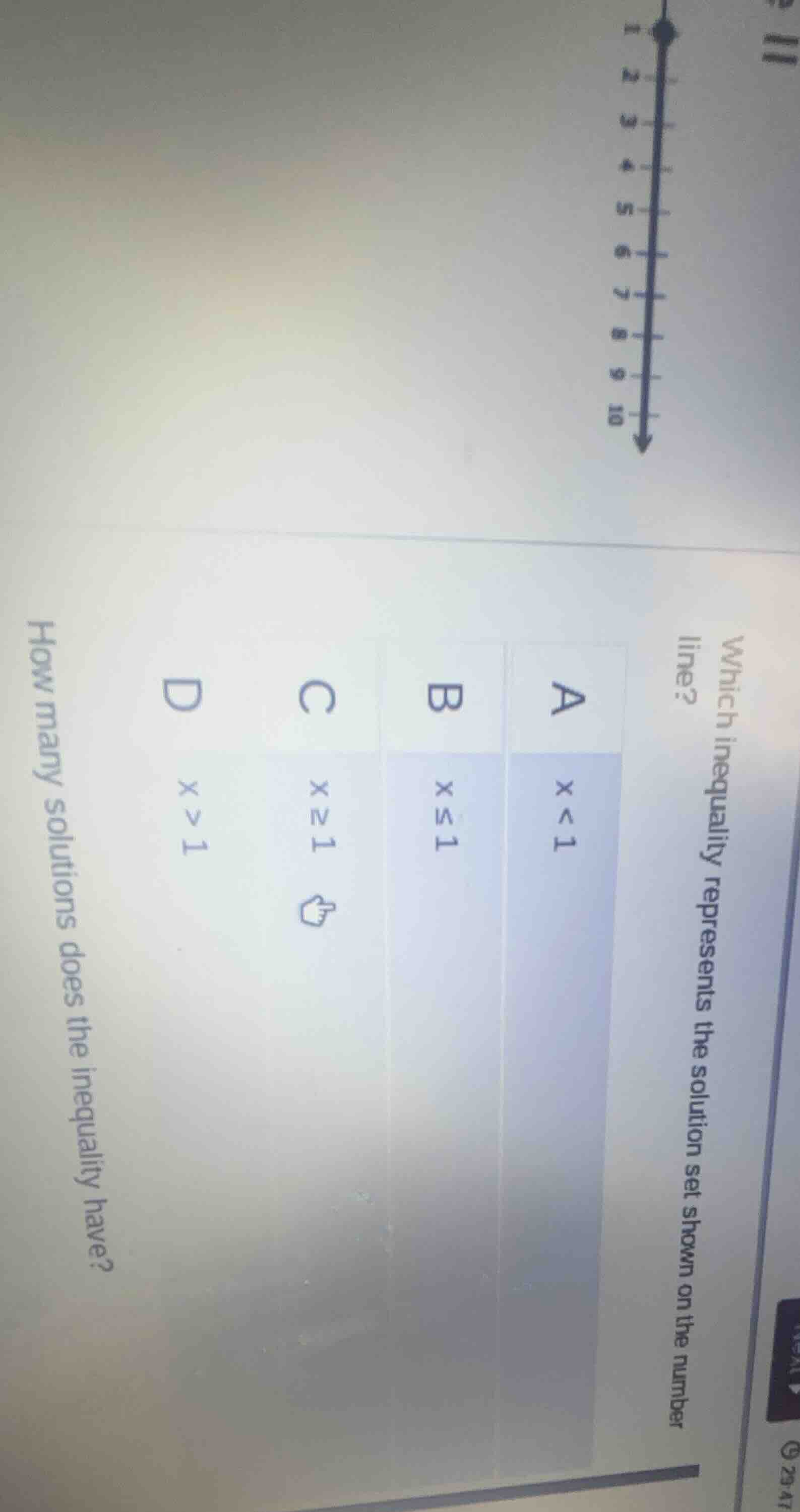
which inequality represents the solution set shown on the number line? a ( x < 1 ) b ( x leq 1 ) c ( x geq 1 ) d ( x > 1 ) how many solutions does the inequality have?
Response
First Sub - Question: Which inequality represents the solution set shown on the number line?
Brief Explanations
- Analyze the number line: The dot at 1 is filled (closed), which means 1 is included in the solution set. The arrow points to the left, indicating values less than or equal to 1.
- Check the options:
- Option A: \(x < 1\) does not include 1, so it's incorrect.
- Option B: \(x\leq1\) includes 1 (closed dot) and all values less than 1 (arrow to the left), which matches the number line.
- Option C: \(x\geq1\) would have an arrow to the right, so it's incorrect.
- Option D: \(x > 1\) does not include 1 and has an arrow to the right, so it's incorrect.
Step1: Recall the nature of inequalities on the real number line
Inequalities like \(x\leq1\) (or other linear inequalities in one variable) represent a range of real numbers. The set of real numbers is infinite, and the solution set for \(x\leq1\) includes all real numbers from negative infinity up to and including 1.
Step2: Determine the number of solutions
Since there are infinitely many real numbers that satisfy \(x\leq1\) (for example, 1, 0, - 1, - 2, 0.5, - 0.5, etc.), the number of solutions is infinite.

Snap & solve any problem in the app
Get step-by-step solutions on Sovi AI
Photo-based solutions with guided steps
Explore more problems and detailed explanations
B. \(x\leq1\)