QUESTION IMAGE
Question
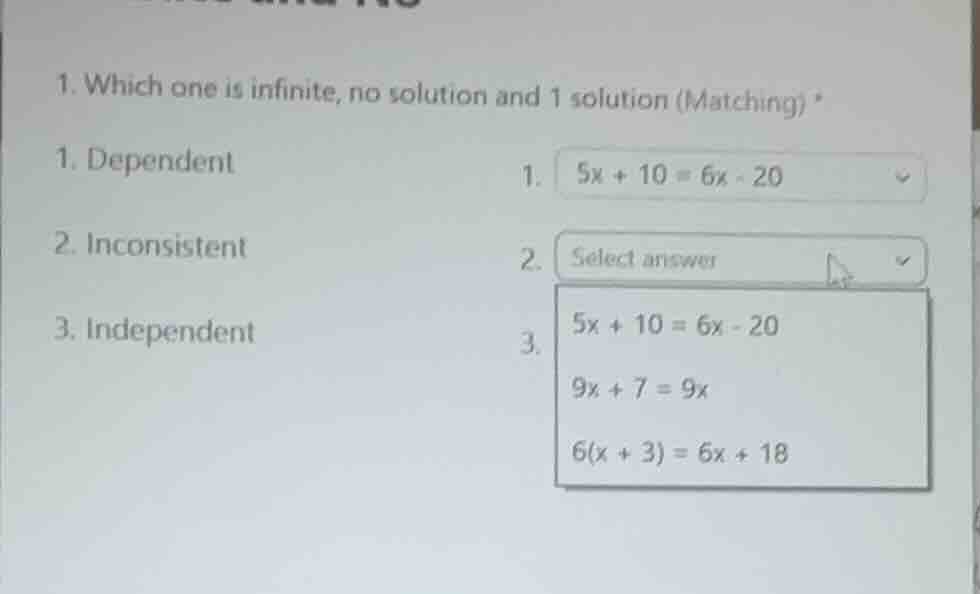
- which one is infinite, no solution and 1 solution (matching) *
- dependent \t\t\t\t 1. $5x + 10 = 6x - 20$
- inconsistent \t\t\t\t 2. select answer
- independent \t\t\t\t 3. $5x + 10 = 6x - 20$
\t\t\t\t\t\t\t\t $9x + 7 = 9x$
\t\t\t\t\t\t\t\t $6(x + 3) = 6x + 18$
To solve this matching problem, we analyze each type of system (dependent, inconsistent, independent) and the equations:
1. Dependent (Infinite Solutions)
A dependent system has equations that are equivalent (same line), so they have infinite solutions. Let's check the equations:
- \( 6(x + 3) = 6x + 18 \)
Simplify left side: \( 6x + 18 = 6x + 18 \). Both sides are identical, so this equation is always true (infinite solutions). Thus, Dependent matches \( 6(x + 3) = 6x + 18 \).
2. Inconsistent (No Solution)
An inconsistent system has equations that are contradictory (parallel lines, no intersection). Let's check:
- \( 9x + 7 = 9x \)
Subtract \( 9x \) from both sides: \( 7 = 0 \), which is false. Thus, this equation has no solution. So, Inconsistent matches \( 9x + 7 = 9x \).
3. Independent (One Solution)
An independent system has one unique solution (intersecting lines). Let's check:
- \( 5x + 10 = 6x - 20 \)
Subtract \( 5x \) from both sides: \( 10 = x - 20 \). Add 20 to both sides: \( x = 30 \). This has one unique solution. Thus, Independent matches \( 5x + 10 = 6x - 20 \).
Final Matches:
- Dependent → \( 6(x + 3) = 6x + 18 \)
- Inconsistent → \( 9x + 7 = 9x \)
- Independent → \( 5x + 10 = 6x - 20 \)
(For the dropdown in the image:
- The second dropdown (labeled "2.") should be \( 9x + 7 = 9x \) (Inconsistent).
- The third equation (labeled "3.") is \( 6(x + 3) = 6x + 18 \) (Dependent).)

Snap & solve any problem in the app
Get step-by-step solutions on Sovi AI
Photo-based solutions with guided steps
Explore more problems and detailed explanations
To solve this matching problem, we analyze each type of system (dependent, inconsistent, independent) and the equations:
1. Dependent (Infinite Solutions)
A dependent system has equations that are equivalent (same line), so they have infinite solutions. Let's check the equations:
- \( 6(x + 3) = 6x + 18 \)
Simplify left side: \( 6x + 18 = 6x + 18 \). Both sides are identical, so this equation is always true (infinite solutions). Thus, Dependent matches \( 6(x + 3) = 6x + 18 \).
2. Inconsistent (No Solution)
An inconsistent system has equations that are contradictory (parallel lines, no intersection). Let's check:
- \( 9x + 7 = 9x \)
Subtract \( 9x \) from both sides: \( 7 = 0 \), which is false. Thus, this equation has no solution. So, Inconsistent matches \( 9x + 7 = 9x \).
3. Independent (One Solution)
An independent system has one unique solution (intersecting lines). Let's check:
- \( 5x + 10 = 6x - 20 \)
Subtract \( 5x \) from both sides: \( 10 = x - 20 \). Add 20 to both sides: \( x = 30 \). This has one unique solution. Thus, Independent matches \( 5x + 10 = 6x - 20 \).
Final Matches:
- Dependent → \( 6(x + 3) = 6x + 18 \)
- Inconsistent → \( 9x + 7 = 9x \)
- Independent → \( 5x + 10 = 6x - 20 \)
(For the dropdown in the image:
- The second dropdown (labeled "2.") should be \( 9x + 7 = 9x \) (Inconsistent).
- The third equation (labeled "3.") is \( 6(x + 3) = 6x + 18 \) (Dependent).)