QUESTION IMAGE
Question
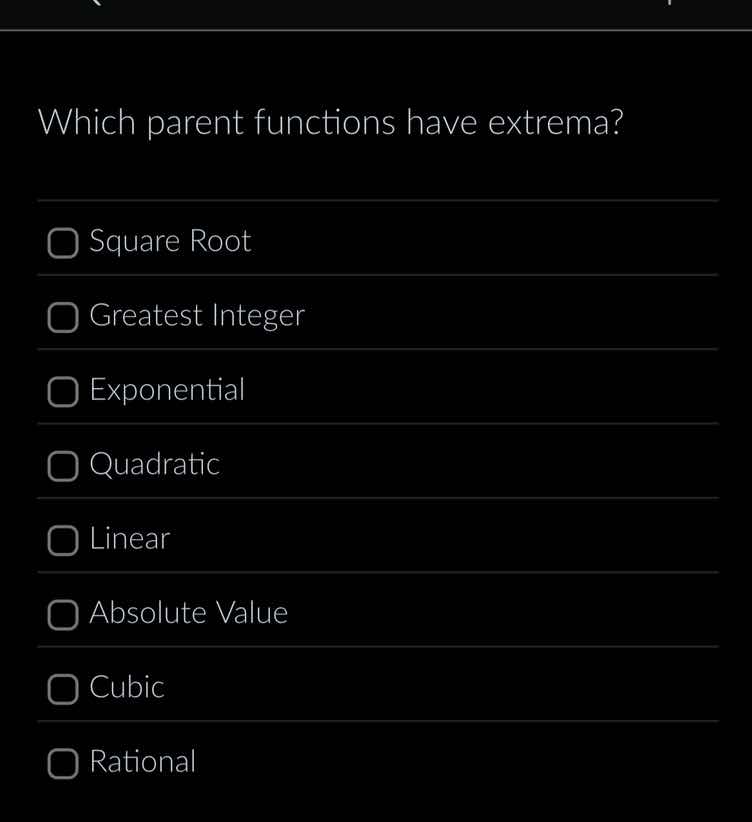
which parent functions have extrema?
square root
greatest integer
exponential
quadratic
linear
absolute value
cubic
rational
Response
To determine which parent functions have extrema, we analyze each function:
- Square Root: The parent square root function \( y = \sqrt{x} \) (domain \( x \geq 0 \)) is strictly increasing, so it has no extrema (no maximum or minimum in its domain, as it approaches \( 0 \) as \( x \to 0 \) and increases without bound as \( x \to \infty \)).
- Greatest Integer: The greatest integer function (floor function \( y = \lfloor x
floor \)) is piecewise constant and non - differentiable at integers. It has no extrema (it does not have a single maximum or minimum over its domain \( \mathbb{R} \)).
- Exponential: The parent exponential function \( y = a^x \) (\( a>0, a
eq1 \)) is either strictly increasing (\( a > 1 \)) or strictly decreasing (\( 0 < a < 1 \)), so it has no extrema.
- Quadratic: The parent quadratic function \( y = x^2 \) has a parabola opening upward. Its vertex at \( (0,0) \) is a minimum (no maximum, as \( x \to \pm\infty \), \( y \to \infty \)). Thus, it has a minimum (extremum).
- Linear: The parent linear function \( y = x \) is strictly increasing (slope \( 1 \)) and has no extrema (no maximum or minimum over \( \mathbb{R} \)).
- Absolute Value: The parent absolute value function \( y = |x| \) has a V - shape with a vertex at \( (0,0) \), which is a minimum (as \( x \to \pm\infty \), \( y \to \infty \)). Thus, it has a minimum (extremum).
- Cubic: The parent cubic function \( y = x^3 \) has a point of inflection at \( (0,0) \) and is strictly increasing (derivative \( y'=3x^2\geq0 \), with equality only at \( x = 0 \)), so it has no extrema.
- Rational: The parent rational function (e.g., \( y=\frac{1}{x} \)) has no extrema over its domain (it has vertical asymptotes and is not bounded, so no maximum or minimum).

Snap & solve any problem in the app
Get step-by-step solutions on Sovi AI
Photo-based solutions with guided steps
Explore more problems and detailed explanations
Quadratic, Absolute Value