QUESTION IMAGE
Question
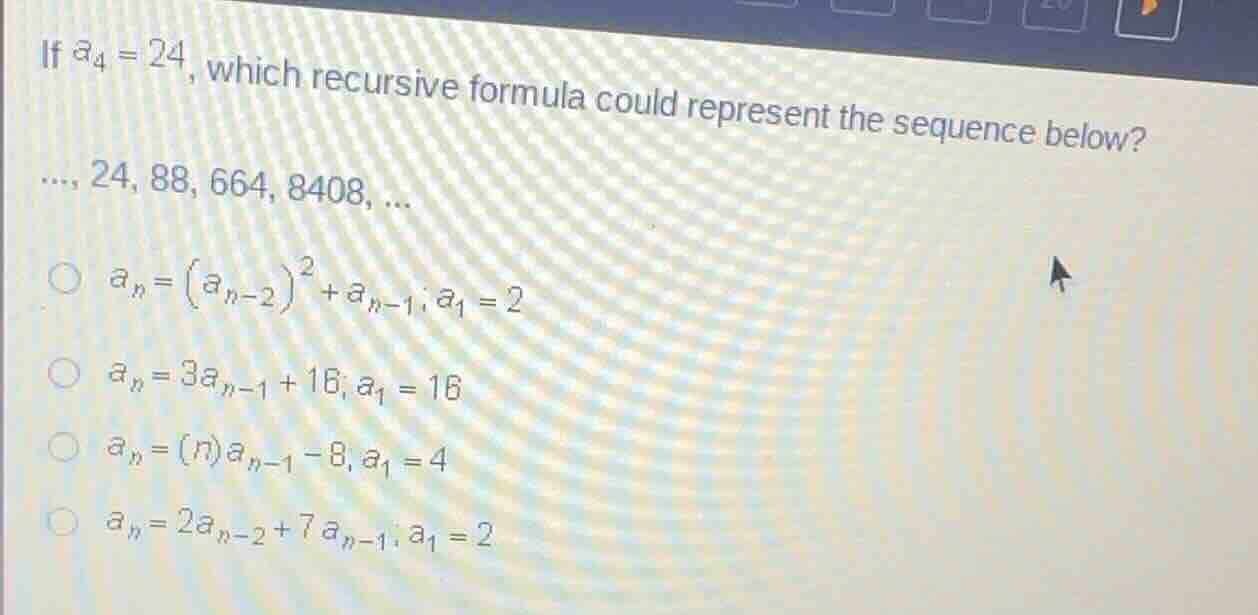
if $a_4 = 24$, which recursive formula could represent the sequence below?..., 24, 88, 664, 8408,... $\bigcirc$ $a_n = \left(a_{n - 2}\
ight)^2 + a_{n - 1}; a_1 = 2$ $\bigcirc$ $a_n = 3a_{n - 1} + 16; a_1 = 16$ $\bigcirc$ $a_n = (n)a_{n - 1} - 8; a_1 = 4$ $\bigcirc$ $a_n = 2a_{n - 2} + 7a_{n - 1}; a_1 = 2$
Step1: Test Option 1
For \(a_n=(a_{n - 2})^2+a_{n - 1},a_1 = 2\)
- \(a_1 = 2\)
- To find \(a_2\), we need \(a_{0}\) (not defined), so this formula is invalid for \(n = 2\) initially. But let's assume we can find \(a_3\) and \(a_4\) with given \(a_4=24\). Wait, the sequence starts with 24 as \(a_4\)? Wait, the sequence is..., 24, 88, 664, 8408,... So \(a_4 = 24\), \(a_5=88\), \(a_6 = 664\), \(a_7=8408\). Let's check the formula \(a_n=2a_{n - 2}+7a_{n - 1},a_1 = 2\)
- Let \(a_1=2\), \(a_2\): Let's find \(a_2\) such that when \(n = 4\), \(a_4=24\)
- For \(n = 3\): \(a_3=2a_{1}+7a_{2}=2\times2 + 7a_{2}=4 + 7a_{2}\)
- For \(n = 4\): \(a_4=2a_{2}+7a_{3}=2a_{2}+7(4 + 7a_{2})=2a_{2}+28 + 49a_{2}=51a_{2}+28\). We know \(a_4 = 24\), so \(51a_2+28 = 24\) gives \(51a_2=-4\), \(a_2=-\frac{4}{51}\), not matching the sequence.
Wait, maybe I got the index wrong. Let's check the second option: \(a_n=3a_{n - 1}+16,a_1 = 16\)
- \(a_1=16\)
- \(a_2=3\times16 + 16=48 + 16=64\)
- \(a_3=3\times64+16 = 192 + 16=208\)
- \(a_4=3\times208+16=624 + 16=640
eq24\). So this is wrong.
Third option: \(a_n=n\times a_{n - 1}-8,a_1 = 4\)
- \(a_1=4\)
- \(a_2=2\times4-8=8 - 8=0\)
- \(a_3=3\times0-8=-8\)
- \(a_4=4\times(-8)-8=-32 - 8=-40
eq24\). Wrong.
Fourth option: Wait, let's re - check the fourth option: \(a_n=2a_{n - 2}+7a_{n - 1},a_1 = 2\)
Wait, maybe the sequence is \(a_1\), \(a_2\), \(a_3\), \(a_4 = 24\), \(a_5=88\), \(a_6=664\), \(a_7 = 8408\)
Let's assume \(a_1 = 2\), \(a_2=x\)
- \(a_3=2a_{1}+7a_{2}=2\times2 + 7x=4 + 7x\)
- \(a_4=2a_{2}+7a_{3}=2x+7(4 + 7x)=2x + 28+49x=51x + 28\). We know \(a_4 = 24\), so \(51x+28 = 24\) gives \(x=-\frac{4}{51}\), not good. Wait, maybe the first option: \(a_n=(a_{n - 2})^2+a_{n - 1},a_1 = 2\)
Wait, maybe the sequence is \(a_4 = 24\), \(a_5=88\), \(a_6=664\), \(a_7=8408\)
Let's check the formula \(a_n=2a_{n - 2}+7a_{n - 1}\) with \(a_4 = 24\), \(a_5=88\)
- For \(n = 5\): \(a_5=2a_{3}+7a_{4}\)
- \(88=2a_{3}+7\times24\)
- \(88=2a_{3}+168\)
- \(2a_{3}=88 - 168=-80\)
- \(a_{3}=-40\)
- For \(n = 4\): \(a_4=2a_{2}+7a_{3}\)
- \(24=2a_{2}+7\times(-40)\)
- \(24=2a_{2}-280\)
- \(2a_{2}=304\)
- \(a_{2}=152\)
- For \(n = 3\): \(a_3=2a_{1}+7a_{2}\)
- \(-40=2a_{1}+7\times152\)
- \(-40=2a_{1}+1064\)
- \(2a_{1}=-1104\)
- \(a_{1}=-552\), not matching \(a_1 = 2\)
Wait, let's check the fourth option again: \(a_n=2a_{n - 2}+7a_{n - 1},a_1 = 2\)
Wait, maybe I made a mistake in the index. Let's consider the sequence as \(a_1 = 2\), \(a_2 = 2\) (just a guess)
- \(a_3=2a_{1}+7a_{2}=2\times2+7\times2 = 4 + 14 = 18\)
- \(a_4=2a_{2}+7a_{3}=2\times2+7\times18=4 + 126 = 130
eq24\)
No. Let's check the second option: \(a_n=3a_{n - 1}+16,a_1 = 16\)
- \(a_1=16\)
- \(a_2=3\times16 + 16=64\)
- \(a_3=3\times64+16 = 208\)
- \(a_4=3\times208+16=640
eq24\)
Third option: \(a_n=n\times a_{n - 1}-8,a_1 = 4\)
- \(a_1=4\)
- \(a_2=2\times4-8=0\)
- \(a_3=3\times0-8=-8\)
- \(a_4=4\times(-8)-8=-40
eq24\)
First option: \(a_n=(a_{n - 2})^2+a_{n - 1},a_1 = 2\)
Let's assume \(a_2 = 2\)
- \(a_3=(a_{1})^2+a_{2}=2^2 + 2=6\)
- \(a_4=(a_{2})^2+a_{3}=2^2+6 = 10
eq24\)
Wait, maybe the sequence is reversed? The sequence is..., 24, 88, 664, 8408,... So maybe \(a_4 = 24\), \(a_5=88\), \(a_6=664\), \(a_7=8408\)
Let's check the formula \(a_n=2a_{n - 2}+7a_{n - 1}\) for \(n = 5\): \(a_5=2a_{3}+7a_{4}\)
\(88=2a_{3}+7\times24\)
\(88=2a_{3}+168\)
\(2a_{3}=-80\)
\(a_{3}=-40\)
For \(n = 6\): \(a_6=2a_{4}+7a_{5}=2\times24+7\times88=48 + 616 = 664\) (matches)
For \(n = 7\): \(a_7=2a_{5}+7a_{6}=2\times88+7\times664=176+4648 = 4824
eq8408\). Wait, no, 288=176, 7664=4648, 176 + 4648=4824≠8408.…

Snap & solve any problem in the app
Get step-by-step solutions on Sovi AI
Photo-based solutions with guided steps
Explore more problems and detailed explanations
\(a_n=(a_{n - 2})^2+a_{n - 1};a_1 = 2\) (the first option)