QUESTION IMAGE
Question
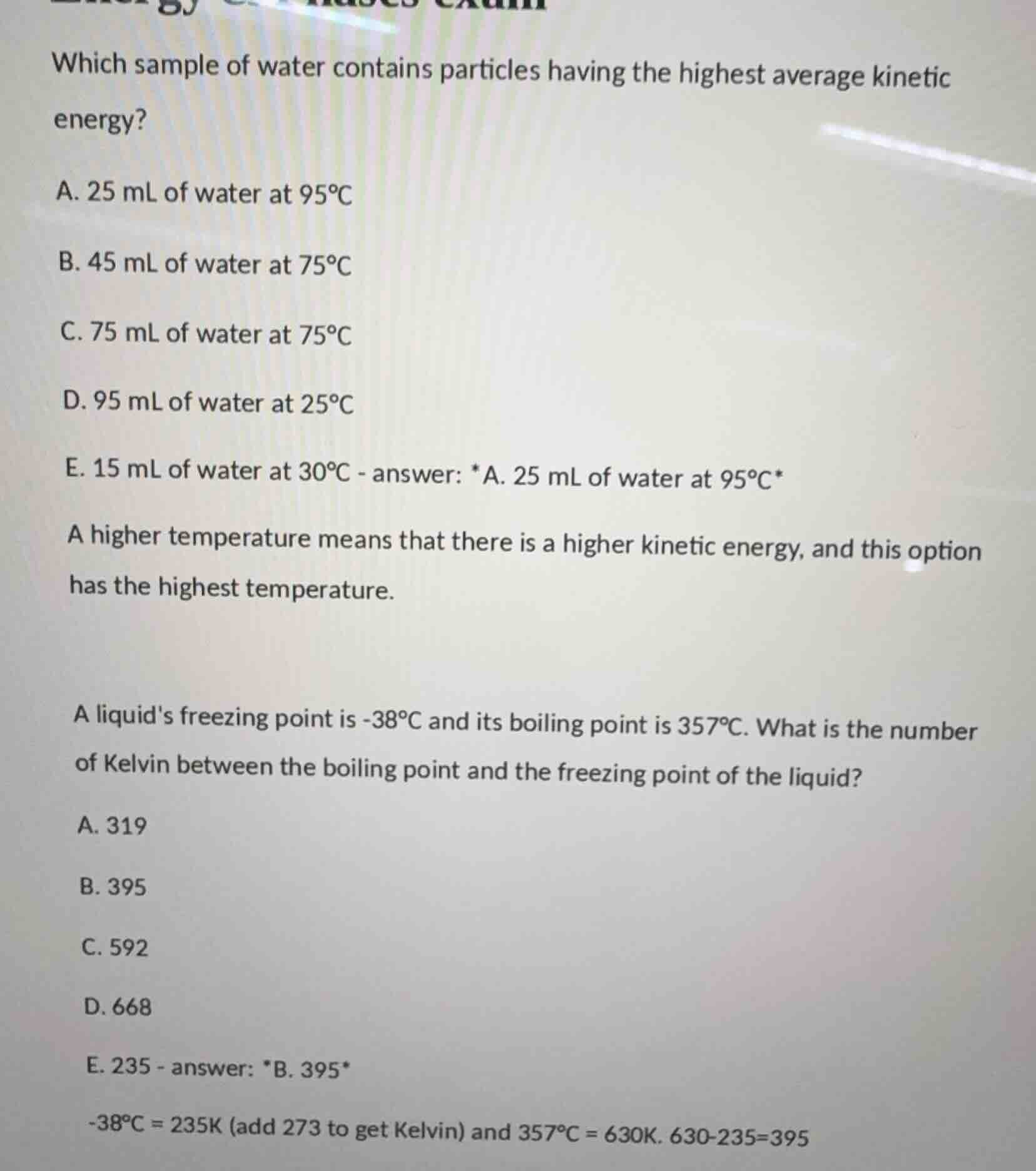
which sample of water contains particles having the highest average kinetic energy?
a. 25 ml of water at 95°c
b. 45 ml of water at 75°c
c. 75 ml of water at 75°c
d. 95 ml of water at 25°c
e. 15 ml of water at 30°c - answer: a. 25 ml of water at 95°c
a higher temperature means that there is a higher kinetic energy, and this option has the highest temperature.
a liquids freezing point is -38°c and its boiling point is 357°c. what is the number of kelvin between the boiling point and the freezing point of the liquid?
a. 319
b. 395
c. 592
d. 668
e. 235 - answer: b. 395
-38°c = 235k (add 273 to get kelvin) and 357°c = 630k. 630 - 235 = 395
First Question (Kinetic Energy of Water Particles)
The average kinetic energy of particles in a substance is directly related to temperature (mass/volume doesn’t affect average kinetic energy for the same substance). We compare the temperatures of each option: A is 95°C, B and C are 75°C, D is 25°C, E is 30°C. The highest temperature is 95°C (option A), so its particles have the highest average kinetic energy.
Step1: Convert freezing point to Kelvin
The formula to convert Celsius to Kelvin is $K = °C + 273$. For the freezing point ($-38°C$), we calculate $K_{freezing} = -38 + 273 = 235K$.
Step2: Convert boiling point to Kelvin
For the boiling point ($357°C$), we calculate $K_{boiling} = 357 + 273 = 630K$.
Step3: Find the difference in Kelvin
Subtract the freezing point Kelvin from the boiling point Kelvin: $630 - 235 = 395$.

Snap & solve any problem in the app
Get step-by-step solutions on Sovi AI
Photo-based solutions with guided steps
Explore more problems and detailed explanations
A. 25 mL of water at 95°C