QUESTION IMAGE
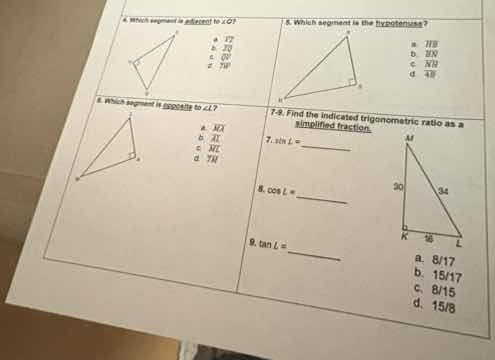
Question
- which segment is adjacent to ∠g?
a.
b.
c.
d.
- which segment is opposite to ∠l?
a.
b.
c.
d.
- which segment is the hypotenuse?
a.
b.
c.
d.
7–9. find the indicated trigonometric ratio as a simplified fraction.
- (sin l = )
- (cos l = )
- (\tan l = )
a. (\frac{8}{17})
b. (\frac{15}{17})
c. (\frac{8}{15})
d. (\frac{15}{8})
7. Finding \(\sin L\)
In a right - triangle, the sine of an angle is defined as the ratio of the length of the opposite side to the length of the hypotenuse. For angle \(L\) in right - triangle \(JKL\) (right - angled at \(K\)):
- The hypotenuse (the side opposite the right angle) is \(JL = 34\).
- The side opposite angle \(L\) is \(JK=30\).
So, \(\sin L=\frac{\text{opposite}}{\text{hypotenuse}}=\frac{JK}{JL}\)
Step 1: Identify the sides
We know that \(JK = 30\) (opposite to \(\angle L\)) and \(JL=34\) (hypotenuse).
Step 2: Calculate \(\sin L\)
\(\sin L=\frac{30}{34}=\frac{15}{17}\)? Wait, no, wait. Wait, maybe I mixed up the angle. Wait, angle \(L\): let's re - check the triangle. The triangle has \(JK = 30\), \(KL = 16\) (wait, the diagram shows \(JK = 30\), \(JL = 34\), so by Pythagoras, \(KL=\sqrt{34^{2}-30^{2}}=\sqrt{(34 + 30)(34 - 30)}=\sqrt{64\times4}=\sqrt{256}=16\)). So for angle \(L\), the side adjacent to \(L\) is \(KL = 16\), opposite is \(JK = 30\), hypotenuse \(JL = 34\). Wait, no, maybe the angle is \(L\), so the opposite side to \(L\) is \(JK\), adjacent is \(KL\). Wait, the problem says "Find the indicated trigonometric ratio as a simplified fraction. 7. \(\sin L\)".
Wait, maybe I made a mistake. Let's re - calculate. If the triangle has \(JK = 30\), \(KL = 16\), \(JL = 34\) (since \(30^{2}+16^{2}=900 + 256 = 1156=34^{2}\)). So for angle \(L\):
- Opposite side: \(JK = 30\)
- Hypotenuse: \(JL = 34\)
- Adjacent side: \(KL = 16\)
So \(\sin L=\frac{\text{opposite}}{\text{hypotenuse}}=\frac{JK}{JL}=\frac{30}{34}=\frac{15}{17}\)? But the options are a. \(\frac{8}{17}\), b. \(\frac{15}{17}\), c. \(\frac{8}{15}\), d. \(\frac{15}{8}\). Wait, maybe the angle is \(J\)? No, the problem says \(\sin L\). Wait, maybe I got the opposite and adjacent wrong. Wait, angle \(L\): the sides: in triangle \(JKL\), right - angled at \(K\), so vertices are \(J\), \(K\), \(L\) with right angle at \(K\). So angle \(L\) is at \(L\), so the sides:
- Opposite to \(L\): \(JK\)
- Adjacent to \(L\): \(KL\)
- Hypotenuse: \(JL\)
So \(\sin L=\frac{JK}{JL}=\frac{30}{34}=\frac{15}{17}\) (option b).
8. Finding \(\cos L\)
In a right - triangle, the cosine of an angle is defined as the ratio of the length of the adjacent side to the length of the hypotenuse. For angle \(L\) in right - triangle \(JKL\):
- The hypotenuse is \(JL = 34\).
- The side adjacent to angle \(L\) is \(KL = 16\) (since \(KL\) is adjacent to \(\angle L\) as it forms angle \(L\) with the hypotenuse \(JL\)).
So, \(\cos L=\frac{\text{adjacent}}{\text{hypotenuse}}=\frac{KL}{JL}\)
Step 1: Identify the sides
We know that \(KL = 16\) (adjacent to \(\angle L\)) and \(JL = 34\) (hypotenuse).
Step 2: Calculate \(\cos L\)
\(\cos L=\frac{KL}{JL}=\frac{16}{34}=\frac{8}{17}\)
9. Finding \(\tan L\)
In a right - triangle, the tangent of an angle is defined as the ratio of the length of the opposite side to the length of the adjacent side. For angle \(L\) in right - triangle \(JKL\):
- The side opposite angle \(L\) is \(JK = 30\).
- The side adjacent to angle \(L\) is \(KL = 16\).
So, \(\tan L=\frac{\text{opposite}}{\text{adjacent}}=\frac{JK}{KL}\)
Step 1: Identify the sides
We know that \(JK = 30\) (opposite to \(\angle L\)) and \(KL = 16\) (adjacent to \(\angle L\)).
Step 2: Calculate \(\tan L\)
\(\tan L=\frac{30}{16}=\frac{15}{8}\)
Final Answers:
- \(\sin L=\frac{15}{17}\) (Option b)
- \(\cos L=\frac{8}{17}\) (Option a)
- \(\tan L=\frac{15}{8}\) (Option d)

Snap & solve any problem in the app
Get step-by-step solutions on Sovi AI
Photo-based solutions with guided steps
Explore more problems and detailed explanations
In a right - triangle, the tangent of an angle is defined as the ratio of the length of the opposite side to the length of the adjacent side. For angle \(L\) in right - triangle \(JKL\):
- The side opposite angle \(L\) is \(JK = 30\).
- The side adjacent to angle \(L\) is \(KL = 16\).
So, \(\tan L=\frac{\text{opposite}}{\text{adjacent}}=\frac{JK}{KL}\)
Step 1: Identify the sides
We know that \(JK = 30\) (opposite to \(\angle L\)) and \(KL = 16\) (adjacent to \(\angle L\)).
Step 2: Calculate \(\tan L\)
\(\tan L=\frac{30}{16}=\frac{15}{8}\)
Final Answers:
- \(\sin L=\frac{15}{17}\) (Option b)
- \(\cos L=\frac{8}{17}\) (Option a)
- \(\tan L=\frac{15}{8}\) (Option d)