QUESTION IMAGE
Question
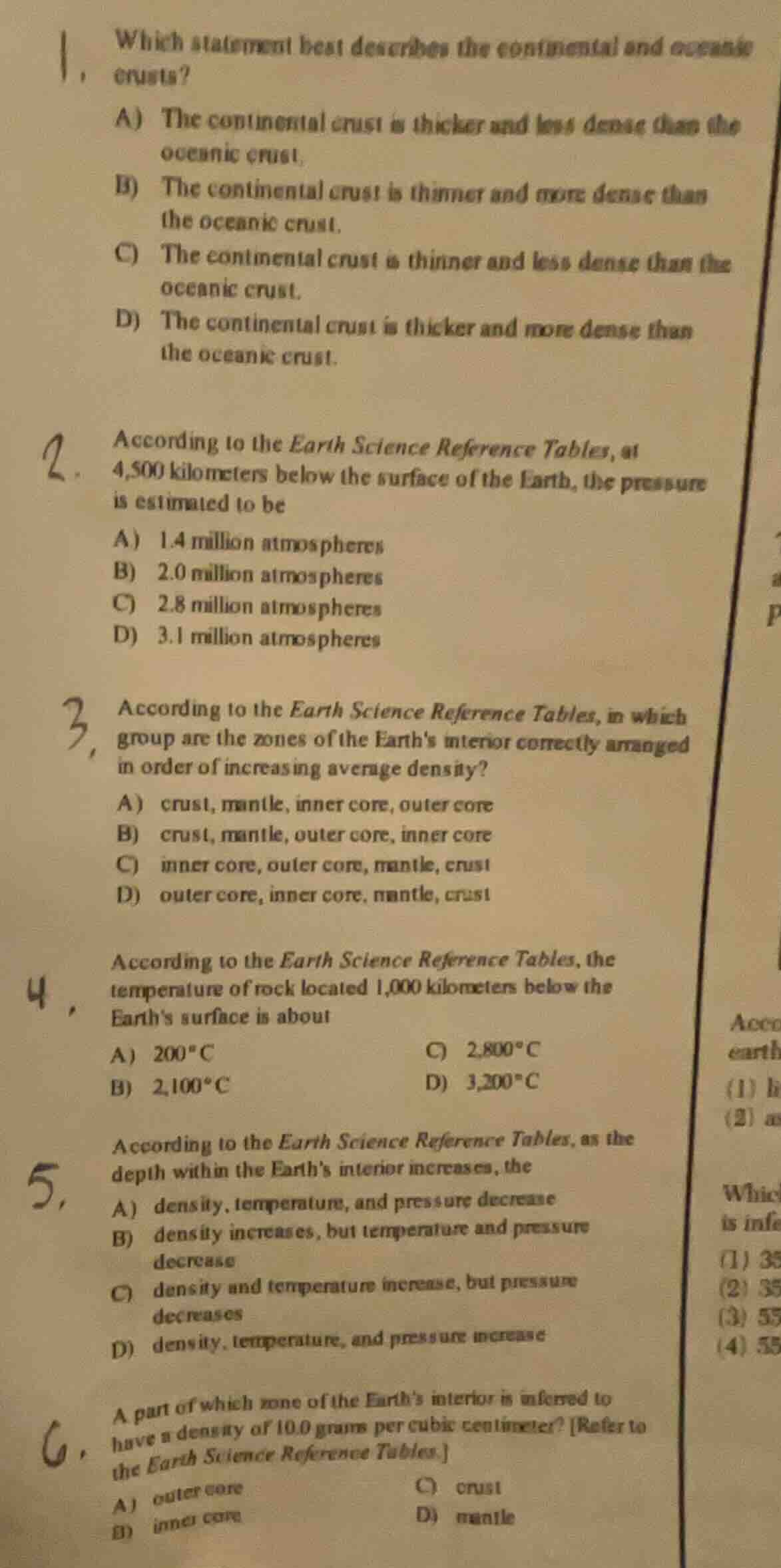
- which statement best describes the continental and oceanic crusts?
a) the continental crust is thicker and less dense than the oceanic crust.
b) the continental crust is thinner and more dense than the oceanic crust.
c) the continental crust is thinner and less dense than the oceanic crust.
d) the continental crust is thicker and more dense than the oceanic crust.
- according to the earth science reference tables, at 4,500 kilometers below the surface of the earth, the pressure is estimated to be
a) 1.4 million atmospheres
b) 2.0 million atmospheres
c) 2.8 million atmospheres
d) 3.1 million atmospheres
- according to the earth science reference tables, in which group are the zones of the earths interior correctly arranged in order of increasing average density?
a) crust, mantle, inner core, outer core
b) crust, mantle, outer core, inner core
c) inner core, outer core, mantle, crust
d) outer core, inner core, mantle, crust
- according to the earth science reference tables, the temperature of rock located 1,000 kilometers below the earths surface is about
a) 200°c \t\tc) 2,800°c
b) 2,100°c \t\td) 3,200°c
- according to the earth science reference tables, as the depth within the earths interior increases, the
a) density, temperature, and pressure decrease
b) density increases, but temperature and pressure decrease
c) density and temperature increase, but pressure decreases
d) density, temperature, and pressure increase
- a part of which zone of the earths interior is inferred to have a density of 10.0 grams per cubic centimeter? refer to the earth science reference tables.
a) outer core \t\tc) crust
b) inner core \t\td) mantle
- Continental crust has a thicker average thickness (30-50 km) and lower density (~2.7 g/cm³) compared to oceanic crust (7-10 km thick, ~3.0 g/cm³).
- Earth science reference tables show pressure at 4,500 km depth is ~2.0 million atmospheres.
- Earth's interior zones in order of increasing density: crust (~2.7-3.0 g/cm³), mantle (~3.3-5.7 g/cm³), outer core (~9.9-12.2 g/cm³), inner core (~12.6-13.0 g/cm³).
- Reference tables indicate rock temperature at 1,000 km depth is about 2,100°C.
- As depth into Earth increases, all three properties (density, temperature, pressure) rise due to increasing compression and geothermal gradient.
- The inner core has the highest density of Earth's layers, reaching up to ~13.0 g/cm³, matching the 10.0 g/cm³ range.

Snap & solve any problem in the app
Get step-by-step solutions on Sovi AI
Photo-based solutions with guided steps
Explore more problems and detailed explanations
- A) The continental crust is thicker and less dense than the oceanic crust.
- B) 2.0 million atmospheres
- B) crust, mantle, outer core, inner core
- B) 2,100°C
- D) density, temperature, and pressure increase
- B) inner core