QUESTION IMAGE
Question
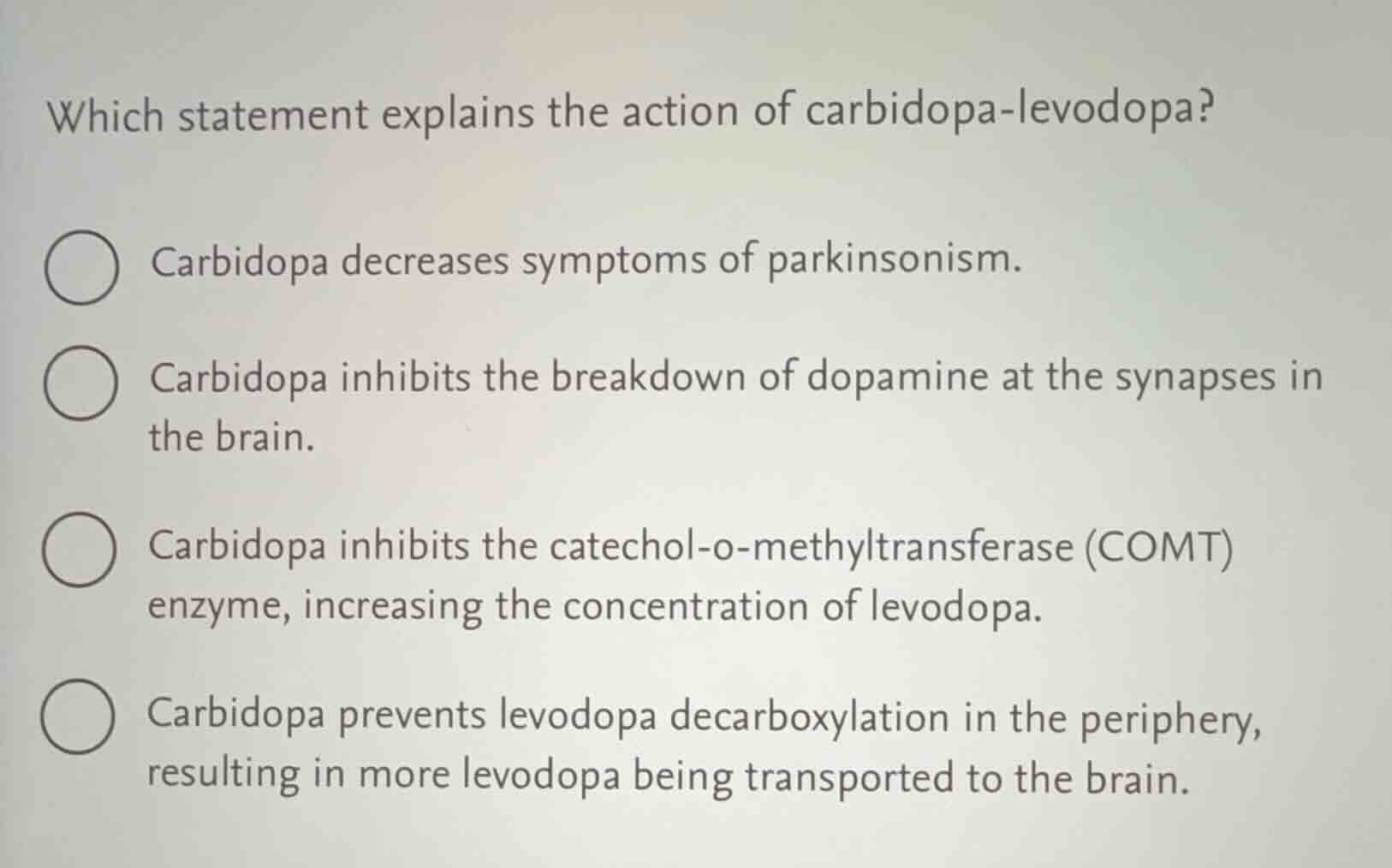
which statement explains the action of carbidopa-levodopa? carbidopa decreases symptoms of parkinsonism. carbidopa inhibits the breakdown of dopamine at the synapses in the brain. carbidopa inhibits the catechol-o-methyltransferase (comt) enzyme, increasing the concentration of levodopa. carbidopa prevents levodopa decarboxylation in the periphery, resulting in more levodopa being transported to the brain.
Brief Explanations
- Analyze each option:
- Option 1: Carbidopa itself does not directly decrease Parkinsonism symptoms; levodopa is the active agent for that, so this is incorrect.
- Option 2: Carbidopa does not inhibit dopamine breakdown at synapses. Drugs like MAO - B inhibitors do that, so this is wrong.
- Option 3: Carbidopa is a decarboxylase inhibitor, not a COMT inhibitor. COMT inhibitors (e.g., entacapone) work on COMT, so this is incorrect.
- Option 4: Carbidopa is a peripheral decarboxylase inhibitor. It stops levodopa from being decarboxylated (converted to dopamine) in the periphery. This means more levodopa can cross the blood - brain barrier and be converted to dopamine in the brain, which is the correct mechanism of carbidopa - levodopa.

Snap & solve any problem in the app
Get step-by-step solutions on Sovi AI
Photo-based solutions with guided steps
Explore more problems and detailed explanations
D. Carbidopa prevents levodopa decarboxylation in the periphery, resulting in more levodopa being transported to the brain.