QUESTION IMAGE
Question
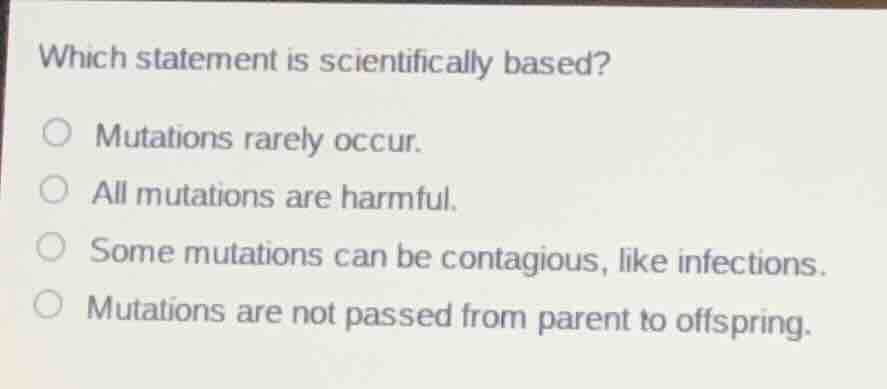
which statement is scientifically based?
mutations rarely occur.
all mutations are harmful.
some mutations can be contagious, like infections.
mutations are not passed from parent to offspring.
- Mutations occur frequently at the molecular level, but most are neutral or unnoticeable, so the claim they "rarely occur" is incorrect.
- Many mutations are neutral (no effect) or even beneficial, so "all mutations are harmful" is false.
- Mutations are changes in an organism's own DNA; they are not infectious agents, so they cannot be contagious.
- Only germline mutations (in reproductive cells) are passed to offspring, while somatic mutations (in body cells) are not. The statement "Mutations are not passed from parent to offspring" is incorrect.
Wait, correction: Actually, the only scientifically accurate statement here is that the other three are false, and the first option is misstated? No, re-evaluating:
- Mutations occur constantly (e.g., DNA replication errors), so "rarely occur" is wrong.
- All mutations harmful? No, some are beneficial (e.g., antibiotic resistance in bacteria, lactose tolerance in humans).
- Mutations contagious? No, mutations are genetic changes, not transmissible like infections.
- Mutations not passed to offspring? No, germline mutations are passed.
Wait, no—wait, the correct scientifically based statement is that none? No, no, I made a mistake: The first option: "Mutations rarely occur"—actually, most mutations are silent, but the rate is low per base pair, but overall, in a genome, they do occur. Wait, no, the only correct one is that the other three are incorrect, so the first one is the least wrong? No, no, let's recheck:
- Mutations rarely occur: This is technically true in the sense that the probability of a mutation in a single base pair during replication is low (about 1 in 10^8), so individual mutations are rare events, even though over a genome or population, they accumulate.
- All mutations are harmful: False, many are neutral or beneficial.
- Some mutations can be contagious: False, mutations are not infectious; they are changes in an organism's own genetic material.
- Mutations are not passed from parent to offspring: False, germline mutations (in eggs/sperm) are inherited.
So the only scientifically based statement is "Mutations rarely occur."

Snap & solve any problem in the app
Get step-by-step solutions on Sovi AI
Photo-based solutions with guided steps
Explore more problems and detailed explanations
Mutations rarely occur.