QUESTION IMAGE
Question
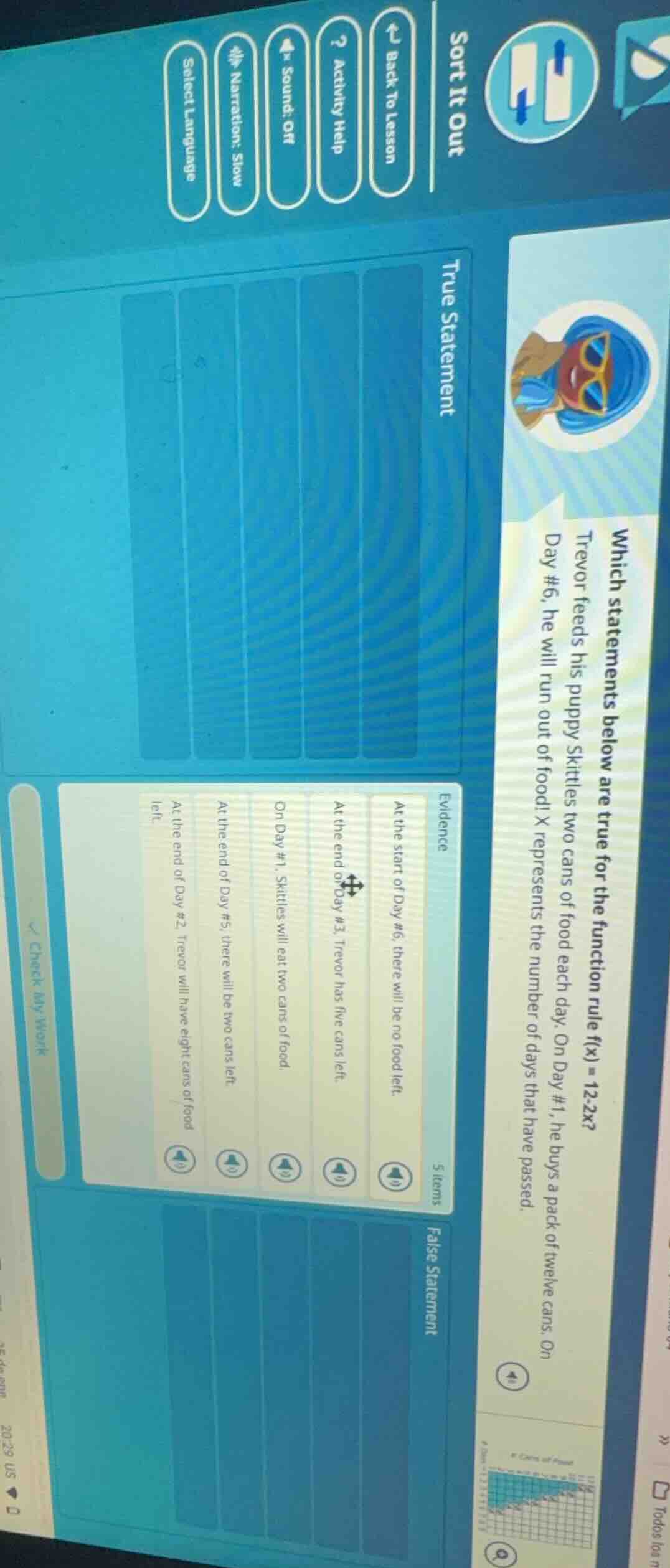
which statements below are true for the function rule f(x) = 12 - 2x?
trevor feeds his puppy skittles two cans of food each day. on day #1, he buys a pack of twelve cans. on day #6, he will run out of food! x represents the number of days that have passed.
evidence
at the start of day #6, there will be no food left.
at the end of day #3, trevor has five cans left.
on day #1, skittles will eat two cans of food.
at the end of day #5, there will be two cans left.
at the end of day #2, trevor will have eight cans of food left.
To determine the true statements, we analyze each one using the function \( f(x) = 12 - 2x \), where \( x \) is the number of days passed.
Statement 1: At the start of Day #6, there will be no food left.
- At the start of Day 6, \( x = 5 \) (since Day 1 to Day 5 have passed).
- Substitute \( x = 5 \) into \( f(x) \): \( f(5) = 12 - 2(5) = 12 - 10 = 2 \).
- There are 2 cans left, so this statement is false.
Statement 2: At the end of Day #3, Trevor has five cans left.
- At the end of Day 3, \( x = 3 \).
- Substitute \( x = 3 \): \( f(3) = 12 - 2(3) = 12 - 6 = 6 \).
- He has 6 cans left, not 5, so this statement is false.
Statement 3: On Day #1, Skittles will eat two cans of food.
- The function \( f(x) = 12 - 2x \) represents the remaining food. The coefficient of \( x \) is -2, meaning 2 cans are eaten per day.
- On Day 1, \( x = 1 \), so 2 cans are eaten. This statement is true.
Statement 4: At the end of Day #5, there will be two cans left.
- At the end of Day 5, \( x = 5 \).
- Substitute \( x = 5 \): \( f(5) = 12 - 2(5) = 2 \).
- There are 2 cans left, so this statement is true.
Statement 5: At the end of Day #2, Trevor will have eight cans of food left.
- At the end of Day 2, \( x = 2 \).
- Substitute \( x = 2 \): \( f(2) = 12 - 2(2) = 12 - 4 = 8 \).
- He has 8 cans left, so this statement is true.
True Statements:
- On Day #1, Skittles will eat two cans of food.
- At the end of Day #5, there will be two cans left.
- At the end of Day #2, Trevor will have eight cans of food left.
False Statements:
- At the start of Day #6, there will be no food left.
- At the end of Day #3, Trevor has five cans left.

Snap & solve any problem in the app
Get step-by-step solutions on Sovi AI
Photo-based solutions with guided steps
Explore more problems and detailed explanations
To determine the true statements, we analyze each one using the function \( f(x) = 12 - 2x \), where \( x \) is the number of days passed.
Statement 1: At the start of Day #6, there will be no food left.
- At the start of Day 6, \( x = 5 \) (since Day 1 to Day 5 have passed).
- Substitute \( x = 5 \) into \( f(x) \): \( f(5) = 12 - 2(5) = 12 - 10 = 2 \).
- There are 2 cans left, so this statement is false.
Statement 2: At the end of Day #3, Trevor has five cans left.
- At the end of Day 3, \( x = 3 \).
- Substitute \( x = 3 \): \( f(3) = 12 - 2(3) = 12 - 6 = 6 \).
- He has 6 cans left, not 5, so this statement is false.
Statement 3: On Day #1, Skittles will eat two cans of food.
- The function \( f(x) = 12 - 2x \) represents the remaining food. The coefficient of \( x \) is -2, meaning 2 cans are eaten per day.
- On Day 1, \( x = 1 \), so 2 cans are eaten. This statement is true.
Statement 4: At the end of Day #5, there will be two cans left.
- At the end of Day 5, \( x = 5 \).
- Substitute \( x = 5 \): \( f(5) = 12 - 2(5) = 2 \).
- There are 2 cans left, so this statement is true.
Statement 5: At the end of Day #2, Trevor will have eight cans of food left.
- At the end of Day 2, \( x = 2 \).
- Substitute \( x = 2 \): \( f(2) = 12 - 2(2) = 12 - 4 = 8 \).
- He has 8 cans left, so this statement is true.
True Statements:
- On Day #1, Skittles will eat two cans of food.
- At the end of Day #5, there will be two cans left.
- At the end of Day #2, Trevor will have eight cans of food left.
False Statements:
- At the start of Day #6, there will be no food left.
- At the end of Day #3, Trevor has five cans left.