QUESTION IMAGE
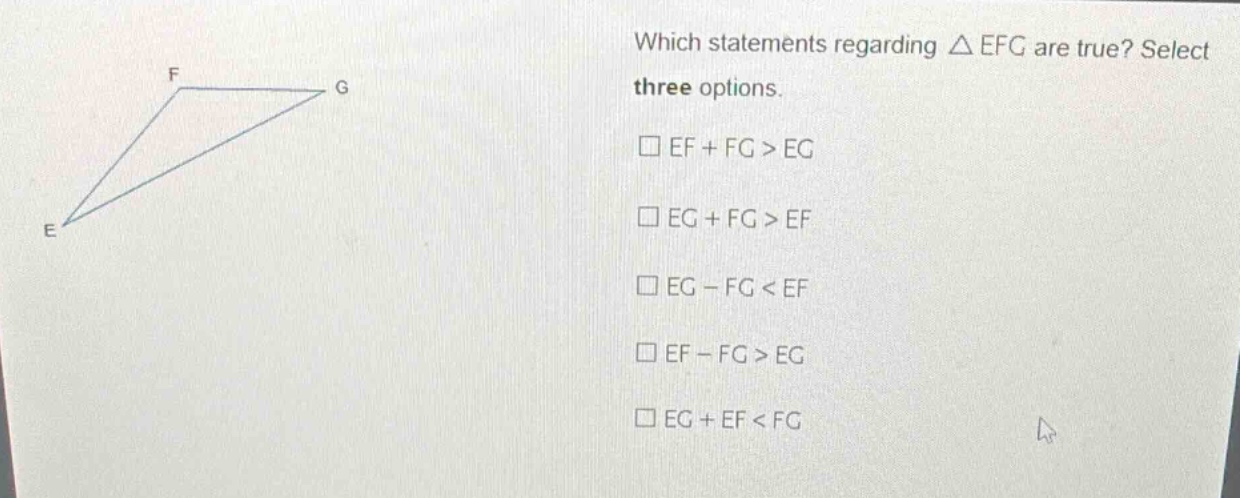
Question
which statements regarding $\triangle efg$ are true? select three options. \\(\square\\ ef + fg > eg\\) \\(\square\\ eg + fg > ef\\) \\(\square\\ eg - fg < ef\\) \\(\square\\ ef - fg > eg\\) \\(\square\\ eg + ef < fg\\)
Brief Explanations
To determine the true statements about \(\triangle EFG\), we use the triangle inequality theorem and its corollaries:
- Triangle Inequality Theorem: The sum of any two sides of a triangle is greater than the third side.
- Corollary (Reverse): The difference of any two sides is less than the third side.
Analyzing Each Option:
- \(EF + FG > EG\): By the triangle inequality theorem (sum of \(EF\) and \(FG\) > third side \(EG\)), this is true.
- \(EG + FG > EF\): By the triangle inequality theorem (sum of \(EG\) and \(FG\) > third side \(EF\)), this is true.
- \(EG - FG < EF\): By the reverse triangle inequality (difference of \(EG\) and \(FG\) < third side \(EF\)), this is true.
- \(EF - FG > EG\): The difference of two sides (\(EF - FG\)) cannot be greater than the third side (\(EG\)) (violates the reverse inequality), so this is false.
- \(EG + EF < FG\): The sum of two sides (\(EG + EF\)) must be greater than the third side (\(FG\)) (violates the triangle inequality), so this is false.

Snap & solve any problem in the app
Get step-by-step solutions on Sovi AI
Photo-based solutions with guided steps
Explore more problems and detailed explanations
- \(EF + FG > EG\)
- \(EG + FG > EF\)
- \(EG - FG < EF\)